
 Deutsch
 English
 Español
 Français
 Nederlands
 Português







COP29's $300 Billion Climate Finance Deal: Strategic Implications for Global Energy Transition
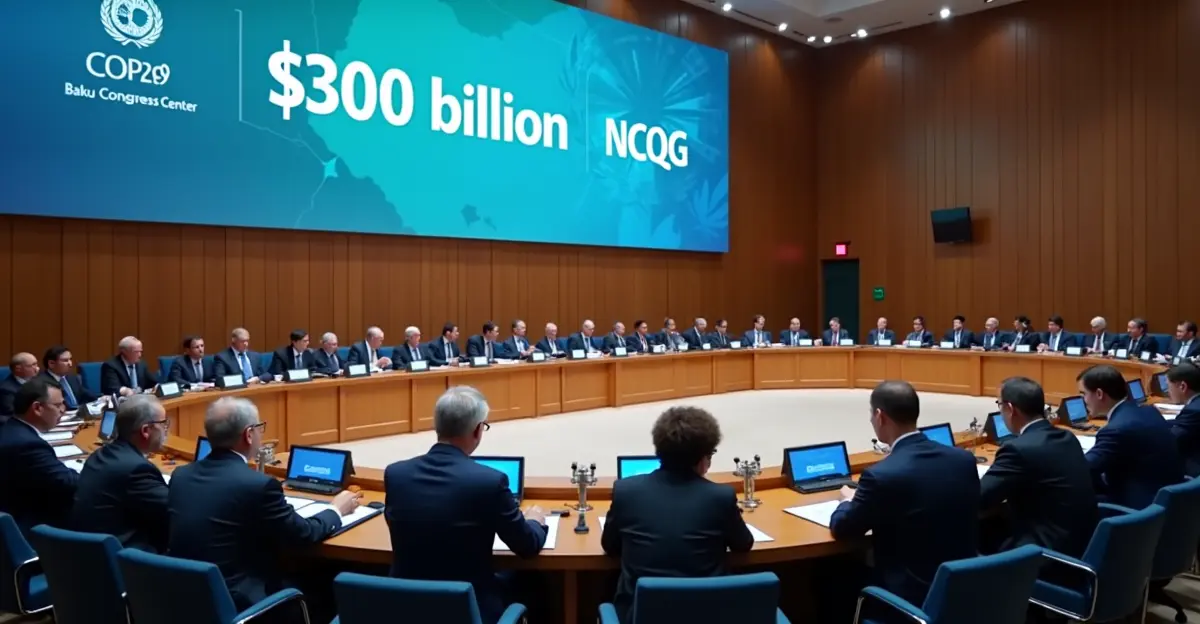
The landmark COP29 agreement to provide at least $300 billion annually in climate finance by 2035 represents a pivotal moment in global climate diplomacy, reshaping investment strategies and North-South relations. Concluded in Baku, Azerbaijan in November 2024, this New Collective Quantified Goal (NCQG) triples previous commitments but faces immediate implementation challenges as developing countries demand more substantial support for their energy transitions and adaptation needs.
What is the COP29 Climate Finance Agreement?
The COP29 agreement establishes a new framework for international climate finance, replacing the previous $100 billion annual goal that expired in 2025. The deal commits developed nations to provide at least $300 billion annually to developing countries by 2035, with an overall target of mobilizing $1.3 trillion in international climate finance. This agreement, described by UN Secretary-General António Guterres as a 'base to build on,' also established rules for a UN-backed global carbon market and extended programs addressing gender and climate change. The Paris Agreement 2015 established the foundation for such financial mechanisms, but COP29 represents their most significant expansion to date.
The Critical Gap: Pledged Amounts vs. Actual Needs
While the $300 billion commitment marks progress, UNCTAD analysis reveals developing countries require approximately $1.1 trillion in climate finance starting in 2025, rising to $1.8 trillion by 2030. The adaptation finance gap is particularly stark: developing nations need over $310 billion annually through 2035 for climate adaptation alone, but received only $26 billion in 2023 - just 8% of requirements. 'The $300 billion target represents a significant increase from previous commitments, but the $1.3 trillion figure better reflects developing countries' actual needs,' notes a World Resources Institute analysis.
Key Financial Shortfalls Identified:
- Adaptation finance gap: $250-350 billion annually
- Loss and Damage Fund: $700 million pledged vs. $150 billion needed annually
- Renewable energy investment gap in emerging markets: $500+ billion annually
- Grid infrastructure needs: $483 billion required for modernization
Geopolitical Implications of Climate Finance Distribution
The COP29 agreement has profound geopolitical implications, reshaping traditional North-South climate diplomacy. Developing nations, particularly African and small island states, expressed disappointment with the deal, with India calling it a 'paltry sum' and African nations stating it 'signals a lack of goodwill.' The distribution mechanisms will determine whether funds flow primarily through bilateral channels dominated by traditional donors or through more equitable multilateral systems. The EU carbon border tax and other trade-related climate measures add complexity to these geopolitical dynamics, as developing countries seek climate finance without compromising their economic development.
Regional Investment Patterns Emerging:
- Asia Pacific: Receiving 47% of global energy transition investment ($800 billion in China alone)
- Africa: Seeking increased grant-based financing for adaptation infrastructure
- Latin America: Positioned for green hydrogen and renewable energy investments
- Small Island States: Prioritizing loss and damage compensation and coastal resilience
Reshaping Global Energy Transition Investment Strategies
The COP29 finance framework will fundamentally alter investment patterns in three key areas: renewable energy deployment, adaptation infrastructure development, and emerging market decarbonization. Global energy transition investment reached a record $2.3 trillion in 2025, with electrified transport ($893 billion), renewable energy ($690 billion), and grid investment ($483 billion) leading the way. However, the new climate finance must address critical gaps in emerging markets where private investment remains insufficient.
Investment Priority Areas Under the New Framework:
- Renewable Energy Deployment: Solar, wind, and geothermal projects in energy-poor regions
- Adaptation Infrastructure: Coastal protection, water management, and climate-resilient agriculture
- Grid Modernization: Smart grid technologies and cross-border interconnection projects
- Emerging Technologies: Green hydrogen production and carbon capture utilization
- Just Transition Support: Workforce retraining and community adaptation programs
Implementation Challenges and the Road to COP30
The 'Baku to Belem Roadmap' launched at COP29 outlines the operational path forward, with Brazil hosting COP30 in 2025 as the next critical opportunity to translate commitments into action. Key implementation challenges include establishing transparent reporting mechanisms, ensuring funds reach the most vulnerable communities, and avoiding increased debt burdens for developing nations. The 2025 economic crisis context adds urgency to these discussions, as climate finance must complement rather than compete with development assistance.
Expert Perspectives on the Deal's Strategic Impact
Climate finance experts emphasize both the progress and limitations of the COP29 agreement. 'While the $300 billion target represents a tripling of previous commitments, it falls far short of the $1.1 trillion developing countries need starting next year,' notes a UNCTAD analyst. Energy transition specialists highlight that the agreement could catalyze private sector investment through blended finance mechanisms, potentially mobilizing additional capital beyond the public commitments. However, concerns remain about whether funds will be delivered as grants or loans, with developing countries advocating for increased grant-based financing to avoid exacerbating debt crises.
Frequently Asked Questions About COP29 Climate Finance
What is the New Collective Quantified Goal (NCQG)?
The NCQG is the $300 billion annual climate finance target established at COP29, replacing the previous $100 billion goal. It represents developed countries' commitment to support developing nations' climate action through 2035.
How does the $300 billion compare to actual needs?
Developing countries require approximately $1.1 trillion annually starting in 2025, rising to $1.8 trillion by 2030. The $300 billion represents about 27% of immediate needs and 17% of 2030 requirements.
Which countries will receive climate finance?
All developing countries are eligible, with priority given to Least Developed Countries, Small Island Developing States, and African nations most vulnerable to climate impacts.
When will the funds be disbursed?
The agreement establishes a phased approach, with increasing annual commitments leading to the full $300 billion by 2035. Initial disbursements are expected beginning in 2026.
How will the funds be allocated between mitigation and adaptation?
While specific allocation percentages aren't mandated, the agreement emphasizes balanced support for both emission reduction projects and climate adaptation infrastructure.
Future Outlook: From Commitments to Implementation
The strategic implications of COP29's climate finance deal will unfold over the coming decade as countries navigate implementation challenges and evolving geopolitical dynamics. Success will depend on transparent governance, equitable distribution, and effective mobilization of private sector capital alongside public funds. As the world prepares for COP30 in Brazil, the focus shifts from negotiation to execution, with developing countries watching closely to see if promises translate into tangible support for their energy transitions and climate resilience efforts.
Sources
UNFCCC COP29 Agreement Details
UNCTAD Analysis of Climate Finance Needs
World Resources Institute NCQG Explanation
BloombergNEF 2025 Energy Transition Investment Report
UNEP 2025 Adaptation Gap Report


Follow Discussion