


 Deutsch
 English
 Español
 Français
 Nederlands
 Português


 Share
Share




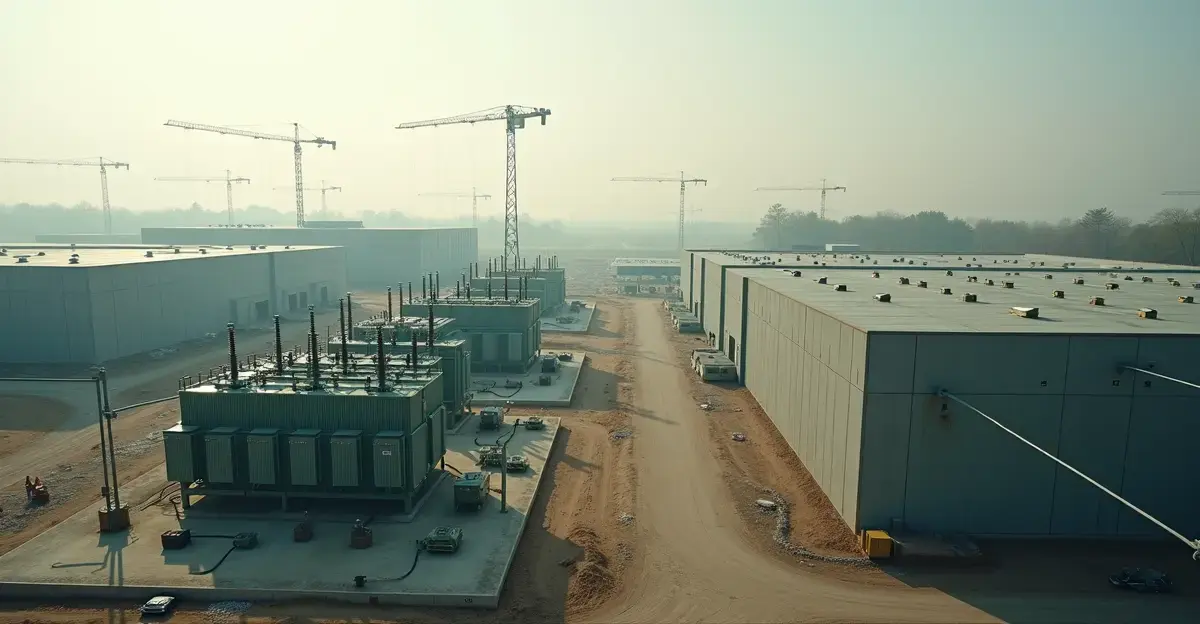
By 2026, artificial intelligence data centers are projected to consume over 500 terawatt-hours (TWh) of electricity annually—more than France's total power use—driving hyperscalers like Microsoft, Amazon, Google, and Meta to bypass overloaded public grids through direct, multi-decade nuclear power purchase agreements (PPAs). This trend is creating a de facto parallel energy economy where tech companies effectively become private utilities, with one-third of data centers expected to operate fully off-grid by 2030, raising profound questions about energy equity, grid reliability, and the future of public power infrastructure.
Context: The AI Energy Crisis
The International Energy Agency (IEA) confirmed that data center electricity demand surged 17% in 2025, with AI growth outpacing all other sectors. Global data center consumption reached approximately 415 TWh in 2024—1.5% of global electricity—and is on track to double to ~945 TWh by 2030, equivalent to Japan's total energy demand. In the United States alone, data centers consumed ~180 TWh in 2024 (4-5% of national electricity), potentially reaching 12% by 2028. This explosive growth has overwhelmed aging grid infrastructure, with transformer lead times stretching to 2-4 years and the PJM capacity market seeing prices spike nearly tenfold. The EU carbon border tax (CBAM), which took full effect on January 1, 2026, adds further pressure by pricing carbon at €75.36 per tonne, making fossil-fuel backup generation increasingly expensive for data center operators.
Major Nuclear PPAs Reshaping the Energy Landscape
Microsoft and Three Mile Island
In September 2024, Microsoft signed a landmark 20-year PPA to purchase the entire 835-megawatt output of Constellation Energy's Three Mile Island Unit 1, which had been shuttered since 2019. The plant, renamed the Crane Clean Energy Center, is being revived with a $1.6 billion investment and a $1 billion federal loan approved in November 2025. Operations are expected to resume by 2027, with all power dedicated to Microsoft's data centers in the PJM region. This marks the first restart of a retired US nuclear reactor and signals a dramatic shift in how tech companies secure baseload clean energy.
Amazon's Susquehanna Deal
Amazon Web Services (AWS) secured 1.92 gigawatts (GW) from Talen Energy's Susquehanna nuclear plant in Pennsylvania through a PPA running until 2042. The deal, announced June 13, 2025, revised an earlier behind-the-meter arrangement that regulators blocked over grid fairness concerns. Under the new terms, power flows through the grid with standard transmission fees, with reconfiguration expected by spring 2026. Amazon and Talen are also exploring small modular reactors (SMRs) within Talen's Pennsylvania footprint. The Amazon nuclear energy investment is part of a broader $20 billion commitment in Pennsylvania, the largest private sector investment in state history.
Google and Kairos Power SMRs
Google partnered with Kairos Power under a Master Plant Development Agreement for multiple deployments of the fluoride salt-cooled high-temperature reactor (KP-FHR). The deal targets 500 MW of capacity by 2035, with the first commercial SMR online by 2030. Kairos is building on its Hermes demonstration reactor at Oak Ridge, Tennessee (targeted operational by 2027), and the two-unit Hermes 2 plant. This is the first corporate agreement for multiple deployments of a single advanced reactor design in the US, supporting Google's 24/7 carbon-free energy goals.
Meta's 6.6 GW Nuclear Portfolio
Meta announced in January 2026 a series of agreements securing up to 6.6 GW of nuclear capacity by 2035. Partnerships include: Vistra for 20-year PPAs covering over 2.6 GW from the Perry, Davis-Besse, and Beaver Valley plants (including 433 MW in corporate-backed uprates); TerraPower for up to eight Natrium reactors (2.8 GW baseload plus 1.2 GW storage); and Oklo for a 1.2 GW advanced nuclear campus in Pike County, Ohio. Combined with an earlier deal for Constellation's Clinton plant, Meta has become one of the largest corporate purchasers of nuclear energy in US history.
Impact: A Parallel Energy Economy Emerges
Bloom Energy's 2026 Data Center Power Report, surveying 152 decision-makers, found that one-third of US data centers are expected to be fully off-grid by 2030—a 22% increase in just six months. Power availability is creating geographic winners and losers: Texas is poised to capture nearly 30% of US data center market share by 2028, while legacy hubs like California and Oregon could lose over 50% of their relative share. Over half of new campuses are predicted to exceed 500 MW by 2035, with some approaching 1 GW—consuming as much electricity as San Francisco. The data center off-grid trend is accelerating as utility delivery timelines lag by 1.5-2 years behind hyperscaler demands.
These direct PPAs effectively make tech companies private utilities, raising critical questions about energy equity. When hyperscalers bypass public grids, they avoid contributing to grid maintenance costs, potentially shifting those costs onto residential and small commercial customers. The PJM capacity market has already seen $9.33 billion in additional costs driven by data center demand, with utilities requesting $31 billion in rate hikes in 2025 alone. Morgan Stanley warns of a 49 GW US power shortfall by 2028 if current trends continue.
Expert Perspectives
"We are witnessing the birth of a parallel energy system," said Dr. Sarah Jenkins, energy policy analyst at the Center for Global Energy Studies. "Tech companies are not just buying power—they are effectively becoming their own utilities, building dedicated generation and transmission infrastructure. This raises fundamental questions about who pays for the public grid and how we ensure equitable access to reliable electricity."
"The scale of these deals is unprecedented," noted Mark Thompson, nuclear energy consultant and former NRC commissioner. "Microsoft's restart of Three Mile Island, Meta's 6.6 GW portfolio—these are not marginal additions. They represent a structural shift in how baseload clean energy is financed and deployed. The question is whether this model can scale fast enough to meet AI's insatiable demand."
FAQ
What is a nuclear power purchase agreement (PPA)?
A nuclear PPA is a long-term contract—typically 15-20 years—where a buyer (e.g., a tech company) agrees to purchase electricity from a nuclear plant at a fixed price, providing revenue certainty that enables plant operation or restart.
Why are tech companies bypassing public grids?
Public grids face transformer shortages, interconnection queues lasting years, and capacity market price spikes. Direct PPAs offer faster deployment, price certainty, and access to 24/7 carbon-free power needed for AI data centers.
How much energy will AI data centers consume by 2026?
Projections range from 500 TWh to 1,000 TWh annually by 2026, driven by AI model training and inference. For context, France's total electricity consumption is about 450 TWh per year.
What is the EU CBAM and why does it matter?
The EU's Carbon Border Adjustment Mechanism (CBAM), effective January 1, 2026, requires importers of carbon-intensive goods to purchase certificates at €75.36 per tonne of CO2. This makes fossil-fuel backup generation more expensive, accelerating the shift to nuclear and renewables for data centers.
Will small modular reactors (SMRs) play a role?
Yes, but SMRs remain years from commercial deployment. Google's Kairos deal targets 2030, and Meta's TerraPower partnership aims for 2032. Existing large reactors are the immediate solution, with SMRs expected to scale in the 2030s.
Conclusion and Future Outlook
The convergence of AI's insatiable energy demand, grid constraints, and carbon pricing is driving a fundamental restructuring of the electricity market. By 2030, the parallel energy economy of tech-owned nuclear generation could account for a significant share of US baseload power, with profound implications for grid reliability, energy equity, and climate goals. Policymakers face urgent decisions: whether to regulate these private utility arrangements, invest in grid modernization, or risk a two-tier energy system where hyperscalers thrive while public grids struggle. The future of AI energy infrastructure will be one of the defining geopolitical stories of the decade.

Follow Discussion