


 Deutsch
 English
 Español
 Français
 Nederlands
 Português


 Share
Share




In 2026, the insatiable energy appetite of artificial intelligence is reshaping global power markets. AI data centers are projected to consume over 500 terawatt-hours (TWh) of electricity this year — more than France's total annual usage — forcing hyperscalers like Microsoft, Amazon, Google, and Meta to bypass overloaded public grids by signing multi-decade nuclear power purchase agreements (PPAs). This AI-nuclear nexus is creating a parallel energy economy, with one-third of data centers expected to operate entirely off-grid by 2030.
The Scale of AI's Energy Hunger
Global data center electricity demand surged 17% in 2025, according to the International Energy Agency (IEA), and is projected to nearly double by 2030. AI-focused data centers are growing even faster, with their consumption tripling over the same period. The IEA reports that capital expenditure from five large tech companies exceeded $400 billion in 2025 and is expected to rise 75% in 2026. The energy demands of AI training are a primary driver: training a single frontier AI model can generate 500–1,000 tonnes of CO2 equivalent, while inference at scale produces multiples more annually.
This surge is concentrated in regions already facing grid constraints. Northern Virginia, the world's largest data center market, could see load reach 35 GW by 2028 against only 19 GW of current generation capacity. PJM Interconnection, the grid operator serving 13 U.S. states, saw capacity prices spike nearly tenfold — from $28.92 per MW-day in 2024/25 to $329.17 in 2026/27 — driven largely by data center demand forecasts. Residential electricity bills have risen $16–21 per month in affected areas, sparking political backlash.
Hyperscalers Go Nuclear: The Deal Breakdown
Facing 5- to 8-year interconnection queues and soaring grid costs, tech giants are signing direct PPAs with nuclear generators. As of May 2026, 13 announced projects commit over 9.8 GW of nuclear capacity to power AI infrastructure. The nuclear power purchase agreements, many spanning 20 years, represent the largest private nuclear procurement in history.
Microsoft: Restarting Three Mile Island
Microsoft signed a 20-year, $16 billion PPA with Constellation Energy to restart Three Mile Island Unit 1 (835 MW) in Pennsylvania — the site of the worst commercial nuclear accident in U.S. history in 1979. The plant, renamed the Crane Clean Energy Center, ceased operations in 2019 due to operating losses. The $1.6 billion refurbishment is backed by a $1 billion Department of Energy loan, with power expected to flow by 2027. The restart is one of three shuttered U.S. nuclear plants aiming to return to service this decade.
Amazon: 1.92 GW from Susquehanna
Amazon Web Services secured 1,920 MW of carbon-free electricity from Talen Energy's Susquehanna nuclear plant in Pennsylvania, one of the largest U.S. nuclear facilities. The long-term PPA runs until 2042 and includes exploring small modular reactor (SMR) technology. Amazon also invested $700 million in X-energy for up to 12 Xe-100 SMRs, part of a broader $20 billion investment in Pennsylvania — the largest private sector investment in state history.
Google: First Corporate SMR Deal
Google signed the world's first corporate agreement to purchase nuclear energy from multiple SMRs developed by Kairos Power. The deal targets up to 500 MW of new 24/7 carbon-free power by 2035, with the first reactor online by 2030. Kairos Power uses a molten-salt cooling system with ceramic pebble fuel and has already broken ground on its Hermes demonstration reactor in Tennessee — the first U.S. advanced reactor to receive a construction permit from the Nuclear Regulatory Commission.
Meta: Record 6.6 GW Portfolio
In January 2026, Meta announced the largest corporate nuclear procurement to date, securing up to 6.6 GW through agreements with Vistra (2.1 GW from existing Perry and Davis-Besse plants, plus 433 MW expansion), TerraPower (up to eight Natrium reactor units producing 2.8 GW with 1.2 GW thermal storage, targeted for 2032), and Oklo (1.2 GW advanced nuclear campus in Ohio, first reactors by 2030). Only the Vistra deal delivers power immediately; the SMR agreements face regulatory and timeline uncertainties.
Creating a Parallel Energy Economy
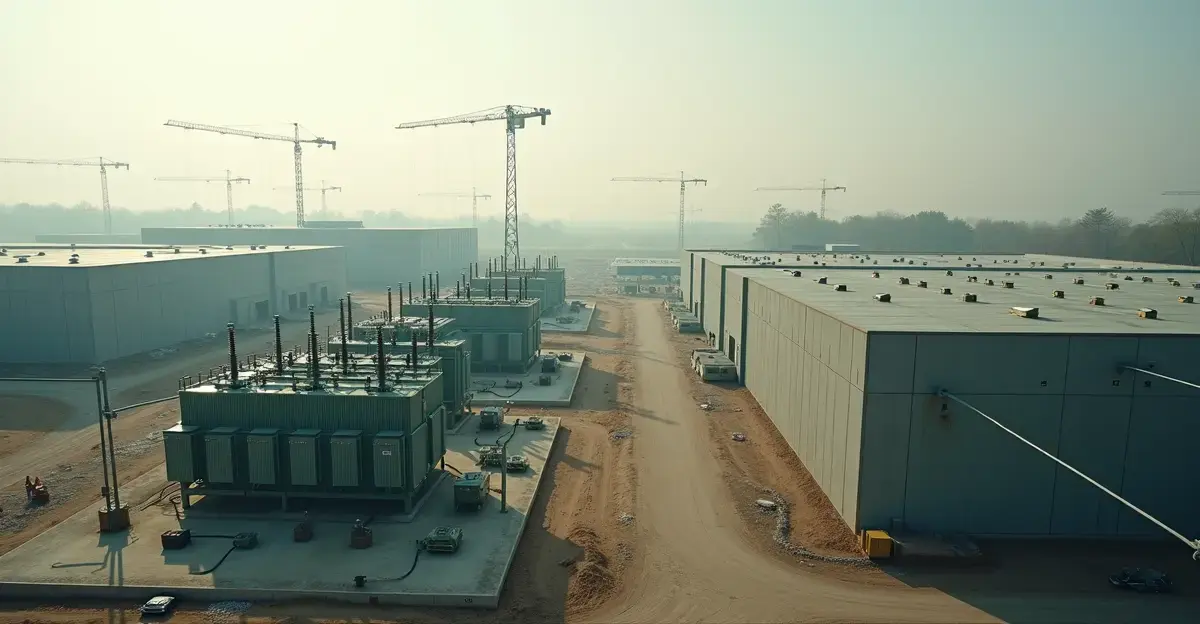
These direct PPAs effectively bypass traditional utilities, creating a parallel energy economy where tech companies control their own power supply. Over 50% of new data center campuses are predicted to exceed 500 MW by 2035, with nearly one-third surpassing 1 GW. Bloom Energy's 2026 Data Center Power Report, surveying 152 decision-makers, found that one-third of data centers are expected to be fully off-grid by 2030, with developers increasingly investing in onsite power to avoid grid delays.
This trend is reshaping energy markets. The geopolitics of AI energy supply is becoming a critical factor: countries providing secure, affordable electricity access will lead the AI race, according to IEA Executive Director Fatih Birol. Texas is poised to capture nearly 30% of U.S. data center market share by 2028, while legacy hubs like California and Oregon stand to lose half their relative market share.
Grid Strain and Political Backlash
The rapid growth of data center electricity demand is straining public grids and raising costs for residential consumers. Monitoring Analytics estimates that data centers caused 63% of the PJM capacity price increase in the 2025/26 auction, adding $9.3 billion in ratepayer costs. Consumer advocates warn that if data center costs are spread across all ratepayers, typical households could pay about $70 more per month. PJM stakeholders recently voted down proposals that would have forced data centers to carry more of their own costs.
Critics argue that direct corporate PPAs shift grid infrastructure costs to residential consumers. Maryland ratepayers face approximately $1.3 billion in charges for Northern Virginia data center infrastructure they do not use. Utility forecasts may overstate actual data center buildout by 40%, meaning customers could pay for phantom infrastructure for decades.
Expert Perspectives
"To successfully address growing energy demand, we must deploy gigawatts of advanced nuclear energy in the 2030s," said Meta in its January 2026 announcement. "This agreement provides financial stability and operational flexibility," said Talen Energy CEO Mac McFarland on the Amazon-Susquehanna deal. Pennsylvania Governor Josh Shapiro voiced strong support, calling the Amazon partnership the largest private sector investment in state history.
However, not all experts are convinced. The IEEFA's Cathy Kunkel warns that inflated forecasts may not fully materialize, but markets are pricing in worst-case scenarios. The sustainability of AI-driven nuclear deals remains an open question, as no commercial SMRs are yet operational in the U.S., and the first deployments are not expected until 2028–2032.
FAQ
How much electricity do AI data centers consume in 2026?
AI data centers are projected to consume over 500 TWh globally in 2026, more than France's total electricity usage. The IEA reports global data center electricity demand surged 17% in 2025 and is set to double by 2030.
Why are tech companies turning to nuclear power?
Nuclear power offers 24/7 dispatchable baseload electricity with a 92%+ capacity factor, making it ideal for AI workloads that require constant, reliable power. Renewables-plus-storage is considered too slow or expensive to meet near-term data center needs, and grid interconnection queues face 5-8 year backlogs.
Which tech companies have signed nuclear deals?
Microsoft (Three Mile Island restart, 835 MW), Amazon (Susquehanna, 1.92 GW), Google (Kairos Power SMRs, up to 500 MW), and Meta (Vistra, TerraPower, Oklo, up to 6.6 GW) have all signed multi-decade nuclear PPAs. Combined, these deals commit over 9.8 GW of nuclear capacity.
What is the impact on residential electricity prices?
PJM capacity prices have increased nearly tenfold, adding $16–21 per month to residential bills in affected areas. Consumer advocates warn that if data center costs are spread across all ratepayers, typical households could pay about $70 more per month.
Will one-third of data centers be off-grid by 2030?
According to Bloom Energy's 2026 Data Center Power Report, one-third of data centers are expected to be fully off-grid by 2030, with developers increasingly investing in onsite power generation to avoid grid delays and interconnection bottlenecks.
Conclusion: A New Energy Paradigm
The AI-nuclear nexus of 2026 marks a fundamental restructuring of global energy markets. Tech giants are no longer passive consumers of grid electricity but active architects of a parallel energy economy. While the nuclear renaissance offers a path to reliable, carbon-free power for AI, it raises critical questions about grid equity, regulatory frameworks, and the pace of SMR deployment. As the IEA notes, the countries that provide secure, affordable electricity access will lead the AI race — and 2026 is the year that race truly begins.


Follow Discussion