


 Deutsch
 English
 Español
 Français
 Nederlands
 Português


 Share
Share




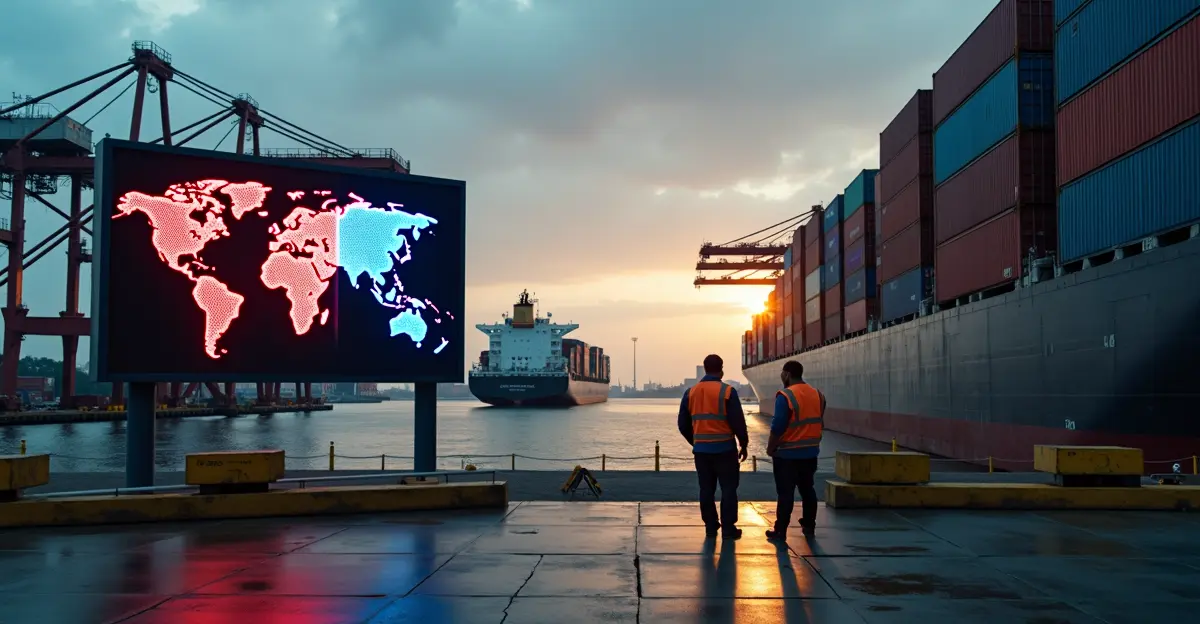
The World Economic Forum's Global Risks Report 2026, released in January, has ranked geoeconomic confrontation as the top risk most likely to trigger a global crisis this year, with 18% of surveyed experts citing it as the primary threat. This designation comes as US-China trade volumes have plummeted by roughly 30% following successive tariff escalations, and after the US Supreme Court's February 2026 ruling in Learning Resources, Inc. v. Trump invalidated IEEPA-based tariffs, triggering new emergency measures under Section 122 of the Trade Act of 1974. The fragmentation of the multilateral trading system into competing blocs is now redefining global supply chains, raising input costs for manufacturers, and forcing central banks to reassess inflation and growth projections.
WEF Global Risks Report 2026: An Age of Competition
The WEF's 21st edition of the Global Risks Report paints a stark picture of an "age of competition" where multilateralism is retreating. Half of respondents expect a turbulent or stormy outlook over the next two years, rising to 57% over the next decade. Geoeconomic confrontation tops the two-year risk ranking, followed by state-based armed conflict (14%), misinformation, societal polarization, and extreme weather. Economic risks such as downturn and inflation have risen sharply in the rankings. The report warns that tariffs could escalate into full-scale economic war and that 68% of leaders believe the global political environment will become more fragmented over the next decade. Environmental concerns, while deprioritized in the short term, remain the most severe risks over the ten-year horizon, with extreme weather events leading the long-term list.
US-China Trade War: A 30% Collapse in Bilateral Trade
US-China trade volumes have dropped by approximately 30% from pre-tariff levels, according to data from the Peterson Institute for International Economics. After President Trump raised tariffs on China by 145 percentage points in early 2025, US imports from China fell by 28% in 2025 alone, reaching levels not seen since the 2009 financial crisis. China's share of US goods imports dropped from 22% in 2017 to just 9% by the end of 2025. The US-China trade war escalation has seen tariff-affected goods such as laptops, monitors, and game consoles experience 70% drops in Chinese sourcing, with Vietnam, Taiwan, and Mexico emerging as primary alternatives. However, China retains significant leverage through its control of 90% of global rare earth processing, which it has weaponized to restrict exports of critical minerals essential for electronics and defense manufacturing.
The Supreme Court's Landmark Ruling and Section 122 Tariffs
On February 20, 2026, the US Supreme Court ruled 6-3 in Learning Resources, Inc. v. Trump that the International Emergency Economic Powers Act (IEEPA) does not authorize the President to impose tariffs, striking down the administration's IEEPA-based tariffs as unlawful. Hours later, President Trump terminated those tariffs and issued a new proclamation under Section 122 of the Trade Act of 1974, imposing a temporary 10% global import surcharge effective February 24, 2026, for a 150-day period (through July 24, 2026). Section 122 allows tariffs of up to 15% to address "large and serious" balance-of-payments deficits, but measures must be applied uniformly and cannot target individual countries. Exemptions include USMCA-compliant goods, critical minerals, energy products, pharmaceuticals, certain electronics, and aerospace products. The administration has signaled plans to increase the surcharge to 15%, though no formal action has been taken yet. Importers now face the dual challenge of pursuing refunds for billions of dollars in previously paid IEEPA duties while modeling forward exposure under the new Section 122 regime.
Global Trade Growth Amid Fragmentation
Despite the tariff turmoil, global trade grew by 4.2% in 2025, driven overwhelmingly by AI-related semiconductors and data-center equipment. According to a Federal Reserve FEDS Note published in February 2026, AI-driven trade fueled nearly half of merchandise trade growth in the first half of 2025, despite representing only about 15% of total trade. US data-center spending alone exceeded half a trillion dollars in 2025. Deloitte's 2026 Semiconductor Industry Outlook projects global chip sales will reach a historic $975 billion in 2026, with 26% growth driven by the AI infrastructure boom. However, this growth masks a stark divergence: high-value AI chips now drive roughly half of total revenue but represent less than 0.2% of unit volume. The global semiconductor supply chain is increasingly concentrated, with the top three chip stocks accounting for 80% of the combined $9.5 trillion market cap of the top ten global chip companies.
The Rise of Alternative Trade Blocs
In response to US tariff policies, the European Union, India, and Latin American nations are raising their own tariffs and pursuing alternative trade agreements. In January 2026, the EU signed landmark trade deals with both Mercosur (Argentina, Brazil, Paraguay, Uruguay) and India. The EU-Mercosur agreement creates one of the world's largest free trade zones, covering approximately 700 million consumers across 31 countries, and would save EU firms over €4 billion per year in customs duties. The EU-India FTA, described by European Commission President Ursula von der Leyen as the "mother of all deals," creates a free trade zone of approximately two billion people, with India progressively eliminating or reducing tariffs on 96.6% of EU exports, including cars (currently 110%), machinery, chemicals, and pharmaceuticals. These agreements send a political signal that multilateral cooperation remains viable amid rising protectionism, though ratification faces potential delays — the European Parliament has requested a CJEU opinion on the Mercosur deal's compatibility with EU law, which may delay ratification by up to 18 months.
Mercosur, Indonesia, and India: Accessing 2 Billion Consumers
The EU trade agreements with Mercosur and India are part of a broader trend of regional bloc formation. Indonesia has also been pursuing trade deals, and Latin America's Mercosur bloc is exploring further expansion. These alternative blocs aim to provide market access to over 2 billion consumers, reducing dependence on the US and Chinese markets. The UNCTAD Global Trade Update for January 2026 notes that South-South trade has surged to $6.8 trillion in exports, and that around 18,000 new discriminatory trade measures have been implemented since 2020, raising compliance costs for businesses worldwide.
Impact on Central Banks and Inflation Projections
The fragmentation of global trade is forcing central banks to reassess their inflation and growth projections. A World Economic Forum report from June 2026 estimates that geoeconomic fragmentation is costing the global economy $213–$307 billion annually and adding 0.2–0.3 percentage points to inflation. If current trends accelerate, global losses could reach $6.9 trillion (6.4% of global GDP), with emerging markets facing potential output losses of 10.7%. The IMF's January 2026 World Economic Outlook Update projects global growth at 3.3% for 2026, slightly upgraded from October 2025, but warns that an escalation of geopolitical tensions and trade policy headwinds could derail the recovery. The European Central Bank, which kept rates unchanged at 2.00% in February 2026, noted that the outlook remains uncertain due to global trade policy tensions and potential tariff impacts. The impact of tariffs on inflation expectations is a key concern, as higher input costs for manufacturers could feed through to consumer prices.
Expert Perspectives
"The global risk landscape is becoming more volatile and interconnected," said Saadia Zahidi, Managing Director of the World Economic Forum. "Geoeconomic confrontation is no longer a theoretical risk — it is reshaping trade flows, investment decisions, and monetary policy in real time." Chad P. Bown of the Peterson Institute for International Economics noted that "the US-China trade war has fundamentally altered global supply chains, with Vietnam, Taiwan, and Mexico emerging as the primary beneficiaries of the shift away from Chinese sourcing." However, he cautioned that "China's control over rare earth processing gives it a powerful retaliatory tool that could cripple advanced manufacturing in the US and Europe."
Frequently Asked Questions
What is geoeconomic confrontation?
Geoeconomic confrontation refers to the use of economic tools — such as tariffs, sanctions, export controls, and investment restrictions — by countries to achieve strategic objectives, often at the expense of multilateral cooperation. It is ranked as the top global risk for 2026 by the World Economic Forum.
How much have US-China trade volumes dropped?
US-China trade volumes have fallen by approximately 30% from pre-tariff levels. US imports from China declined by 28% in 2025 alone, and China's share of US goods imports dropped from 22% in 2017 to 9% by the end of 2025.
What is Section 122 of the Trade Act of 1974?
Section 122 allows the US President to impose tariffs of up to 15% for up to 150 days in response to "large and serious" balance-of-payments deficits. It was invoked in February 2026 after the Supreme Court struck down IEEPA-based tariffs, resulting in a temporary 10% global import surcharge.
Which countries are forming alternative trade blocs?
The European Union has signed major trade agreements with Mercosur (Argentina, Brazil, Paraguay, Uruguay) and India in January 2026. Indonesia and other nations are also pursuing new trade partnerships, aiming to create blocs serving over 2 billion consumers.
How are central banks responding to trade fragmentation?
Central banks are reassessing inflation and growth projections. The IMF projects 3.3% global growth for 2026 but warns of downside risks from trade tensions. The ECB has kept rates unchanged while citing trade policy uncertainty. The WEF estimates fragmentation adds 0.2–0.3 percentage points to inflation annually.
Conclusion and Future Outlook
The geoeconomic confrontation defining 2026 is not a temporary disruption but a structural shift in the global order. The fragmentation of the multilateral trading system into competing blocs — US-led, China-led, and emerging alternative blocs — is likely to persist, raising costs for businesses and consumers alike. While the AI-driven trade boom in semiconductors and data-center equipment provided a bright spot in 2025, the underlying trend is one of decoupling and realignment. Policymakers face the urgent task of managing this transition to avoid the worst-case scenarios of full-scale economic war and a 6.4% loss of global GDP. As the WEF report concludes, the choices made in 2026 will determine whether the world moves toward greater fragmentation or finds new pathways for cooperation.
Sources
- World Economic Forum, Global Risks Report 2026, January 2026
- UNCTAD, Global Trade Update, January 2026
- Peterson Institute for International Economics, "The Trump-China Trade Wars: Five Takeaways from US Imports in 2025"
- US Supreme Court, Learning Resources, Inc. v. Trump, February 20, 2026
- Covington & Burling LLP, "IEEPA Tariffs Terminated; Replacement Section 122 Tariffs Take Effect," February 2026
- Federal Reserve, FEDS Note: "The Global Trade Effects of the AI Infrastructure Boom," February 2026
- Deloitte, 2026 Semiconductor Industry Outlook
- IMF, World Economic Outlook Update, January 2026
- European Central Bank, Economic Bulletin Issue 1, 2026
- Sullivan & Cromwell LLP, "EU Strikes Major Trade Deals with Mercosur and India," January 2026




Follow Discussion