


 Deutsch
 English
 Español
 Français
 Nederlands
 Português


 Share
Share




Despite a temporary U.S.-China trade truce, critical shortages of rare earth elements—particularly yttrium and scandium—are crippling American aerospace and semiconductor production, exposing the deepest geoeconomic vulnerability of 2026. Yttrium prices have surged as much as 140-fold in a year, while domestic U.S. scandium production remains at zero, leaving next-generation 5G chip output and military jet engine coatings at risk. As the Trump-Xi summit approaches in March 2026, this crisis has become the defining geoeconomic story of the moment.
How China Weaponized Rare Earth Refining
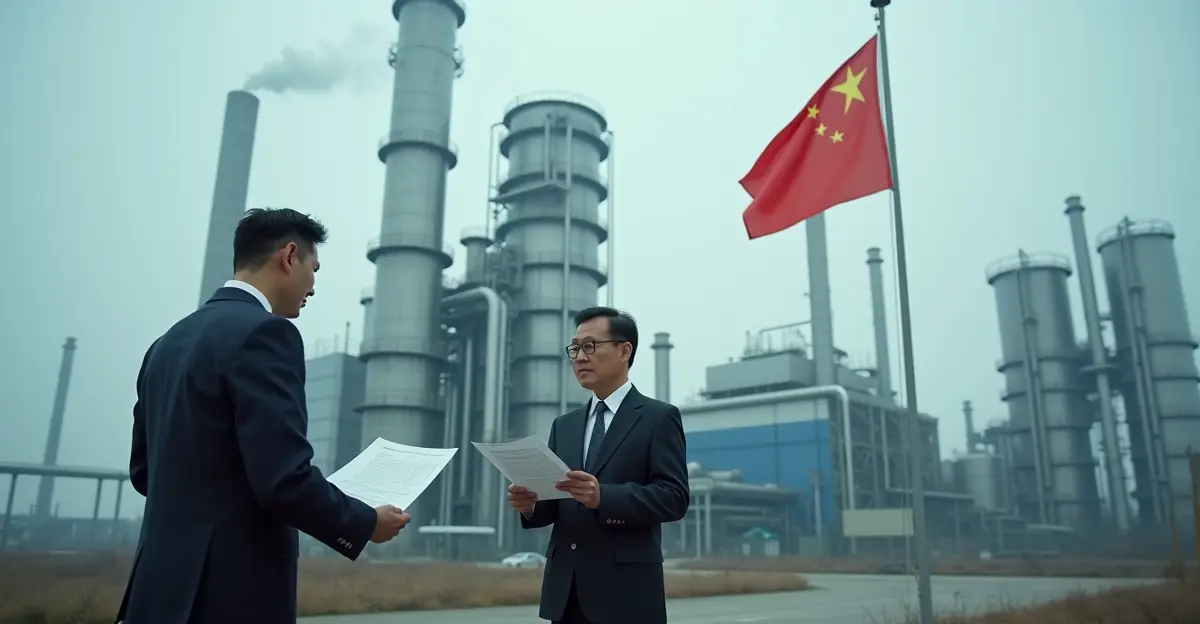
China controls over 90% of global rare earth refining capacity, a dominance built over decades of strategic investment. In April 2025, Beijing imposed export licensing requirements on yttrium, scandium, dysprosium, and terbium—critical elements for defense and high-tech manufacturing. The impact was immediate and severe: yttrium shipments to the United States collapsed from 333 tons to just 17 tons in the eight months following the controls, a 94.9% reduction according to industry data cited by Reuters.
The China rare earth export controls represent what analysts call "midstream weaponization"—targeting processed oxides and alloys rather than raw ore, precisely the forms industry needs. Unlike raw materials, processed rare earths require specialized separation facilities that take years to build and certify, giving Beijing near-total leverage over global supply chains.
Yttrium: The Jet Engine Bottleneck
Yttrium oxide is essential for thermal barrier coatings (TBCs) used in military aircraft engines, allowing turbine blades to withstand temperatures exceeding 1,500 degrees Celsius. Without these coatings, engines in F-35 fighters, CH-53K helicopters, and commercial jetliners would fail catastrophically. The price of yttrium has exploded from under $8 per kilogram at the end of 2024 to as high as $850 per kilogram in February 2026—a 140-fold increase according to multiple market sources.
Two North American coating manufacturers have already suspended production due to supply constraints, while a third is rationing material, prioritizing defense contractors and turning away smaller clients. Industry experts warn that if shortages persist, military aircraft maintenance schedules could face delays within months.
Price Surge Timeline
- End of 2024: Yttrium at ~$6–8/kg
- April 2025: China imposes export licensing; prices begin climbing
- November 2025: Yttrium reaches $126/kg (1,500% increase)
- February 2026: Peak at $850/kg (140-fold increase from 2024)
Scandium: The Zero-Domestic-Production Crisis
Scandium is even more precarious. According to the U.S. Geological Survey's Mineral Commodity Summaries 2026, scandium was not commercially mined or recovered in the United States in 2025. The country has only small-scale metal refining capacity in Ames, Iowa, and Tolleson, Arizona, with additional capacity under development but years from meaningful output.
Scandium is critical for aluminum-scandium nitride (AlScN) thin films used in 5G radio frequency filters—the backbone of next-generation telecommunications infrastructure. U.S. chipmakers' stockpiles are measured in months, not years. The US scandium supply chain vulnerability threatens not only commercial 5G rollout but also military communications and radar systems that rely on the same semiconductor architectures.
Project Vault and the $12 Billion Gamble
In response, the Trump administration announced Project Vault on February 2, 2026—a $12 billion public-private partnership combining $10 billion in Export-Import Bank financing with $2 billion in private capital to build a strategic critical minerals stockpile. Companies including General Motors, Boeing, Stellantis, and Google have joined the program, committing to purchase materials at fixed prices in exchange for access during disruptions.
However, analysts estimate that building meaningful domestic separation and magnet manufacturing capacity will take 3–7 years. The Pentagon's own stockpiles of heavy rare earths would last only two months under a severe disruption, according to reports from the South China Morning Post and Chinese industry analyses. A federal ban on Chinese-sourced rare earth magnets in U.S. weapons platforms takes effect January 1, 2027, creating an impending compliance deadline that defense contractors are struggling to meet.
What Strategic Diversification Can Realistically Achieve
The United States has enlisted over 50 countries to build alternative supply chains, but the obstacles are formidable. MP Materials operates the Mountain Pass mine in California—the largest rare earth mine outside China—but still ships its concentrates to China for processing. Lynas Rare Earths in Australia is expanding, and projects in Canada, Brazil, and South Africa are advancing, but none will achieve significant separation capacity before 2028 at the earliest.
The rare earth supply chain diversification efforts face three fundamental challenges: the capital intensity of building separation facilities, the environmental permitting hurdles for new mines, and the time required to qualify aerospace and defense supply chains. As one industry executive told Reuters, "You can't just flip a switch. Every batch of yttrium oxide has to be certified for use in jet engines—that takes 18 to 36 months."
Impact on the Trump-Xi Summit
The rare earth crisis is expected to dominate the upcoming Trump-Xi summit in Beijing in March 2026. U.S. Trade Representative Jamieson Greer has testified that securing continued access to rare earth minerals is a top administration priority. However, China has framed its export controls as national security measures, and Beijing shows little inclination to relax licensing requirements without significant concessions on technology transfer and tariff policy.
The Trump Xi summit rare earth negotiations represent a high-stakes diplomatic confrontation. China's leverage is substantial: it controls 98–99% of global heavy rare earth supply and nearly all processing capacity for yttrium and scandium. Even if a diplomatic solution is reached, the structural dependency will take years to unwind.
Expert Perspectives
Michael P. Cadenazzi Jr., assistant secretary of war for industrial base policy, told the Senate Armed Services Committee that securing a resilient supply chain for critical minerals is a national security imperative. "China controls 95% of global heavy rare earth output and supplies 90% of U.S. imports. This is not just an economic issue—it is a strategic vulnerability that affects every branch of our military," he testified.
Industry analysts at S&P Global note that supply bottlenecks are set to persist through 2026 and likely beyond, driven by rising demand from clean energy and defense sectors alongside constrained non-Chinese processing capacity. The critical minerals national security risks are now front and center in Pentagon planning.
FAQ: The Rare Earth Crisis
What is yttrium used for in defense?
Yttrium oxide is essential for thermal barrier coatings in jet turbine engines, enabling blades to withstand extreme temperatures. It is also used in laser systems, microwave filters, and superconductors for military applications.
Why is there no US scandium production?
Scandium is rarely found in concentrated deposits and is typically produced as a byproduct of other mining operations. The US has not had economically viable scandium mining, and current refining capacity is limited to small-scale operations in Iowa and Arizona.
How long will US rare earth stockpiles last?
According to multiple reports, US military stockpiles of heavy rare earths would last approximately two months under a severe supply disruption. Commercial stockpiles for yttrium and scandium are measured in months, not years.
Can the US build domestic rare earth processing quickly?
Analysts estimate 3–7 years to build meaningful domestic separation and magnet manufacturing capacity. The key bottleneck is not mining but the complex chemical processing required to separate rare earth oxides into individual elements at the purity levels industry requires.
What is Project Vault?
Project Vault is a $12 billion public-private partnership announced in February 2026 to create a strategic critical minerals stockpile. It combines $10 billion in Export-Import Bank financing with $2 billion in private capital and includes commitments from major defense and technology companies.
Conclusion: The Race Against Time
The rare earth crisis of 2026 represents a fundamental challenge to U.S. economic and national security. While Project Vault and allied diversification efforts offer a path forward, the gap between current dependency and future self-sufficiency remains measured in years—time that China can use to tighten its grip. The upcoming Trump-Xi summit may provide temporary relief, but the structural vulnerability will persist until the West builds a complete mine-to-magnet supply chain. As one Pentagon official put it, "We are in a race against time, and we started late."



Follow Discussion