


 Deutsch
 English
 Español
 Français
 Nederlands
 Português


 Share
Share




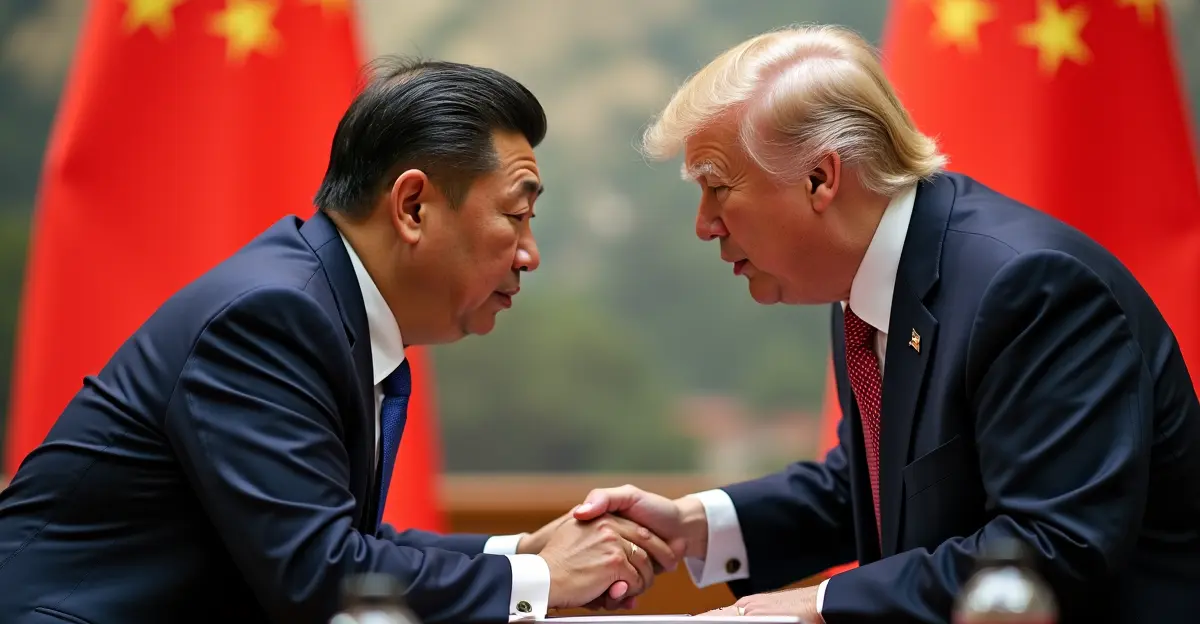
On May 14-15, 2026, U.S. President Donald Trump and Chinese President Xi Jinping met in Beijing for a high-stakes summit that produced a 90-day trade truce, temporarily de-escalating tariffs that had peaked at 145% on Chinese goods. Beneath the diplomatic veneer, the summit exposed the deepening fault lines of a new Tech-Cold War, where the future of AI chip export controls, rare-earth supply chains, and global AI governance hang in the balance. The outcome of this meeting—the first U.S. state visit to China since 2017—will shape the semiconductor industry, AI development, and geopolitical alignments for years to come.
Background: From Tariff Peaks to a Fragile Truce
The 90-day truce announced at the summit marks a tactical pause in a trade war that saw U.S. tariffs on Chinese imports soar to 145% in late 2025. Under the terms of the truce, tariffs have been rolled back to an average of roughly 30%, with further reductions tied to progress on structural issues. The US-China trade war timeline has been marked by repeated escalations and temporary ceasefires, but analysts at Cornell University suggest the likelihood of substantive new agreements emerging from this summit is near zero. Instead, both sides appear focused on 'calendar management'—kicking the can down the road while each pursues strategic advantages.
AI Chip Export Controls: The H200 Dilemma
Central to the summit's tech agenda was the fate of Nvidia's H200 GPU, the second-most-powerful AI chip on the market. In December 2025, the Trump administration announced a policy shift allowing H200 exports to approved Chinese customers under strict conditions, including case-by-case license reviews by the Bureau of Industry and Security (BIS). At the summit, the U.S. cleared around 10 Chinese firms to purchase the H200, but not a single delivery has been made as of mid-May 2026, according to sources familiar with the matter.
Nvidia CEO Jensen Huang accompanied Trump to Beijing, signaling the company's intense interest in preserving access to the Chinese market, which historically accounted for roughly 20% of Nvidia's data-center revenue. However, the AI chip export controls debate has become a double-edged sword: while Washington seeks to limit China's access to cutting-edge hardware, Beijing has accelerated domestic chip development. Huawei's Ascend 910C now reaches approximately 65% of the performance of Nvidia's H100, narrowing the gap faster than many Western analysts predicted.
China's Rare-Earth Leverage
Beijing has not come to the negotiating table empty-handed. In 2025, China introduced two waves of export controls on rare-earth elements (REEs), citing national security. China controls 90% of global rare-earth processing, 80% of tungsten, and 60% of antimony—materials essential for manufacturing semiconductors, electric vehicle batteries, and defense systems. The controls triggered sixfold price spikes outside China, while licensing approvals for European firms fell below 25% in some sectors. At the summit, Xi signaled a willingness to ease restrictions in exchange for concessions on tariffs and technology transfer, but the rare earth supply chain risks remain a potent weapon in Beijing's arsenal.
AI Governance: A Framework in the Making
Perhaps the most forward-looking element of the summit was the discussion around a global AI governance framework. Ahead of the meeting, OpenAI proposed creating an international AI watchdog modeled after the International Atomic Energy Agency (IAEA), with shared safety standards and coordinated testing between U.S. and Chinese AI safety institutes. While the proposal garnered attention, the Time magazine report from the summit noted that AI governance was surprisingly sidelined in favor of more traditional trade deals involving Boeing aircraft and agricultural commodities.
Nevertheless, the global AI governance framework remains a critical long-term issue. China's domestic AI models have reached near-frontier performance despite U.S. chip curbs. DeepSeek's V4 Pro model, evaluated by NIST's Center for AI Standards and Innovation (CAISI) in May 2026, achieved 94.2% of GPT-5's MMLU score while using three times fewer FLOPs—a compute efficiency breakthrough with profound geopolitical implications. Chinese AI providers are now capturing price-sensitive global markets with inference costs one-sixth those of U.S. models.
Impact: Weakening U.S. Semiconductor Leverage
The summit's most significant takeaway may be the fundamental weakening of Washington's semiconductor leverage. When the U.S. first imposed export controls in 2022, the assumption was that denying China access to advanced chips would delay its AI ambitions by years. Instead, China's AI compute cluster now exceeds 400,000 H800-equivalent GPUs, and domestic alternatives like the Ascend 910C are closing the performance gap. NIST's evaluation found that DeepSeek V4 Pro lags behind frontier U.S. models by only about eight months—a timeline that is shrinking.
As one analyst noted, 'Export controls have failed to prevent China from reaching commercial AI competitiveness. The efficiency narrative also presents a medium-term risk to Nvidia's growth thesis.' The US-China tech competition 2026 is no longer a one-sided affair; China has demonstrated the ability to innovate under pressure, fundamentally reshaping the global tech power balance.
Expert Perspectives
Harvard professor Graham Allison, a leading scholar on U.S.-China relations, described the truce as a potential stepping stone toward a formal agreement, calling 'stabilization' the central theme of the summit. HSBC's Justin Feng characterized the meeting as a 'defining test' for the G2 dynamic, noting that the U.S. and China now account for 60% of global GDP alongside the EU. However, critics argue that the truce paper over deep structural divisions. Cornell University analysts warned that the likelihood of substantive new agreements is 'near zero,' and that both sides are primarily engaged in strategic positioning ahead of the next escalation.
FAQ
What is the 90-day trade truce between the US and China?
The 90-day truce, announced at the May 2026 Trump-Xi summit, temporarily reduces U.S. tariffs on Chinese goods from a peak of 145% to an average of roughly 30%, while China agrees to increase purchases of American products and ease some rare-earth export restrictions. The truce provides a window for further negotiations on structural issues.
Why is the H200 chip important in US-China relations?
Nvidia's H200 GPU is the second-most-powerful AI chip available, critical for training large language models and other AI applications. The U.S. has cleared 10 Chinese firms to buy the H200 under strict conditions, but deliveries have not yet begun. The chip's fate is a bellwether for the broader semiconductor export control regime.
How has China's AI development progressed despite US chip curbs?
China's AI models, such as DeepSeek V4 Pro, have reached near-frontier performance levels—within 8 months of top U.S. models—by achieving greater compute efficiency. Domestic chips like Huawei's Ascend 910C now reach about 65% of H100 performance, and China's total AI compute cluster exceeds 400,000 H800-equivalent GPUs.
What role do rare earths play in the US-China tech conflict?
China controls 90% of global rare-earth processing, making it a critical choke point for semiconductor, EV, and defense supply chains. In 2025, Beijing imposed export controls that caused sixfold price spikes outside China, using rare earths as leverage in trade negotiations.
What is the proposed global AI governance framework?
OpenAI has proposed an international AI watchdog modeled after the IAEA, with shared safety standards and coordinated testing between U.S. and Chinese AI safety institutes. The proposal was discussed at the summit but did not result in a formal agreement, as talks focused more on traditional trade issues.
Conclusion: A New Balance of Power
The 90-day truce buys time, but it does not resolve the fundamental tensions driving the Tech-Cold War. China's rapid AI progress despite chip curbs has weakened Washington's primary leverage, while Beijing's control over rare-earth supply chains gives it potent countermeasures. The next 90 days will reveal whether both sides can translate tactical bargains into strategic stability—or whether the world's two largest economies are merely preparing for the next phase of technological confrontation.

Follow Discussion