


 Deutsch
 English
 Español
 Français
 Nederlands
 Português


 Share
Share




The January 15, 2026 final rule from the U.S. Bureau of Industry and Security (BIS) marks a calibrated shift in AI chip export controls, moving from blanket denial to case-by-case review for select advanced semiconductors—while simultaneously imposing a 25% tariff and strict compliance conditions. This regulatory recalibration, combined with China's own algorithm registration mandates and compute localization requirements, is accelerating the fragmentation of global technology into two distinct ecosystems. The resulting 'AI splinternet' forces multinational corporations to build modular, sovereign-by-design architectures, raising costs, limiting cross-border data flows, and fundamentally reshaping the global semiconductor supply chain.
What Is the AI Splinternet?
The term 'AI splinternet' refers to the geopolitical fragmentation of the internet into separate ecosystems—a U.S.-led bloc and a China-led bloc—where data, AI models, and hardware can no longer flow freely across borders due to national security laws and trade bans. Unlike earlier internet fragmentation debates, the AI splinternet is driven by physical hardware controls on advanced semiconductors, the essential components for training and deploying large language models and other AI systems. The BIS export controls on AI chips are the primary catalyst, creating a bifurcated global market where companies must choose which regulatory regime to serve.
The BIS Final Rule: A Calibrated Shift
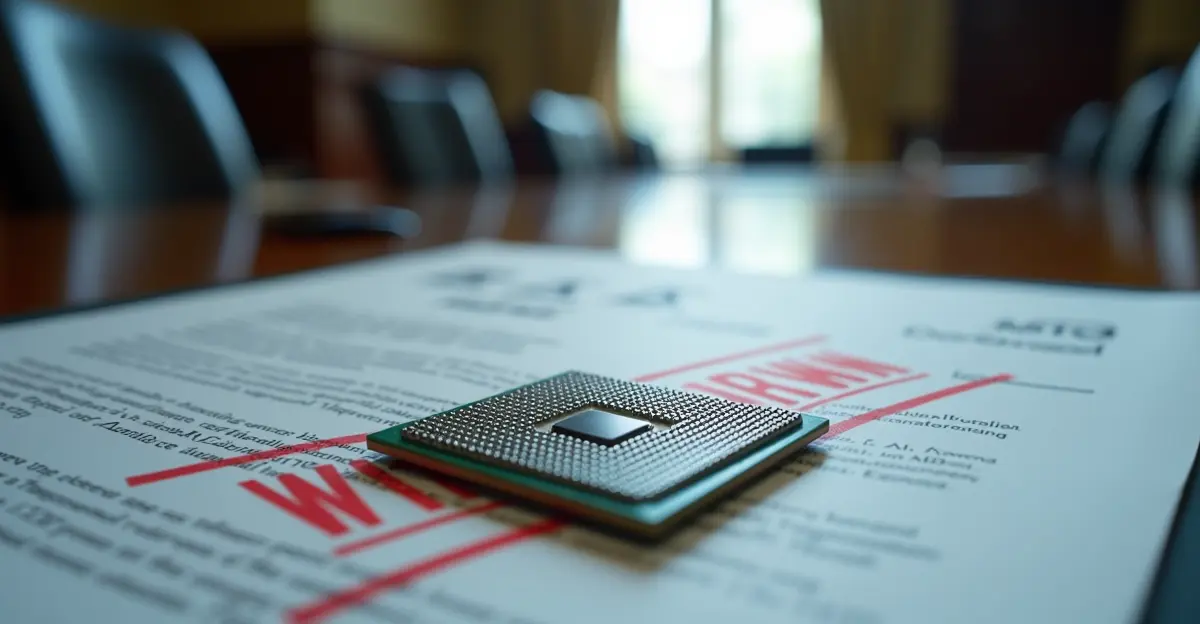
Effective January 15, 2026, the BIS final rule revises the license review policy for exports of certain advanced computing semiconductors to China and Macau. The policy moves from a 'presumption of denial' to a case-by-case review—but only for direct exports from the United States of chips below specific performance thresholds: Total Processing Performance (TPP) under 21,000 and DRAM bandwidth under 6,500 GB/s. Eligible chips include NVIDIA's H200 and AMD's MI325X (by a tight margin), while next-generation architectures like NVIDIA Blackwell B200 and AMD MI400 series remain fully restricted.
Four Strict Conditions for Approval
To qualify for case-by-case approval, applicants must meet four conditions: First, U.S. supply priority—China shipments cannot exceed 50% of U.S. sales. Second, Chinese purchasers must have export compliance programs including customer screening. Third, products must undergo independent third-party testing by a U.S.-based entity to verify performance and security. Fourth, robust KYC and remote access safeguards must be in place. Reexports from third countries and in-country transfers within China remain under presumption of denial.
The 25% Tariff and Dual Trade-Control Approach
Concurrently, a 25% tariff under Section 232 was imposed on matching chips imported into the United States, creating a dual trade-control policy that combines export licensing with import duties. This unconventional hybrid approach—controls and monetization—has drawn criticism from both industry advocates who argue it undermines U.S. competitiveness and hawks who believe any chip sales to China endanger national security. The semiconductor supply chain restructuring is now a central challenge for global tech firms.
China's Regulatory Response: Algorithm Registration and Compute Localization
China has responded with its own sweeping regulatory framework. The Algorithm Recommendation Regulation mandates filing of algorithm logic, training data, risk assessments, and security measures with the Ministry of Industry and Information Technology (MIIT) within 30 days of deployment. The Deep Synthesis Provisions require registration, safety testing, and mandatory labeling of all AI-generated synthetic media, with fines up to ¥5 million. The Interim Measures for Generative AI impose pre-launch filing within 45 days, content restrictions aligned with 'core socialist values,' and data protection compliance under the Personal Information Protection Law (PIPL).
Compute Localization Mandates
Perhaps most consequentially, China now requires compute localization for AI models serving Chinese citizens. Domestic GPU clusters must be used for training and inference, effectively prohibiting the use of foreign cloud AI services for the Chinese market. This requirement, combined with mandatory quarterly algorithmic audits covering fairness and security, creates a walled-garden AI ecosystem that is increasingly incompatible with Western infrastructure. Multinational enterprises must now redesign AI products for modular compliance across jurisdictions.
Impact on Multinational Corporations
The regulatory bifurcation forces multinational corporations to adopt 'sovereign-by-design' architectures—building separate AI stacks for the U.S.-led and China-led ecosystems. This involves data localization, model forking, and exponentially increased infrastructure costs. A single global AI model is no longer feasible; companies must maintain at least two parallel deployments with different training data, compliance frameworks, and hardware supply chains.
Cost and Operational Complexity
McKinsey estimates that sovereign AI infrastructure investments could add 30-50% to AI deployment costs for multinationals operating in both blocs. The semiconductor supply chain bottleneck is exacerbated by concentrated production—TSMC holds nearly 70% of advanced foundry market share—and long lead times for lithography equipment. Moody's warns that supply chain constraints, rather than production capacity, will be the primary bottleneck in 2026, with global semiconductor sales surpassing $790 billion in 2025 but structural vulnerabilities persisting.
Expert Perspectives
'This is not just about chips—it's about the architecture of the global internet,' said Dr. Li Wei, a technology policy fellow at the Carnegie Endowment for International Peace. 'The AI splinternet means that a company building a global AI product must now design for two fundamentally different regulatory and infrastructure environments. That raises costs, limits innovation, and ultimately fragments the global AI market.'
Under Secretary of Commerce for Industry and Security Jeffrey Kessler defended the BIS rule, stating: 'This policy strengthens the American technology ecosystem while protecting national security. By allowing case-by-case review for commercially available chips, we maintain U.S. leadership while preventing diversion to military applications.'
FAQ
What is the AI splinternet?
The AI splinternet is the fragmentation of global technology into separate U.S.-led and China-led ecosystems, driven by export controls on AI chips, data localization laws, and divergent AI regulations that prevent the free flow of data, models, and hardware across borders.
Which AI chips are affected by the January 2026 BIS rule?
The rule covers chips with TPP under 21,000 and DRAM bandwidth under 6,500 GB/s, including NVIDIA H200 and AMD MI325X. Next-generation chips like NVIDIA Blackwell B200 and AMD MI400 remain under presumption of denial for exports to China.
What are China's algorithm registration requirements?
China requires mandatory filing of algorithm logic, training data, and risk assessments with MIIT within 30 days, plus quarterly audits, content labeling, and compute localization for AI models serving Chinese users.
How are multinational corporations responding?
Companies are adopting 'sovereign-by-design' architectures with separate AI stacks for each regulatory bloc, increasing costs by 30-50% and requiring parallel compliance teams, data centers, and supply chains.
What is Operation Gatekeeper?
Operation Gatekeeper is a DOJ investigation that shut down a major smuggling network exporting NVIDIA H100 and H200 chips to China, seizing over $50 million in GPUs and resulting in guilty pleas for violations of export control laws.
Conclusion and Future Outlook
The AI splinternet is not a temporary disruption but a structural realignment of the global technology landscape. With the BIS rule now in effect and China's regulatory framework solidifying, multinational corporations must invest in modular, jurisdiction-aware AI architectures. The semiconductor supply chain will continue to bifurcate, with independent ecosystems emerging around U.S. and Chinese standards. Companies that fail to adapt risk being locked out of one of the world's two largest AI markets. The future of global AI governance will be defined by this ongoing fragmentation.





Follow Discussion