


 Deutsch
 English
 Español
 Français
 Nederlands
 Português


 Share
Share




The World Economic Forum's Global Risks Report 2026 has ranked geoeconomic confrontation as the top short-term risk, marking a historic shift in the global order. As the old rules-based trading system fractures, a multipolar landscape is emerging where the United States, China, Europe, and the Global South each pursue distinct economic blocs. With US tariffs having increased more than sixfold over the past year and over 85% of global merchandise trade now bypassing the United States entirely, supply chains are being rewired through bilateral deals and regional partnerships rather than multilateral frameworks. This article analyzes the strategic implications for businesses and governments navigating this fragmentation, from semiconductor sovereignty battles to the rise of corridor-based trade between Southeast Asia, India, and the Middle East.
The New Geoeconomic Reality
The WEF Global Risks Report 2026, based on a survey of over 1,300 global leaders, identifies geoeconomic confrontation — fueled by tariffs, economic weaponization, and supply chain constraints — as the defining near-term risk. Half of respondents expect 2026 to be 'turbulent' or 'stormy,' and 68% anticipate more fragmentation over the next decade. The report describes a world entering an 'age of competition' where multilateral institutions are increasingly sidelined.
According to BCG's analysis, 'Trade in Transition: How to Prepare for a Patchwork World Order,' global goods trade could still grow 2.5% annually through 2034, expanding from ~$23 trillion to nearly $30 trillion. However, this growth will occur within a 'multi-nodal trade patchwork' centered around four nodes: the US, China, the Plurilateralists (EU, CPTPP members, etc.), and BRICS+ (excluding China). Under this scenario, US-China trade would decline by 4.5% annually, while Plurilateralist internal trade could grow at 3% CAGR and China's trade with BRICS+ nations at 5.5% CAGR.
Tariff Escalation and Its Consequences
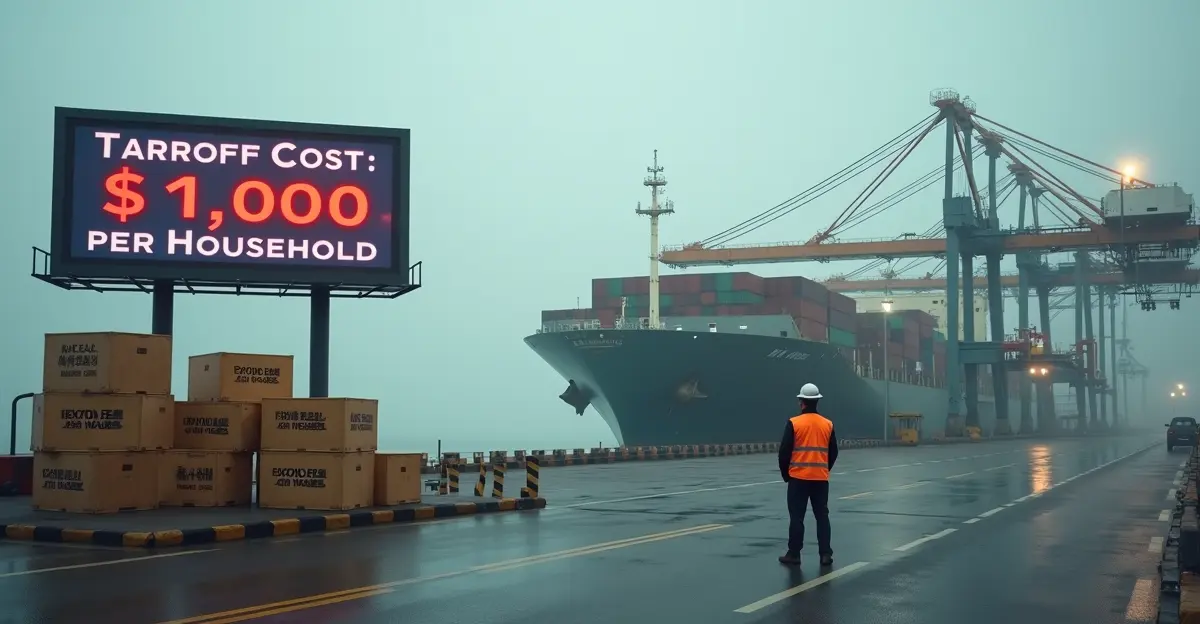
US tariff policy has undergone a dramatic transformation. As of April 2026, the US average effective tariff rate stands at 11.8% — the highest since the early 1940s, according to Yale's Budget Lab. The Tax Foundation estimates the 2026 tariffs amount to an average tax increase of $700 per US household. BCG reports that US tariffs have increased more than sixfold over the last 12 months, with industrial policy measures surging sixfold since 2022 globally.
The Thomson Reuters 2026 Global Trade Report reveals that 72% of trade professionals identify US tariff volatility as the most impactful regulatory change, up from 41%. Companies are responding by changing sourcing patterns (65%), renegotiating contracts (57%), and nearshoring (51%). Notably, 39% are absorbing tariff costs rather than passing them to customers. Supply chain management is now the top strategic priority for 68% of respondents, up from 35%.
The 'Silicon Curtain' and Semiconductor Sovereignty
Perhaps nowhere is the geoeconomic fracture more visible than in the semiconductor industry. A 'Silicon Curtain' is descending, dividing global chip manufacturing into rival ecosystems. The US has imposed sweeping export restrictions on chip-making technology to China, while the CHIPS and Science Act boosts domestic production. Combined with a US-Japan-Netherlands trilateral equipment blockade — now restricting not just sales but also maintenance and spare parts — Chinese foundries like SMIC face severe operational friction. SMIC's advanced 7nm/5nm node yields are only 60-70%, well below TSMC's 85%+.
China has responded with a 'whole-of-nation' self-sufficiency push and a 50% domestic equipment mandate, but faces 20-30% fab efficiency drops. The era of cheap, politically neutral globalized chip manufacturing is over, replaced by a system of 'Fortress Fabs' and a bifurcated AI landscape. The semiconductor sovereignty race is now a central battleground in the broader geoeconomic confrontation.
The Rise of Corridor-Based Trade
As multilateral frameworks weaken, bilateral and regional trade corridors are gaining prominence. The India–Middle East–Europe Corridor (IMEC), launched at the 2023 G20 summit, is emerging as a key alternative to China's Belt and Road Initiative. IMEC is a multimodal system linking ports, rail, energy, and digital infrastructure across India, the Gulf, and Europe. Once operational, it could reduce Asia-Europe trade transit times by ~40% to 12+ days, generating ~$5.4 billion in annual savings. For India alone, IMEC could increase export valuation by 5-8%, returning $21.85 billion in additional exports annually.
GCC nations are anchoring IMEC with over $15 billion in infrastructure investments while boosting African upstream partnerships for critical raw materials like cobalt and lithium, increasing investments by over 25%. Saudi Arabia's Vision 2030 mandates 50% domestic procurement for national projects by 2026. Meanwhile, the EU is pursuing free-trade agreements with Mercosur and Indonesia, and Asian economies are deepening integration through the CPTPP and RCEP frameworks. These new trade corridors are reshaping global supply chains away from US-centric models.
Implications for Businesses and Governments
BCG urges business leaders to move beyond tactical stockpiling and take structural decisions to navigate the patchwork world order. The McKinsey Global Institute's 2026 update on 'Geopolitics and the Geometry of Global Trade' emphasizes that trade flows are being reoriented away from pure economic efficiency toward considerations of national security and resilience. KPMG's 2026 Global Trade Outlook warns of persistent, compounding trade disruptions, with US imports surging over 50% in early 2025 as firms rushed to get goods 'on the water,' then shriveling in subsequent quarters.
The Global South is expected to account for about half of global economic growth by decade's end, according to BCG. China's goods trade is projected to grow 40% faster than the US, deepening ties with BRICS+ and the Global South. The US share of global goods trade is declining as it focuses on deficit reduction and domestic production. For businesses, the key challenge is operating across multiple regulatory regimes with divergent rules on tariffs, technology transfer, and investment screening.
Expert Perspectives
'We are witnessing a fundamental reordering of the global trading system,' says Rich Lesser, Global Chair of BCG. 'Tariffs have increased more than sixfold to levels not seen since the 1930s. This is a new world order requiring flexibility, foresight, and proactive engagement from leaders.'
The WEF report warns the world is 'sitting on a precipice' of poly-crises including trade wars, rapid tech revolution, and climate impacts. Environmental risks like extreme weather remain the top decade-long concern but have been deprioritized in the short term amid geopolitical distractions.
FAQ
What is geoeconomic confrontation?
Geoeconomic confrontation refers to the use of economic tools — such as tariffs, sanctions, export controls, and supply chain restrictions — as instruments of geopolitical competition between nations. It is the top global risk identified in the WEF Global Risks Report 2026.
How much have US tariffs increased?
US tariffs have increased more than sixfold over the past 12 months, according to BCG. The average effective tariff rate reached 11.8% as of April 2026, the highest since the early 1940s, per Yale's Budget Lab.
What is the 'multi-nodal trade patchwork'?
BCG's scenario describes a global trading system organized around four nodes: the US, China, Plurilateralist nations (EU, CPTPP members, etc.), and BRICS+ (excluding China). Each node operates under distinct rules, with trade flows gravitating within and between these blocs.
How are supply chains changing?
Companies are shifting from just-in-time to just-in-case models, with 65% changing sourcing patterns, 57% renegotiating contracts, and 51% nearshoring. New corridors like IMEC are emerging, while semiconductor supply chains are bifurcating into US-aligned and China-aligned ecosystems.
What does this mean for the Global South?
The Global South is becoming a key battleground for influence, expected to account for about half of global economic growth by decade's end. Both the US and China are competing for partnerships, while nations like India, Brazil, and South Africa are wielding greater independent influence.
Conclusion
The geoeconomic fracture is not a temporary disruption but a structural transformation of the global trading system. As tariff wars intensify and multipolar rivalry deepens, businesses and governments must adapt to a world where economic relationships are increasingly defined by geopolitical alignment rather than market efficiency. The future of global trade will be shaped by those who can navigate this fragmentation with strategic foresight and operational agility.





Follow Discussion