


 Deutsch
 English
 Español
 Français
 Nederlands
 Português


 Share
Share




Quantum Computing's 2026 Breakthrough: Practical Applications Reshape Global Security and Finance
IBM experts predict 2026 as the pivotal year when quantum computing achieves 'quantum advantage'—the threshold where quantum computers outperform classical computers for the first time in practical applications. This breakthrough fundamentally alters strategic calculations across national security, economic competition, and global technological leadership, with immediate implications for cybersecurity, financial systems, and supply chain optimization. The emerging 'quantum divide' risks creating technological stratification where over 150 countries lack quantum strategies, potentially creating new dependencies on quantum-powered services from leading nations.
What is Quantum Advantage?
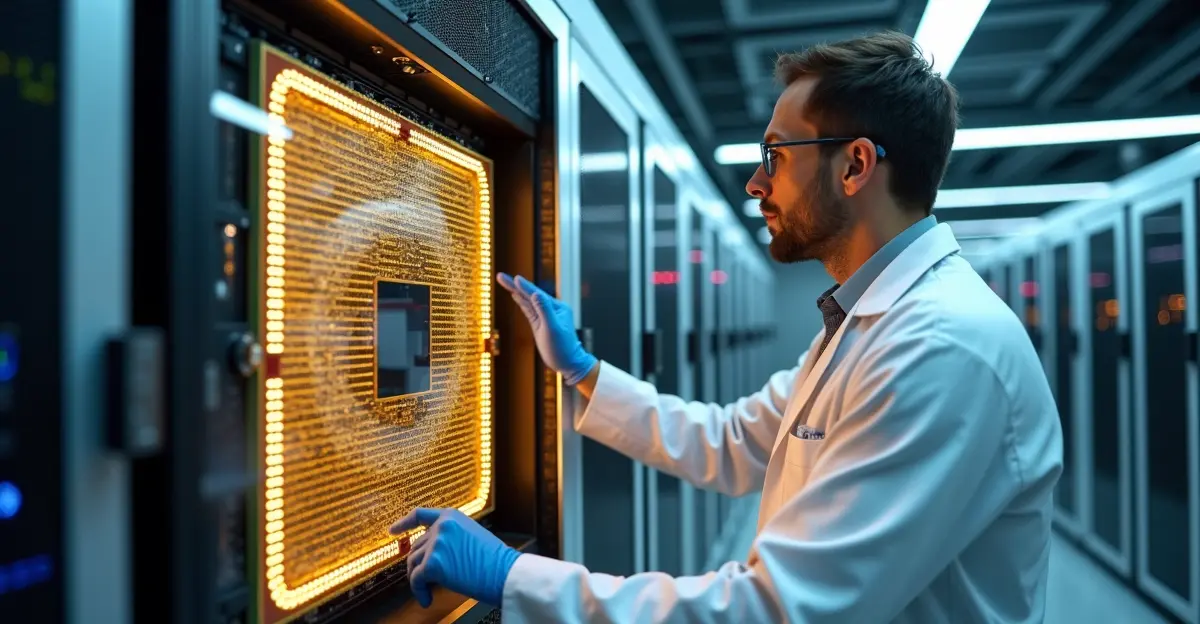
Quantum advantage, also known as quantum supremacy, represents the milestone where quantum computers solve problems that are practically impossible for classical computers to handle within reasonable timeframes. Unlike previous demonstrations focused on artificial benchmarks, the 2026 breakthrough targets practical applications with real-world impact. According to IBM's roadmap, this will be achieved through the Nighthawk processor featuring up to 360 qubits across three 120-qubit modules, capable of running 7,500 gates while working alongside high-performance computing systems.
The 2026 Timeline: From Theory to Reality
Recent forecasts from IBM, S&P Global, and quantum research institutes identify 2026 as the pivotal transition year. IBM has announced significant progress toward achieving quantum advantage by 2026 through new quantum processors and tools revealed at its Quantum Developer Conference. The company introduced the Nighthawk processor with 120 qubits featuring a square topology that enables 30% more complex circuits than its predecessor, designed to deliver quantum utility and advantage at scale.
Key Technological Breakthroughs
Several critical advancements are converging to make the 2026 timeline achievable:
- Processor Innovation: IBM Quantum Nighthawk features 120 qubits with 218 tunable couplers enabling circuits with 30% more complexity
- Error Correction: 10x speedup in quantum error correction achieved a year ahead of schedule
- Software Advancements: Qiskit capabilities show 24% accuracy increase with dynamic circuits
- Manufacturing Scale: Shift to 300mm wafer fabrication boosts quantum chip complexity by 10x
Global Security Implications
The quantum computing breakthrough presents unprecedented challenges to global security frameworks. Current encryption methods protecting sensitive government communications, financial transactions, and critical infrastructure could become vulnerable to quantum attacks. The G7 Cyber Expert Group has issued warnings about the dual nature of quantum computing as both opportunity and risk, emphasizing the need for coordinated international strategies.
According to the World Economic Forum, quantum computing poses an imminent threat to global financial security, with the potential to create a two-tier financial system. While quantum computers capable of breaking current encryption may arrive in the 2030s, sensitive data is already vulnerable as it can be harvested now and decrypted later. The real danger lies in uneven adoption of post-quantum cryptography (PQC), where wealthy nations and large corporations could become quantum-safe while emerging markets lag behind.
Financial Sector Transformation
The financial industry faces both revolutionary opportunities and existential threats from quantum computing. The Global Risk Institute's 2026 Quantum Computing Primer for Financial Sector Executives highlights that quantum computing presents significant benefits and risks beyond current computer capabilities. Key applications include:
- Portfolio Optimization: Solving complex investment problems in minutes rather than days
- Risk Assessment: Modeling financial markets with unprecedented accuracy
- Fraud Detection: Identifying patterns invisible to classical algorithms
- Cryptographic Transition: Migrating to quantum-resistant security protocols
Studies show insufficient preparation across the financial sector, with India's financial institutions scoring only 2.4 out of 5 on quantum readiness assessments. The World Economic Forum emphasizes that 2026 is a critical planning year, advocating for AI-driven automation to accelerate PQC migration and treating quantum security as shared global infrastructure.
The Quantum Divide: Global Inequality Risks
UNESCO's Global Quantum Initiative (2026-2028) represents a comprehensive response to the emerging 'quantum divide' where over 150 countries lack national quantum strategies. With global quantum investments exceeding $55.7 billion, the initiative aims to advance inclusive quantum capacity and international cooperation. Key objectives include building quantum education and training pathways, strengthening institutional capacity, enabling resource sharing, and fostering responsible innovation.
The program targets training 1,000+ quantum professionals, engaging 70+ Member States (especially from the Global South), publishing 30+ open resources, and forming 15+ infrastructure partnerships. UNESCO has already launched initiatives including quantum training for African women scientists, youth engagement through art, and international dialogues to ensure equitable access to quantum technologies for sustainable development.
Expert Perspectives on the 2026 Milestone
'The 2026 quantum advantage breakthrough represents more than just a technological milestone—it's a geopolitical turning point,' says Sofia Martinez, quantum policy analyst. 'Nations without quantum strategies risk becoming dependent on quantum-powered services from leading countries, creating new forms of technological colonialism.'
IBM's commitment to an open, community-led quantum advantage tracker developed with partners Algorithmiq, Flatiron Institute, and BlueQubit ensures independent validation of quantum advantage claims. This transparency is crucial for building trust in quantum computing's capabilities and limitations.
Practical Applications Reshaping Industries
The 2026 breakthrough extends beyond theoretical possibilities to tangible applications:
| Industry | Quantum Application | Impact Timeline |
|---|---|---|
| Pharmaceuticals | Molecular simulation for drug discovery | 2026-2028 |
| Logistics | Supply chain optimization | 2026-2027 |
| Finance | Portfolio optimization & risk modeling | 2026-2027 |
| Materials Science | New material discovery | 2027-2029 |
| Cybersecurity | Post-quantum cryptography | 2026-2030 |
Future Outlook and Strategic Recommendations
As 2026 approaches, organizations must develop comprehensive quantum strategies. The EU quantum initiative provides a model for coordinated national approaches, while the US quantum computing act demonstrates legislative support for quantum research. Key recommendations include:
- Immediate assessment of cryptographic vulnerabilities
- Investment in quantum education and workforce development
- Development of quantum-resistant security protocols
- International cooperation to prevent technological stratification
- Public-private partnerships for quantum infrastructure development
Frequently Asked Questions
What is quantum advantage?
Quantum advantage is the point where quantum computers solve practical problems faster than classical computers, marking a fundamental shift in computational capabilities.
Why is 2026 significant for quantum computing?
IBM and other leading institutions predict 2026 as the year when quantum computers will achieve practical quantum advantage for real-world applications, moving beyond laboratory demonstrations.
How does quantum computing threaten cybersecurity?
Quantum computers could break widely used encryption methods, potentially compromising secure communications, financial transactions, and government systems unless quantum-resistant cryptography is implemented.
What is the 'quantum divide'?
The quantum divide refers to the growing gap between nations with quantum strategies and capabilities versus the over 150 countries lacking quantum infrastructure, risking technological dependency and inequality.
How should financial institutions prepare for quantum computing?
Financial institutions should immediately assess cryptographic vulnerabilities, develop migration plans to quantum-resistant algorithms, invest in quantum education, and participate in industry consortia for coordinated responses.





Follow Discussion