


 Deutsch
 English
 Español
 Français
 Nederlands
 Português


 Share
Share




The Quantum Computing Milestone: How 2026's Breakthroughs Reshape Global Security and Economic Competition
In a landmark prediction that has sent shockwaves through technological and geopolitical circles, IBM experts have identified 2026 as the year quantum computing will achieve 'quantum advantage' – the critical threshold where quantum computers outperform classical computers for the first time. This breakthrough represents more than just a technical milestone; it fundamentally alters strategic calculations across national security, economic competition, and global technological leadership. As nations race toward quantum supremacy, the implications extend far beyond laboratory walls, touching everything from financial encryption to pharmaceutical discovery and international power dynamics.
What is Quantum Advantage?
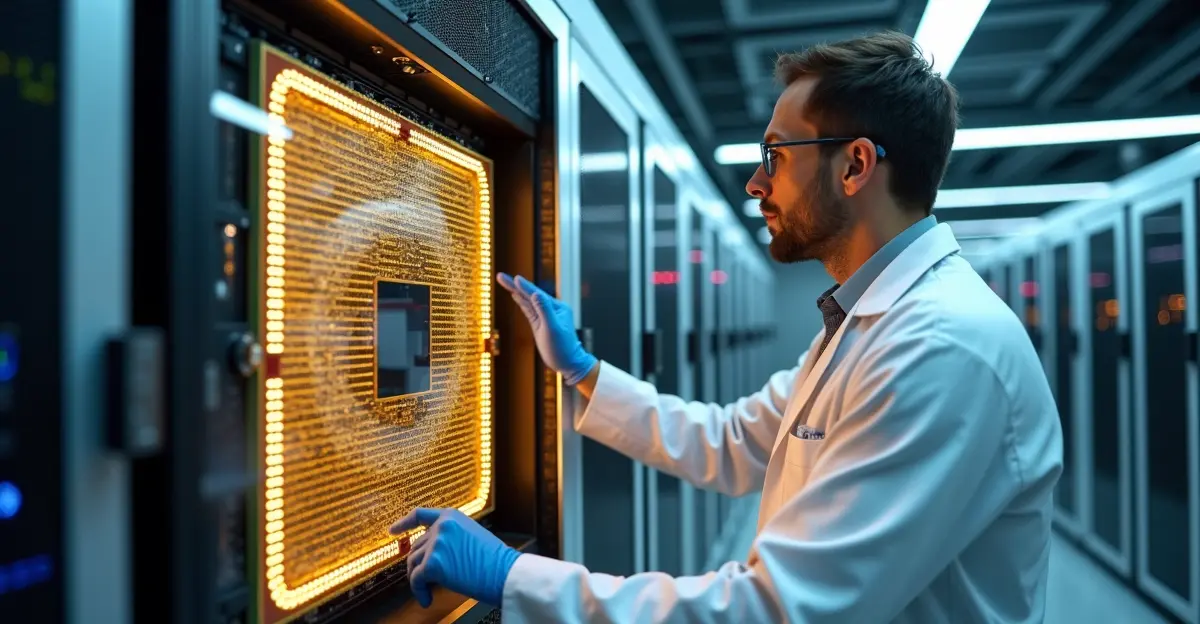
Quantum advantage, also known as quantum supremacy, refers to the point where a quantum computer can solve a problem that classical computers cannot solve within a reasonable timeframe. IBM has defined two specific criteria for this milestone: quantum separation (provable outperformance in efficiency, time, accuracy, or quality) and validation (rigorous verification of results). The company's Nighthawk processor, a 120-qubit chip with square lattice design capable of producing 30% more complex quantum circuits than previous models, is expected to be their flagship for achieving quantum advantage this year. This breakthrough follows quantum utility achieved in 2023 and targets fault-tolerant quantum computing with error correction by 2029.
The Geopolitical Quantum Race
The competition for quantum supremacy has become a central front in the US-China technological rivalry, with both nations investing tens of billions into quantum development. According to the U.S.-China Economic and Security Review Commission, while the U.S. maintains leadership in most quantum research through its distributed innovation ecosystem, China has deployed industrial-scale funding and centralized coordination to achieve dominance in quantum systems, particularly in quantum communications. China's state-directed approach focuses on national security goals with close integration between research labs, defense firms, and the military, while the U.S. strategy emphasizes private sector innovation and academic collaboration.
Export Controls and Technological Sovereignty
The 2026 quantum export controls implemented by the US, EU, and China have created strategic fractures in global technology collaboration, establishing parallel development paths. The US has adopted security-first restrictions covering quantum computers, equipment, and software, while the EU's Quantum Europe Strategy focuses on sovereignty through coordination across 27 member states with €5.91 billion in national funding commitments. China leads with massive $15 billion state investment in quantum communications, including the world's largest quantum communication network spanning 12,000 kilometers. This fragmentation raises critical questions about innovation acceleration versus security vulnerabilities, potentially creating incompatible quantum standards similar to the 5G technology divide.
The Cybersecurity Revolution
Perhaps the most immediate impact of quantum advantage lies in cybersecurity, where current encryption standards face existential threats. Three groundbreaking research papers published between May 2025 and March 2026 have dramatically accelerated the quantum computing threat timeline by reducing the resources needed to break modern encryption. Google Quantum AI's March 2026 paper demonstrated that elliptic curve cryptography protecting major cryptocurrencies could be broken with fewer than 500,000 qubits in minutes rather than days. This represents the most significant shift in quantum threat assessment since Shor's 1994 algorithm.
Financial Systems at Risk
The G7 Cyber Expert Group has released a cybersecurity roadmap to help the financial sector prepare for quantum computing threats. Quantum computers could potentially crack current cryptographic systems used to protect financial institutions' data and networks. The 'harvest now, decrypt later' threat model poses particular risks to financial systems and blockchain security, where encrypted data stolen today could be decrypted once quantum computers reach sufficient scale. The US Post-Quantum Cryptography regulatory framework includes the Quantum Computing Cybersecurity Preparedness Act requiring federal agency inventories and migration, with NSM-10 establishing a 2035 migration target for quantum-resistant systems.
Economic Disruption Across Industries
Quantum computing has reached a pivotal commercial viability point in 2026, transitioning from theoretical research to practical applications across industries. According to Deloitte's research, quantum computing could drive profound innovation across multiple sectors:
- Pharmaceuticals: Quantum computers can simulate molecular interactions at unprecedented scales, potentially accelerating drug discovery from years to months and reducing development costs by billions.
- Materials Science: Quantum simulations enable discovery of new materials for batteries, semiconductors, and superconductors, with potential breakthroughs in energy storage and transmission.
- Finance: Portfolio optimization, risk analysis, and trading algorithms could be revolutionized, with quantum algorithms potentially identifying market patterns invisible to classical systems.
- Logistics and Supply Chains: Complex optimization problems involving routing, scheduling, and resource allocation could be solved with quantum efficiency.
The Emerging Quantum Divide
UNESCO's Global Quantum Initiative (2026-2028) represents a comprehensive response to the emerging 'quantum divide' where over 150 countries lack national quantum strategies. With global quantum investments exceeding $55.7 billion, the initiative aims to advance inclusive quantum capacity and international cooperation. Research by A. Ayda Gercek and Zeki C. Seskir identifies four distinct quantum divides: scientific gaps among researchers, technological path-dependency, disparities between countries, and societal implications. This technological stratification risks creating new forms of dependency where nations without quantum capabilities become dependent on quantum-powered services from leading nations, similar to patterns observed during the digital transformation era.
Strategic Policy Responses Needed
The U.S. Government Accountability Office report GAO-26-107759, published March 18, 2026, finds that the national quantum computing strategy needs significant updates to ensure U.S. leadership. The federal government spends approximately $200 million annually on quantum computing activities, but the current strategy lacks key elements for effective coordination. Specifically, it fails to include performance measures to track progress, doesn't specify required resources and infrastructure, and doesn't clearly define federal agencies' specific roles and responsibilities.
Corporate Preparedness
For corporations, the quantum transition requires immediate strategic assessment. Organizations should begin quantum readiness assessments, invest in quantum talent development (the sector faces a projected 600,000-job shortage within a decade), and develop migration plans for quantum-resistant cryptography. The investment landscape shows structural transformation from research to industrialization, with SPAC mergers bringing quantum companies to public markets and creating new investment opportunities in the emerging technology sector.
Frequently Asked Questions
What exactly is quantum advantage?
Quantum advantage refers to the point where a quantum computer can solve a problem that classical computers cannot solve within a reasonable timeframe. IBM defines this through two criteria: quantum separation (provable outperformance) and validation (rigorous verification of results).
How soon will quantum computers break current encryption?
Recent research suggests the timeline has accelerated dramatically. Google Quantum AI's March 2026 paper showed elliptic curve cryptography could be broken with fewer than 500,000 qubits in minutes, moving quantum risk from a distant concern to an immediate priority for cybersecurity professionals.
Which industries will be most affected by quantum computing?
Pharmaceuticals, materials science, finance, and cybersecurity will experience the earliest and most profound impacts, followed by logistics, energy, and artificial intelligence as quantum computing matures.
What is the quantum divide?
The quantum divide refers to the growing gap between nations with quantum capabilities and those without, potentially creating new forms of technological dependency and inequality in the global technological landscape.
How should governments respond to quantum advancements?
Governments need updated national strategies with clear performance measures, resource allocation, agency responsibilities, and international cooperation frameworks to ensure security while fostering innovation.
Conclusion: Navigating the Quantum Future
The 2026 quantum advantage milestone represents a critical inflection point in technological history, comparable to the advent of classical computing or the internet. As IBM's Borja Peropadre noted at CES 2026, "We expect strong claims of quantum advantage to emerge this year, marking a potential inflection point in quantum computing." The convergence of geopolitical competition, cybersecurity threats, economic disruption, and technological stratification creates both unprecedented challenges and opportunities. Organizations and nations that begin strategic preparation today will be best positioned to navigate the quantum future, while those that delay risk being left behind in what may become the defining technological shift of the 21st century. The quantum era has arrived, and its implications will reshape our world in ways we are only beginning to comprehend.




Follow Discussion