


 Deutsch
 English
 Español
 Français
 Nederlands
 Português


 Share
Share




The Quantum Computing Inflection Point: How 2026's Hardware Milestones Reshape Global Security and Economic Competition
IBM experts predict 2026 will mark the year quantum computers first outperform classical computers for specific tasks, creating immediate pressure on global encryption standards and triggering strategic technology competition between major powers. This quantum advantage milestone represents a systemic shift comparable to the internet's emergence, with IBM targeting verified quantum advantage by 2026 using their new 120-qubit Nighthawk processor, followed by fault-tolerant quantum computing by 2029. The convergence of hardware breakthroughs, geopolitical tensions, and urgent cybersecurity needs is creating a perfect storm that will redefine global power dynamics across multiple domains.
What is Quantum Advantage and Why Does 2026 Matter?
Quantum advantage refers to quantum computers solving problems that classical computers cannot solve practically. Unlike classical bits that exist as 0 or 1, quantum bits (qubits) can exist in superposition states, enabling exponential computational power for specific applications. The 2026 milestone matters because it represents the first commercially relevant demonstration where quantum computers outperform classical systems on real-world problems, moving beyond laboratory curiosities to practical applications that could disrupt entire industries.
Geopolitical Implications: The New Digital Divide
The race for quantum supremacy has evolved into a full-scale geopolitical competition reminiscent of the space race. The United States implemented comprehensive quantum export controls in September 2024 through the Bureau of Industry and Security, restricting international transfer of quantum computing technologies, components, and technical knowledge. China has responded with massive $15 billion state investments and leads in quantum communications with a 12,000-kilometer network. Europe has unveiled an ambitious quantum sovereignty strategy aiming for leadership by 2030 with €50 million facilities and pilot quantum internet projects. This technological fragmentation creates parallel infrastructures that could hinder global scientific progress while creating security vulnerabilities through technological bifurcation.
The semiconductor export controls of recent years provide a cautionary tale for quantum technology restrictions. As nations implement protectionist policies, the global quantum market forecasted to exceed €155 billion by 2040 faces potential fragmentation that could slow innovation while increasing security risks through incompatible systems.
The Cybersecurity Revolution: Post-Quantum Cryptography Urgency
The most immediate threat from quantum computing advancement is to current cryptographic systems protecting financial transactions and national security communications. Quantum computers using Shor's algorithm can break widely used encryption standards like RSA and ECC, creating what security experts call 'harvest now, decrypt later' attacks where adversaries collect encrypted data today to decrypt later with quantum computers.
NIST's Post-Quantum Cryptography Standards
In response to this threat, the National Institute of Standards and Technology (NIST) has released three principal post-quantum cryptography (PQC) standards: FIPS 203 (ML-KEM) for key encapsulation, FIPS 204 (ML-DSA) for digital signatures, and FIPS 205 (SLH-DSA) for stateless hash-based signatures. Organizations are urged to begin migrating systems to these quantum-resistant algorithms now, with compliance deadlines including January 1, 2027 for new US National Security System acquisitions and full mandatory compliance by 2033.
The financial sector faces particular urgency, as quantum computers could potentially break the encryption protecting global banking transactions, stock trades, and digital currencies. Major financial institutions have begun pilot testing hybrid handshakes combining classical and PQC algorithms, with companies like Akamai beginning deployment of hybrid ML-KEM + X25519 key exchange in September 2025.
Economic Disruption Potential Across Industries
Beyond security threats, quantum computing offers revolutionary potential for accelerating innovation in three critical industries where the 2026 milestone could deliver breakthrough competitive advantages.
Pharmaceuticals and Drug Discovery
Quantum computing could enable exploration of the vast chemical space of approximately 10^60 potential drug molecules, far exceeding classical computational capabilities. By leveraging quantum advantages in molecular simulation through methods like Quantum Phase Estimation (QPE) and Variational Quantum Eigensolver (VQE), pharmaceutical companies could accelerate drug development timelines from years to potentially just a few years, reducing costs and improving success rates.
Materials Science Innovation
The ability to simulate quantum-mechanical interactions at the atomic level could enable design of novel superconductors, advanced batteries, and revolutionary materials with properties impossible to achieve through classical simulation alone. This has implications for energy storage, electronics, and manufacturing sectors where material breakthroughs could create trillion-dollar markets.
Financial Optimization
Quantum algorithms offer exponential speedups for complex optimization problems in portfolio management, risk analysis, and trading strategies. Financial institutions investing in quantum capabilities could gain significant advantages in market prediction, arbitrage opportunities, and algorithmic trading systems.
The artificial intelligence optimization techniques currently transforming finance will face quantum-enhanced competition as financial quantum computing matures beyond the 2026 milestone.
Semiconductor Industry Response and Supply Chain Implications
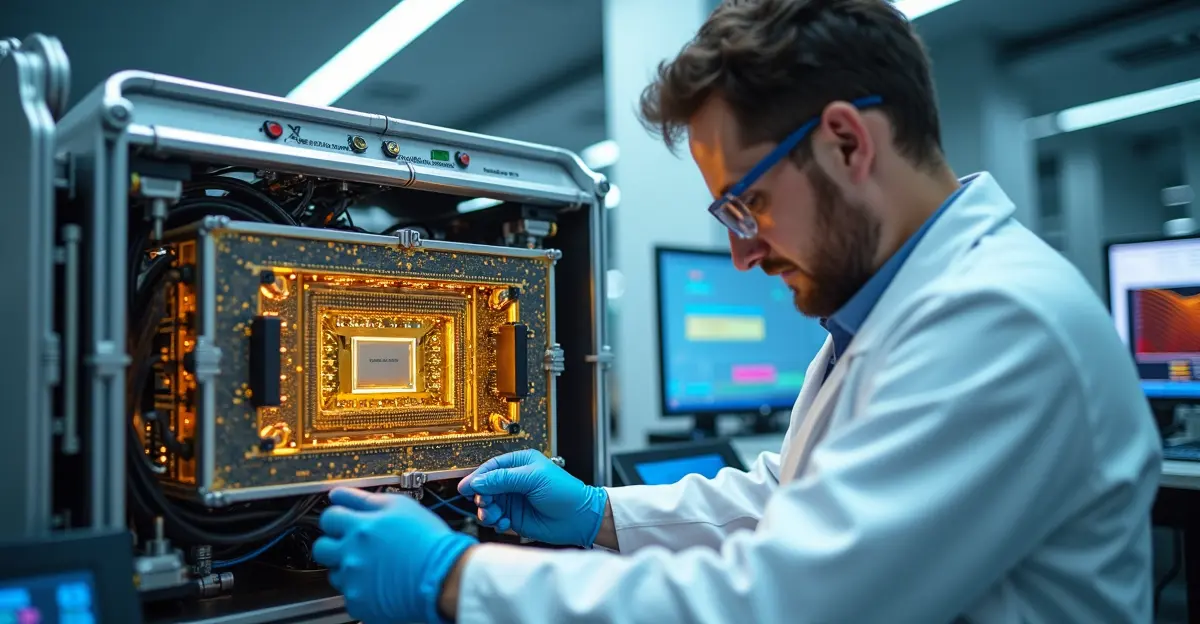
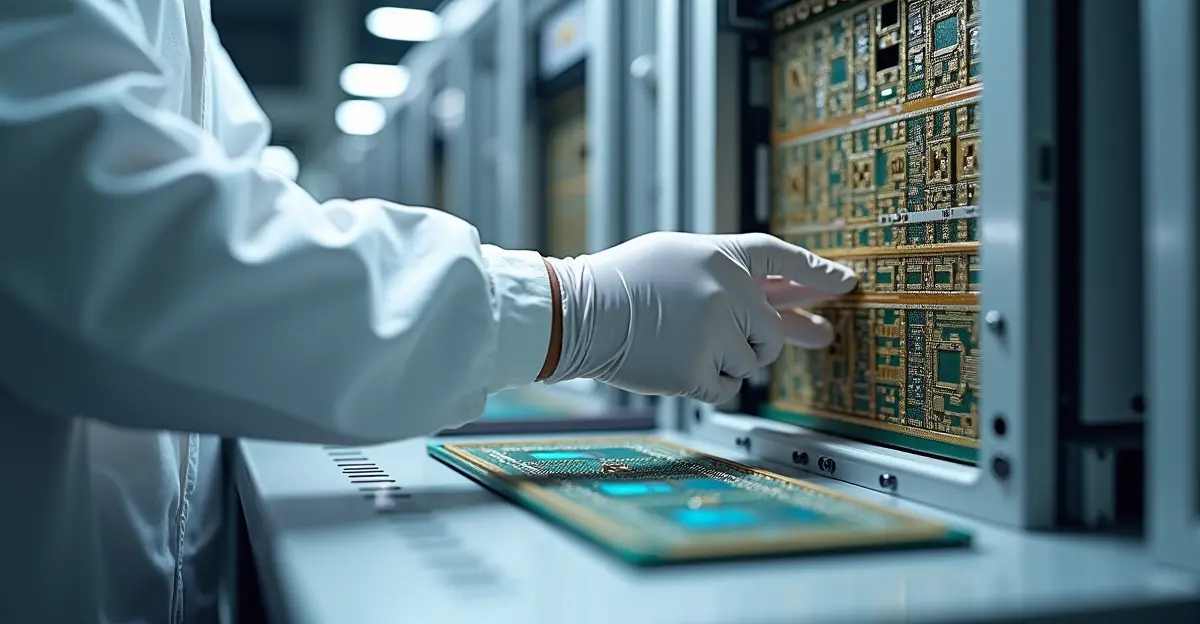
The quantum computing revolution is creating specialized hardware demands that are reshaping the semiconductor industry. The quantum hardware stack extends far beyond just the quantum processing unit (QPU) chip, requiring specialized components for different quantum platforms. For superconducting systems, this includes dilution refrigerators (dominated by Bluefors, Oxford Instruments, and Leiden Cryogenics), control electronics, cryogenic wiring, and amplifiers.
Cryogenics remains a significant bottleneck with systems costing $1-5 million and lead times of 6-12 months. Trapped-ion and neutral-atom systems require ultra-high vacuum chambers, precision laser systems, and high-performance imaging, while photonic quantum computers depend on single-photon sources, integrated photonic circuits, and superconducting nanowire detectors. This complex supply chain reveals hidden dependencies and identifies investment opportunities beyond QPU makers, showing where vertical integration is shaping the competitive landscape for the next decade.
Defense Technology Applications Reshaping Military Strategy
Quantum technologies are poised to revolutionize defense capabilities across multiple domains, with potential applications in cryptography, navigation, and intelligence gathering that could fundamentally alter military balance. Defense agencies worldwide are investing heavily, with the U.S. Department of Defense launching a National Quantum Initiative and China reportedly spending over $15 billion on quantum military applications.
Military Applications of Quantum Computing
- Cryptanalysis: Breaking adversary encryption while protecting own communications
- Secure Communications: Quantum key distribution for unbreakable encryption
- Navigation: Quantum sensing for GPS alternatives in contested environments
- Simulation: Advanced modeling of complex battlefield scenarios
- Intelligence Analysis: Pattern recognition in massive datasets
The cybersecurity defense strategies of major powers are being rewritten to account for quantum threats, with defense agencies like DARPA actively testing quantum prototypes and aiming for defense-ready systems by 2033. The technology race is compared to the Manhattan Project in strategic importance, with the first nation to operationalize quantum capabilities potentially gaining significant military and intelligence advantages.
Systemic Shift: Winners and Losers in the Quantum Era
The 2026 quantum advantage milestone represents more than just a technological breakthrough—it signals a systemic shift in global power dynamics. Winners in this new era will be determined by strategic investment, regulatory foresight, and the ability to integrate quantum capabilities across economic and security domains. Nations that successfully navigate the transition to post-quantum cryptography while developing quantum applications in key industries will gain significant competitive advantages.
The global technology competition framework is being rewritten as quantum capabilities become the new frontier of national power. As with previous technological revolutions, early leaders could establish enduring advantages that shape global economics and security for decades to come.
Frequently Asked Questions About Quantum Computing 2026
What is quantum advantage and when will it be achieved?
Quantum advantage refers to quantum computers solving problems that classical computers cannot solve practically. IBM predicts verified quantum advantage will be achieved by 2026 using their 120-qubit Nighthawk processor with 30% greater circuit complexity than previous systems.
Why is quantum computing a threat to current encryption?
Quantum computers using Shor's algorithm can break widely used encryption standards like RSA and ECC that protect financial transactions and national security communications. This creates 'harvest now, decrypt later' attacks where encrypted data collected today can be decrypted once quantum computers become available.
What industries will benefit most from quantum computing?
Pharmaceuticals (accelerating drug discovery), materials science (designing novel materials), and financial services (optimization problems) will see the most immediate benefits from quantum computing advancements post-2026.
How are governments responding to quantum threats?
Governments are implementing export controls (US Bureau of Industry and Security), investing in national quantum initiatives (China's $15 billion program), developing post-quantum cryptography standards (NIST's FIPS 203-205), and creating quantum sovereignty strategies (EU's 2030 leadership goals).
What is the timeline for post-quantum cryptography adoption?
NIST recommends beginning migration now, with compliance deadlines including January 1, 2027 for new US National Security System acquisitions and full mandatory compliance by 2033 for high-risk systems.




Follow Discussion