


 Deutsch
 English
 Español
 Français
 Nederlands
 Português


 Share
Share




The Quantum Computing Tipping Point: How 2026's Breakthroughs Are Reshaping Global Security and Economic Competition
In 2026, quantum computing has reached a critical milestone that experts have anticipated for decades: the first verified instances where quantum computers outperform classical supercomputers on practical, real-world problems. According to IBM's 2026 technology predictions, this year marks the tipping point where quantum advantage transitions from theoretical possibility to tangible reality, creating immediate strategic implications for global security, economic competition, and technological sovereignty. This breakthrough represents more than just a technical achievement—it signals the beginning of a new era in which quantum capabilities will fundamentally reshape international power dynamics and economic structures.
What is Quantum Computing and Why Does 2026 Matter?
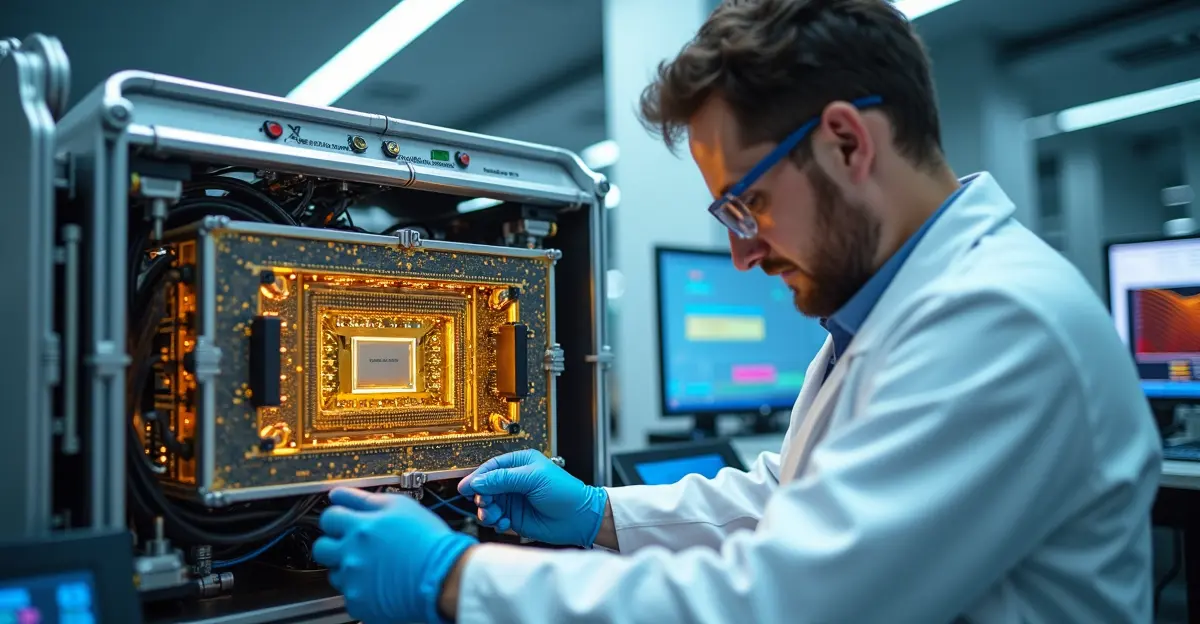
Quantum computing represents a fundamentally different approach to processing information compared to classical computing. While classical computers use bits that exist as either 0 or 1, quantum computers use qubits that can exist in multiple states simultaneously through quantum superposition and entanglement. This allows quantum computers to perform certain calculations exponentially faster than even the most powerful classical supercomputers. The 2026 milestone is significant because it marks the first time quantum computers have demonstrated practical superiority on commercially relevant problems, moving beyond artificial benchmarks to applications with real economic and security implications. IBM's 120-qubit Nighthawk processor, launched in December 2025, has been central to achieving this breakthrough, capable of running 5,000 quantum gates with plans to reach 7,500 by year's end.
The Geopolitical Implications of Quantum Supremacy
The race for quantum supremacy has become a central front in global competition, with nations investing over $55.7 billion in quantum research and development. The United States follows a private-sector-driven approach through the National Quantum Initiative Act, while China pursues centralized state-led development with over $15 billion in investments. The European Union focuses on collaborative research through its Quantum Flagship program, and other key players including the UK, India, and Russia have developed distinct national strategies. This technological competition mirrors the semiconductor geopolitics of previous decades but with potentially greater strategic consequences. The first nation to achieve sustained quantum advantage will gain disproportionate benefits in encryption-breaking capabilities, materials science, energy production, medical research, and intelligence collection.
The US-China Quantum Competition Intensifies
According to the U.S.-China Economic and Security Review Commission, while America leads in most quantum research areas, China has deployed industrial-scale funding and centralized coordination to achieve dominance in quantum systems. China currently leads the world in quantum communications and is making rapid progress in quantum computing and sensing. The competition has taken on characteristics of a new arms race, with both nations recognizing that quantum leadership could determine future economic dominance and military superiority. The artificial intelligence regulation debates of recent years provide important context for understanding how nations are approaching quantum governance, with similar tensions emerging between innovation promotion and risk management.
The Urgent Need for Quantum-Resistant Cryptography
The most immediate security threat posed by quantum computing involves current encryption standards that protect sensitive communications worldwide. Quantum computers threaten to break widely-used public-key cryptography as early as 2030, compromising digital communications security across government, military, and commercial sectors. In response, the National Institute of Standards and Technology (NIST) has released its first three finalized post-quantum encryption standards in August 2024, designed to protect electronic information against future quantum computer attacks. These standards—ML-KEM (FIPS 203) for key exchange, ML-DSA (FIPS 204) for digital signatures, and SLH-DSA (FIPS 205) as a hash-based backup—are ready for immediate implementation.
The 'Harvest Now, Decrypt Later' Threat
Security experts warn of the 'harvest now, decrypt later' threat, where adversaries are already collecting encrypted data for future quantum decryption. This means sensitive information transmitted today could become vulnerable once sufficiently powerful quantum computers emerge. Organizations must begin transitioning to quantum-resistant cryptography immediately, with compliance deadlines starting January 1, 2027 for U.S. National Security Systems. The migration represents one of the most significant cybersecurity challenges of the decade, requiring coordinated efforts across government agencies, private companies, and international partners.
Dual-Use Applications: Commercial and Security Implications
Quantum technologies exhibit dual-use characteristics with both civilian and military applications, creating complex governance challenges. On the commercial side, quantum computing promises revolutionary advances in drug discovery, materials science, financial optimization, and artificial intelligence. IBM's quantum-centric supercomputing reference architecture, unveiled in March 2026, enables quantum processors to work alongside classical CPUs and GPUs across on-premises systems, research centers, and cloud environments. This hybrid approach is already delivering results in creating novel molecules, simulating large proteins, and modeling quantum systems.
Military and Intelligence Applications
Simultaneously, quantum technologies offer significant military advantages including enhanced sensing capabilities, improved navigation systems, and potential breakthroughs in weapons development. Quantum sensing technologies provide benefits for monitoring critical infrastructure and remote environments, while quantum communication offers enhanced security through quantum key distribution that detects tampering attempts. The intersection of quantum computing with cybersecurity threats creates unprecedented challenges for national security planners, requiring new approaches to defense and intelligence gathering.
Economic Competition and Technological Sovereignty
The quantum breakthrough is accelerating strategic competition in technology supply chains and intellectual property development. Nations recognize that quantum leadership will determine their ability to set global standards and capture economic value in the emerging quantum era. The European Union's approach to digital sovereignty initiatives provides a model for how regions might seek to maintain technological independence in the quantum domain. Countries are positioning themselves not just as consumers of quantum technology but as architects of the quantum ecosystem, investing in education, infrastructure, and regulatory frameworks to support domestic quantum industries.
Expert Perspectives on the Quantum Transition
Industry leaders emphasize the practical nature of the 2026 breakthrough. 'This isn't about theoretical supremacy but verified quantum advantage—quantum computers solving real-world problems faster, cheaper, or better than traditional supercomputers,' explains an IBM quantum researcher. Security experts warn about the urgency of the cryptographic transition: 'The window for migrating to quantum-resistant encryption is closing rapidly. Organizations that delay risk exposing sensitive data to future quantum attacks.' Geopolitical analysts note the strategic implications: 'Quantum computing represents a paradigm shift with critical implications for national security, economic competitiveness, and technological sovereignty. The first country to achieve sustained advantage will gain disproportionate benefits across multiple domains.'
FAQ: Quantum Computing in 2026
What is quantum advantage versus quantum supremacy?
Quantum supremacy refers to a quantum computer performing a calculation that's impossible for classical computers, while quantum advantage means quantum computers solve practical problems faster, cheaper, or better than classical systems. The 2026 milestone focuses on verified quantum advantage for real-world applications.
How soon will quantum computers break current encryption?
Experts estimate quantum computers could break widely-used public-key cryptography as early as 2030, which is why organizations must begin transitioning to quantum-resistant encryption standards now to protect against 'harvest now, decrypt later' attacks.
Which countries lead in quantum computing development?
The United States leads in quantum research, China leads in quantum communications and has made rapid progress in computing, while the European Union focuses on collaborative research through its Quantum Flagship program. Other key players include the UK, India, and Russia.
What are the main commercial applications of quantum computing?
Key applications include drug discovery and development, materials science research, financial optimization and risk analysis, artificial intelligence enhancement, and complex system simulation across various industries.
How should organizations prepare for quantum computing threats?
Organizations should begin transitioning to NIST-approved post-quantum cryptography standards, assess current security infrastructure vulnerabilities, develop quantum migration strategies, and stay informed about quantum technology developments and regulatory requirements.
Conclusion: Navigating the Quantum Future
The 2026 quantum computing breakthrough represents a watershed moment in technological history, marking the transition from laboratory research to real-world utility with profound implications for global security and economic competition. As nations position themselves in this new technological frontier, the dual-use nature of quantum technologies creates both unprecedented opportunities and complex governance challenges. The race for quantum advantage has become a central component of strategic competition between major powers, with implications that extend far beyond computing to encompass national security, economic competitiveness, and technological sovereignty. Successfully navigating this transition will require coordinated international cooperation, robust risk management frameworks, and proactive adaptation to the emerging quantum era.




Follow Discussion