


 Deutsch
 English
 Español
 Français
 Nederlands
 Português


 Share
Share




U.S. Outbound Investment Regulations: Strategic Implications for Global Tech Competition
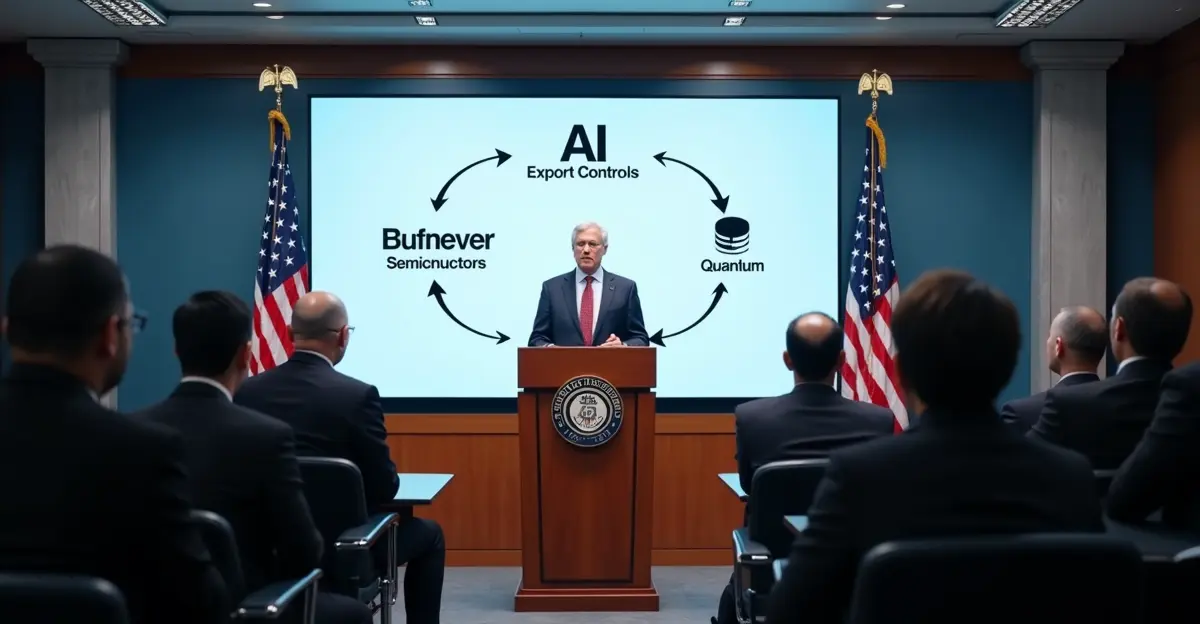
The U.S. Treasury Department's outbound investment regulations, which officially take effect on January 2, 2025, represent a watershed moment in global technology competition. These rules prohibit or require notification for U.S. investments in Chinese quantum computing, semiconductor, and artificial intelligence technologies, fundamentally reshaping capital flows and innovation ecosystems in critical national security sectors. As the regulations become enforceable, global technology firms and investors face immediate compliance requirements while navigating the accelerating technological decoupling between the world's two largest economies.
What Are the U.S. Outbound Investment Regulations?
The Outbound Investment Security Program, established by Executive Order on August 9, 2023, creates a new regulatory framework targeting U.S. investments in sensitive technologies within designated countries of concern. The program specifically focuses on three critical technology areas: semiconductors and microelectronics, quantum information technologies, and artificial intelligence systems. The People's Republic of China, including Hong Kong and Macau, is currently the sole designated country of concern under these regulations. The final rules, issued on October 28, 2024, establish two categories of transactions: prohibited investments that are completely banned, and notifiable transactions requiring disclosure to the Treasury Department through the Outbound Notification System.
Key Provisions and Compliance Requirements
The regulations impose significant obligations on U.S. persons, including citizens, permanent residents, and entities organized under U.S. law. According to Treasury guidance, compliance requires:
- Prohibited Transactions: Complete bans on U.S. investments in Chinese entities developing advanced semiconductors, quantum computers, and certain AI systems with military applications
- Notification Requirements: Mandatory disclosures for investments in less sensitive but still critical technology areas
- Due Diligence Standards: Reasonable investigation requirements to identify covered transactions
- Controlled Foreign Entity Compliance: U.S. persons must ensure their foreign subsidiaries also comply with restrictions
Non-compliance carries severe penalties similar to OFAC sanctions violations, including substantial fines and potential criminal liability. The International Emergency Economic Powers Act provides enforcement authority, with Treasury empowered to investigate violations and impose penalties.
Impact on Global Technology Supply Chains
Semiconductor Sector Disruption
The semiconductor industry faces immediate disruption from these regulations. A November 2025 ITIF report warns that in a full decoupling scenario, U.S. firms could lose approximately $77 billion in semiconductor sales in the first year alone. This revenue loss would reduce U.S. semiconductor R&D investments by about 24% ($14 billion) compared to current levels. The report projects significant job losses, with over 80,000 fewer U.S. semiconductor industry jobs and nearly 500,000 fewer downstream positions. These restrictions are accelerating a global reconfiguration of the semiconductor industry, forcing companies to diversify supply chains away from China toward Southeast Asia, Europe, and other regions.
Quantum and AI Innovation Ecosystems
The regulations create particularly complex challenges for quantum computing and artificial intelligence development. Quantum information technologies, which have seen rapid advancement in recent years, now face restricted capital flows between the U.S. and China. Similarly, AI systems with potential military or surveillance applications are subject to strict investment prohibitions. This fragmentation threatens to create parallel innovation ecosystems, potentially slowing global progress in these critical fields while increasing security risks through reduced international collaboration.
Third-Country Implications and Strategic Realignment
The U.S.-China technology competition is forcing third-party countries to make strategic choices between competing technology ecosystems. According to analysis from Modern Diplomacy, this 'New Fragmentation' could reduce global GDP by up to 7% according to IMF estimates. Countries like South Korea, Taiwan, Japan, and European nations are positioned to benefit from redirected investment flows, but also face pressure to align with either U.S. or Chinese technology standards. The regulations create opportunities for emerging tech hubs in Southeast Asia and India, while complicating existing global supply chain partnerships.
Corporate Compliance Challenges
Global technology firms face unprecedented compliance complexity under the new regime. Key challenges include:
- Due Diligence Complexity: Identifying whether potential investments involve covered technologies requires sophisticated technical analysis
- Notification Timing: Understanding when and how to submit required notifications through Treasury's system
- Foreign Subsidiary Management: Ensuring controlled foreign entities comply with U.S. restrictions
- Risk Assessment: Evaluating whether transactions qualify for national interest exemptions
Legal experts warn that the regulations create a 'compliance minefield' for multinational corporations operating in the targeted technology sectors. The rules apply not only to direct investments but also to indirect support through licensing agreements, joint ventures, and other collaborative arrangements.
Long-Term Strategic Implications
Accelerated Technological Decoupling
The regulations represent a significant acceleration in U.S.-China technological decoupling. By restricting capital flows in critical sectors, the rules reinforce the division of global technology ecosystems into competing blocs. This fragmentation threatens to reduce innovation efficiency through duplicated research efforts and restricted knowledge sharing. However, proponents argue that decoupling is necessary to protect national security and prevent sensitive technologies from enhancing Chinese military capabilities.
Innovation Ecosystem Reshaping
Both U.S. and Chinese innovation ecosystems will undergo fundamental reshaping. Chinese technology companies may face reduced access to U.S. capital and expertise, potentially slowing advancement in targeted sectors. Conversely, U.S. firms may lose access to Chinese manufacturing capabilities and market opportunities. The regulations could spur increased domestic investment in both countries, potentially leading to parallel but separate technological development paths. This dynamic mirrors broader trends in geopolitical realignment affecting multiple sectors beyond technology.
Expert Perspectives on the Regulatory Shift
Industry analysts offer mixed assessments of the regulations' impact. 'These rules represent the most significant expansion of U.S. economic security policy in decades,' notes a technology policy analyst at a major Washington think tank. 'While necessary for national security, they create substantial compliance burdens and market uncertainty at a time when global technology collaboration is more important than ever.'
Chinese technology executives express concern about the long-term implications. 'Restricting capital flows in critical technologies threatens to fragment global innovation ecosystems,' states the CEO of a Shanghai-based semiconductor firm. 'We risk creating parallel technology standards that increase costs and reduce interoperability for everyone.'
Frequently Asked Questions
What technologies are covered by the outbound investment regulations?
The regulations cover three specific technology areas: semiconductors and microelectronics, quantum information technologies, and artificial intelligence systems with potential military or surveillance applications.
When do the regulations take effect?
The final rules become enforceable on January 2, 2025, with compliance requirements applying to transactions occurring on or after that date.
Who must comply with these regulations?
U.S. persons including citizens, permanent residents, and entities organized under U.S. law must comply, along with their controlled foreign entities.
What are the penalties for non-compliance?
Violations can result in severe penalties similar to OFAC sanctions violations, including substantial fines and potential criminal liability under the International Emergency Economic Powers Act.
How do these regulations affect third-country investments?
The rules primarily target China but create compliance challenges for global firms with complex international operations, potentially redirecting investment flows to other regions.
Conclusion and Future Outlook
The January 2, 2025 implementation of U.S. outbound investment regulations marks a pivotal moment in global technology competition. These rules will reshape capital flows, innovation patterns, and corporate strategies in critical technology sectors for years to come. While designed to protect national security, they risk accelerating technological fragmentation and reducing global innovation efficiency. As companies navigate the new compliance landscape, the long-term implications for U.S.-China relations, third-country positioning, and global technological progress remain uncertain. The regulations represent not just a policy shift but a fundamental rethinking of how technology competition intersects with national security in an increasingly divided world.





Follow Discussion