


 Deutsch
 English
 Español
 Français
 Nederlands
 Português


 Share
Share




The 2026 Quantum Computing Milestone: Strategic Implications for National Security and Global Tech Leadership
IBM's bold prediction that 2026 will mark the first time quantum computers outperform classical computers for specific practical tasks represents a watershed moment in technological history with profound implications for global power dynamics. This quantum advantage milestone, distinct from earlier demonstrations of quantum supremacy on theoretical problems, signals the beginning of quantum computing's transition from laboratory curiosity to real-world utility in critical domains including cryptography, drug discovery, materials science, and financial optimization. As nations and corporations position themselves for this breakthrough, the emerging quantum technology race is reshaping international relations and creating new security vulnerabilities that demand urgent attention.
What is Quantum Advantage and Why Does 2026 Matter?
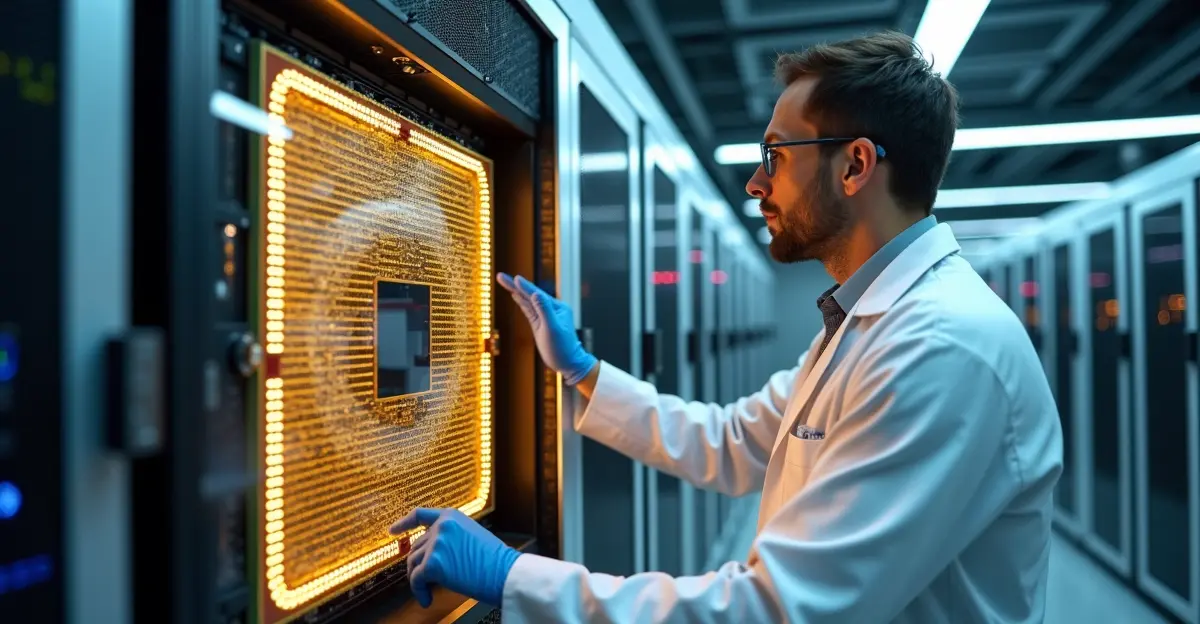
Quantum advantage, sometimes called quantum supremacy, occurs when a quantum computer solves a problem faster, cheaper, or more accurately than the best classical supercomputer. Unlike previous demonstrations focused on specialized academic problems, IBM's 2026 timeline targets practical applications with real-world impact. The company's confidence stems from its Nighthawk processor launched in December 2025, featuring 120 qubits capable of running 5,000 quantum gates, with plans to reach 7,500 gates by 2026. This hardware advancement, combined with 10x improvements in quantum error correction decoding achieved ahead of schedule, creates the foundation for solving genuine business and scientific challenges.
The Geopolitical Quantum Race: US, China, and Global Competition
The competition for quantum leadership has become a central front in the Great Power Competition, with nations investing over $55.7 billion in quantum research and development. According to a U.S.-China Economic and Security Review Commission report, while America leads in most quantum research, China has deployed industrial-scale funding and centralized coordination to seize dominance in quantum systems. China currently leads the world in quantum communications and is making rapid progress in quantum computing and sensing.
National Security Implications: The Encryption Crisis
The most immediate threat from quantum computing involves current encryption standards that protect sensitive government, financial, and military communications worldwide. "Quantum computers could potentially break encryption that currently safeguards everything from bank transactions to military secrets," warns a Forbes Tech Council analysis. This vulnerability has prompted urgent calls for developing quantum-resistant cryptography and establishing new security protocols. The cybersecurity implications are staggering, with Citi Institute reports describing a "trillion-dollar security race" to address these emerging threats.
Economic Transformation: Four Key Application Areas
- Drug Discovery: Quantum computers can explore the vast chemical space of approximately 10^60 potential drug molecules, potentially reducing the typical decade-long, billion-dollar drug development timeline.
- Materials Science: Quantum simulations enable precise modeling of molecular interactions, accelerating development of new materials for energy, electronics, and manufacturing.
- Financial Optimization: Quantum algorithms can solve complex optimization problems in portfolio management, risk assessment, and trading strategies with unprecedented efficiency.
- Artificial Intelligence: Quantum-enhanced machine learning could revolutionize pattern recognition and data analysis across multiple industries.
The Emerging Quantum Divide: Global Implications
UNESCO's Global Quantum Initiative (2026-2028) represents a comprehensive response to the emerging 'quantum divide' where over 150 countries lack national quantum strategies and Global South participation remains limited. As noted in research published on arXiv, this divide manifests across four dimensions: scientific access inequalities, technological path-dependency, international adoption gaps, and societal implications. The technology sovereignty concerns are particularly acute, with nations risking dependency on foreign quantum infrastructure for critical applications.
Corporate Positioning: Who Leads the Quantum Revolution?
Beyond IBM, several corporations are positioning themselves for the quantum era. Quantum technology companies are racing to go public despite volatile markets, with firms like Xanadu Quantum and Horizon Quantum recently listing through SPAC mergers. The industry is experiencing an inflection point with improved quantum error correction, higher qubit counts, and longer coherence times achieved in 2024-2025. Analysts expect practical quantum advantage around 2028-2029 with 100 logical qubits, while commercially impactful applications requiring 1,000-10,000 logical qubits are projected for the mid-2030s.
Intersection with AI and Semiconductor Geopolitics
The quantum computing breakthrough intersects with two other critical technological frontiers: artificial intelligence advancement and semiconductor geopolitics. Quantum-enhanced AI could accelerate machine learning algorithms exponentially, while the semiconductor supply chain tensions directly impact quantum hardware development. The convergence of these technologies creates both unprecedented opportunities and complex challenges for global governance and economic competition.
Expert Perspectives and Strategic Recommendations
Defense technology reports highlight quantum technologies as one of five critical frontiers for national security innovation in 2026. The U.S.-China Economic and Security Review Commission recommends Congress recognize quantum as a mission-essential national asset and mobilize resources accordingly. Similarly, India's NITI Aayog has published comprehensive analyses examining how quantum technologies could impact strategic preparedness, emphasizing both opportunities and threats.
FAQ: Quantum Computing 2026 Milestone
What exactly will quantum computers achieve in 2026?
IBM predicts quantum computers will solve practical, real-world problems faster than classical computers for the first time, moving beyond theoretical demonstrations to applications in drug discovery, materials science, and optimization.
How will quantum computing affect current encryption?
Quantum computers could break widely used encryption standards, threatening financial, government, and military communications security, prompting urgent development of quantum-resistant cryptography.
Which countries lead in quantum computing development?
The United States leads in research, China leads in quantum communications and has centralized funding, while the European Union focuses on collaborative research through its Quantum Flagship program.
What is the "quantum divide"?
The growing gap between nations with quantum capabilities and those without, with over 150 countries lacking national quantum strategies, creating risks of technological dependency and inequality.
How does quantum computing intersect with AI?
Quantum-enhanced AI could revolutionize machine learning through exponential acceleration of algorithms, creating powerful synergies between these transformative technologies.
Conclusion: Navigating the Quantum Future
The 2026 quantum computing milestone represents more than a technological achievement—it signals a fundamental shift in global power dynamics. As nations and corporations position themselves for this breakthrough, the strategic implications extend across national security, economic competitiveness, and technological sovereignty. The emerging technology governance challenges require international cooperation to ensure quantum advancements benefit humanity while mitigating risks. With UNESCO's Global Quantum Initiative aiming to train 1,000+ quantum professionals and engage 70+ Member States, the race is on to bridge the quantum divide before it becomes an unbridgeable chasm in the global technological landscape.
Sources
IBM Quantum Developer Conference announcements (2025), U.S.-China Economic and Security Review Commission reports, UNESCO Global Quantum Initiative documentation, Forbes Tech Council analysis, Citi Institute quantum threat assessment, NITI Aayog frontier technology insights, Nature npj Drug Discovery research, and academic publications on quantum computing applications and societal impacts.




Follow Discussion