


 Deutsch
 English
 Español
 Français
 Nederlands
 Português


 Share
Share




Semiconductor Sovereignty Race: How Export Controls Accelerate China's Tech Decoupling
The U.S. Commerce Department's recent strengthening of export controls on advanced semiconductors to China has created a paradoxical effect: rather than stifling Chinese technological advancement, these restrictions are accelerating Beijing's push for technological self-sufficiency, creating a critical inflection point in the global technology competition. As Chinese companies like Huawei and SMIC demonstrate significant progress in developing domestic alternatives despite restrictions, the world is witnessing the emergence of a bifurcated global tech ecosystem with profound implications for supply chains, AI development, and geopolitical power dynamics.
What is the Semiconductor Sovereignty Race?
The semiconductor sovereignty race refers to the strategic competition between nations to achieve technological independence in chip manufacturing and design. This competition has intensified dramatically since the U.S. implemented new export controls on advanced computing and semiconductor manufacturing items to China in October 2022. These controls, which expanded restrictions on items destined for supercomputers or semiconductor development in China, were designed to address national security concerns but have inadvertently triggered a massive push for domestic innovation within China's tech sector.
The Paradox of Export Controls
Recent analysis from the Center for Strategic and International Studies (CSIS) reveals that while U.S. export restrictions have disrupted China's semiconductor ecosystem and caused price spikes, they have also prompted China to launch an all-out government-backed effort to achieve chip self-sufficiency. According to the CSIS report, "China has responded with significant achievements including Huawei developing advanced semiconductors and SMIC producing 5G-capable chips." This counterintuitive outcome demonstrates how restrictive measures can sometimes accelerate the very developments they aim to prevent.
Huawei's and SMIC's Breakthrough Achievements
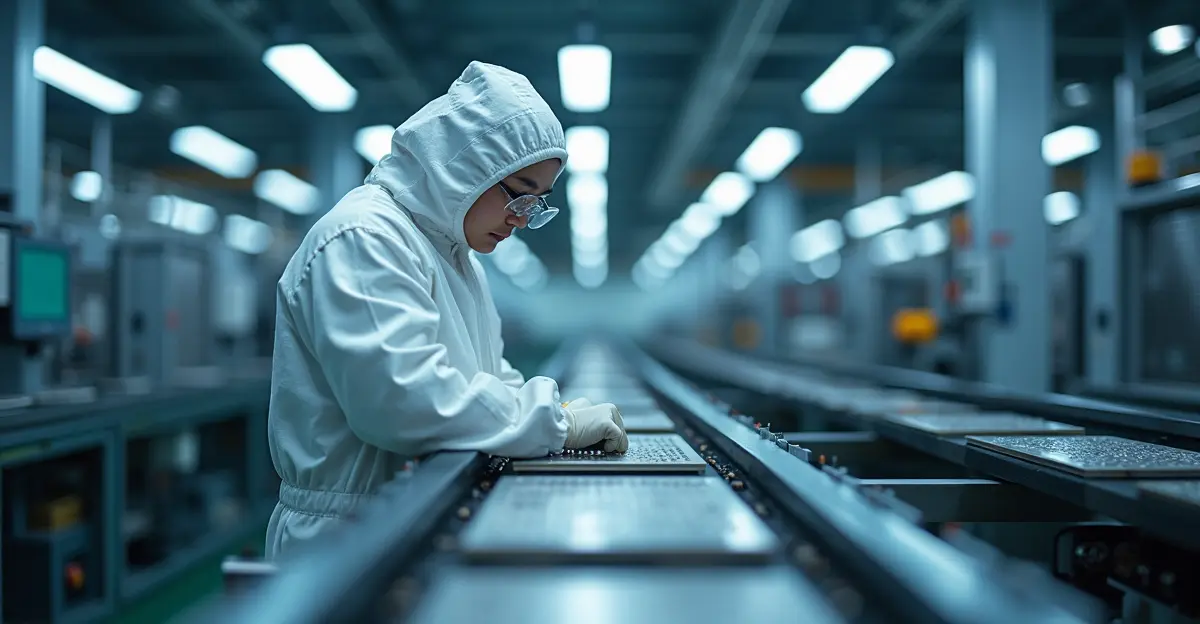
The Huawei Mate 60 Pro smartphone represents a watershed moment in China's semiconductor progress. TechInsights analysis confirmed that the device contains a Kirin 9000s processor manufactured using SMIC's 7nm (N+2) process technology. This achievement is particularly significant because it demonstrates advanced chip manufacturing capabilities without access to EUV lithography tools, which remain restricted under U.S. export controls. The chip features a die measuring 107 mm² and represents SMIC's advancement beyond its previous 14nm node, marking a made-in-China design and manufacturing breakthrough.
Huawei is emerging as the leader of China's national semiconductor team, quietly dominating the country's chip manufacturing supply chain while transforming from a telecommunications champion to a comprehensive supply chain integrator. According to a MERICS report, "Huawei operates discreetly, often hiding its involvement under different company names, making it difficult for Western entities to assess China's technological progress." This clandestine approach complicates Western de-risking strategies and makes it harder to ensure technology isn't diverted to military applications.
China's Strategic Response and Investment
China has invested over $50 billion through its 'Big Fund' to support semiconductor self-sufficiency, with the country aiming to triple domestic production capacity and achieve 20% of global semiconductor output according to Bain & Company's 2025 Technology Report. The strategy focuses on the entire supply chain, with particular emphasis on overcoming critical challenges in upstream segments: EDA software (dominated by US/German firms), semiconductor materials like photoresists (controlled by Japanese companies), and core equipment including lithography machines (monopolized by ASML).
Rather than direct confrontation with global leaders, China is pursuing "asymmetric" advantages through targeted breakthroughs in key areas while leveraging its vast domestic market. Domestic companies are making progress in areas like 12-inch silicon wafers and mid-range photoresists, but face significant hurdles in advanced nodes and high-end materials. The 2025 goal involves achieving higher domestic coverage in mature process nodes while advancing toward more advanced technologies through concentrated resource allocation and strategic market positioning.
The Emergence of Parallel Technology Ecosystems
AI Development Divergence
The AI landscape is experiencing a significant bifurcation between China and the global market, driven by geopolitical tensions and export controls. China is rapidly developing its own AI ecosystem through companies like Huawei, whose Ascend 910C chips offer about 60% of Nvidia's H100 inference performance but are gaining domestic adoption. Meanwhile, the global market continues to rely on Nvidia's dominant GPUs like the H100 and upcoming Blackwell architecture. This divergence extends beyond hardware to software ecosystems, data governance, and supply chain strategies.
Sovereign AI has evolved from theory to geopolitical imperative, with nations pursuing domestic AI systems trained on local data to ensure data security, regulatory alignment, and reduced foreign dependence. The US leads in high-performance chips and foundation models, while China advances through initiatives like DeepSeek-R1 and Huawei's Ascend 910C chip. Global efforts include the EU's €200 billion InvestAI initiative and Saudi Arabia's Humain project building massive domestic data centers.
Supply Chain Reshaping
The technological decoupling is fundamentally reshaping global supply chains, creating parallel systems that operate with limited interoperability. Companies must navigate this complex landscape by making strategic decisions with optionality, moving boldly where confidence is high while maintaining flexibility amid uncertainty. The resulting parallel technology ecosystems could lead to increased costs for multinational companies, shifting competitive dynamics, and the potential emergence of separate U.S.-led and China-led digital spheres.
According to industry analysts, the global chip shortage has been exacerbated by these geopolitical tensions, creating additional pressure on supply chains already strained by pandemic-related disruptions. The EU's semiconductor strategy represents another major player in this complex landscape, with European nations seeking to reduce their own dependencies while navigating the U.S.-China competition.
Long-Term Geopolitical Implications
The creation of parallel technology standards and separate digital spheres has profound implications for global power dynamics. As China accelerates its AI independence drive, it poses a direct challenge to the United States' longstanding position as the world's leading AI power, potentially altering the balance of technological influence in the coming years. This competition extends beyond technological advancement to encompass geopolitical influence, economic competitiveness, and national security considerations.
The fundamental challenge for policymakers is whether U.S. strategy aims to slow China's progress, compete alongside it, or ensure U.S. resilience. Current policy gestures toward multiple objectives without fully committing to any clear strategy, creating uncertainty for businesses and allies. Export controls have become more conditional and administratively complex rather than clear prohibitions, reflecting the tension between the White House's pragmatic approach and Congress's more hawkish stance.
Experts in international trade policy warn that the current trajectory could lead to a fragmented global technology landscape with limited interoperability between systems. The digital sovereignty movement is gaining momentum worldwide, with nations increasingly prioritizing control over their technological infrastructure and data flows.
Expert Perspectives and Future Outlook
Industry analysts note that while China has made impressive progress in semiconductor manufacturing, significant challenges remain. The U.S. export bans on advanced chip-making equipment, particularly EUV lithography machines, have widened the technology gap in some areas, forcing China to intensify domestic R&D. While Chinese companies have achieved breakthroughs with 7nm chips, scaling to 3nm and 2nm nodes remains elusive without access to cutting-edge foreign equipment.
However, China's subsidized development efforts could potentially produce breakthrough technologies that leapfrog current capabilities. The country's approach combines government-led industrial policy with private sector innovation, creating a formidable ecosystem that could reshape global technology leadership. As one analyst noted, "China's push for technological self-sufficiency aims to reduce vulnerabilities to foreign sanctions, while Western firms maintain performance advantages for now."
Frequently Asked Questions
What are the U.S. semiconductor export controls to China?
The U.S. implemented new export controls in October 2022 targeting China's ability to access and develop advanced computing and semiconductor manufacturing items. These controls restrict exports of certain advanced chips, semiconductor manufacturing equipment, and related technologies to China, with licenses for facilities owned by Chinese entities facing a "presumption of denial."
How has China responded to semiconductor restrictions?
China has launched a massive government-backed effort to achieve semiconductor self-sufficiency, investing over $50 billion through its 'Big Fund' and making significant progress in domestic chip manufacturing. Companies like Huawei and SMIC have developed advanced 7nm chips despite restrictions, demonstrating China's growing technological capabilities.
What is technological decoupling?
Technological decoupling refers to the separation of technology ecosystems between nations, particularly between the U.S. and China. This involves the development of parallel technology standards, separate supply chains, and limited interoperability between systems, potentially leading to distinct U.S.-led and China-led digital spheres.
How is AI development affected by semiconductor restrictions?
The AI landscape is bifurcating between China and global markets, with China developing its own AI ecosystem using domestic chips like Huawei's Ascend 910C while the global market relies on Nvidia's GPUs. This divergence affects hardware, software, data governance, and could lead to limited interoperability between AI systems.
What are the long-term implications of technological bifurcation?
Long-term implications include increased costs for multinational companies, shifting competitive dynamics, potential security risks from incompatible systems, and the emergence of separate technology standards that could fragment the global digital economy and reshape geopolitical power dynamics.




Follow Discussion