


 Deutsch
 English
 Español
 Français
 Nederlands
 Português


 Share
Share




The Semiconductor Decoupling Dilemma: How Export Controls Are Reshaping Global Tech Power Dynamics
The global semiconductor industry is undergoing a profound transformation as U.S. export controls on advanced chip technology to China create a bifurcated technological ecosystem with far-reaching economic and geopolitical consequences. Recent analysis from the Information Technology and Innovation Foundation (ITIF) reveals that American semiconductor firms face projected losses of $77 billion in sales in a full decoupling scenario, while China accelerates its domestic self-reliance efforts, raising urgent questions about the long-term strategic wisdom of current policies. This technological decoupling represents what industry analysts now call a "Silicon Curtain" descending between the world's two largest economies, fundamentally reshaping global supply chains, innovation patterns, and strategic alliances in the critical semiconductor sector.
What Are Semiconductor Export Controls?
Semiconductor export controls are regulatory measures implemented by the United States government to restrict China's access to advanced computing chips and manufacturing equipment. The most significant controls were implemented on October 7, 2022, targeting China's ability to develop and produce semiconductors at advanced nodes (16/14nm and below). These restrictions include limitations on high-performance computing chips, semiconductor manufacturing equipment, and related technologies that could support China's military modernization and technological advancement. The controls represent a strategic response to national security concerns but have created complex economic trade-offs that are now becoming increasingly apparent.
The Economic Impact on U.S. Companies
The ITIF report from November 2025 paints a stark picture of the economic consequences facing American semiconductor firms. In a full decoupling scenario, U.S. companies could lose approximately $77 billion in semiconductor sales in the first year alone, representing a significant portion of their global revenue. This revenue loss would translate into a 24% reduction in R&D investment ($14 billion), threatening long-term innovation capabilities in an industry where research intensity is critical for maintaining technological leadership. The report also warns of potential job losses exceeding 80,000 direct positions and nearly 500,000 downstream jobs across the semiconductor ecosystem.
Company-Specific Impacts
Major U.S. semiconductor firms are already feeling the effects. Nvidia faces projected revenue losses of $5.5 billion from restricted China sales, while AMD confronts approximately $800 million in lost opportunities. These companies have been forced to develop "China-compliant" versions of their AI chips with capped capabilities, creating additional development costs and market fragmentation. The CHIPS Act 2022 provided $52 billion in domestic manufacturing incentives, but industry experts question whether this can offset the scale of revenue losses from the world's largest semiconductor market.
China's Accelerated Self-Reliance Drive
While U.S. companies face revenue challenges, China is aggressively pursuing semiconductor independence through massive state investment and industrial policy. According to recent reports, China's domestic semiconductor production capacity reached 28% self-sufficiency in Q4 2025, up from just 16% in 2024. This rapid progress is driven by three key developments: SMIC's breakthrough in mass-producing 7nm chips without EUV lithography using novel multi-patterning techniques, $150 billion in state subsidies since 2020, and the repatriation of over 3,000 Chinese engineers from Taiwan, South Korea, and the United States.
Technological Breakthroughs
Chinese companies have demonstrated remarkable resilience in the face of export controls. Huawei has developed its Ascend AI accelerator series with ambitious production targets, planning to double output to 600,000 units in 2026. SMIC has achieved 7nm and 5nm-class chip production using DUV lithography instead of restricted EUV equipment, while ChangXin Memory has made advances in HBM memory technology. These developments challenge previous assumptions about China's technological dependence and suggest the country may achieve functional independence in advanced semiconductors within the next 3-5 years.
Global Supply Chain Fragmentation
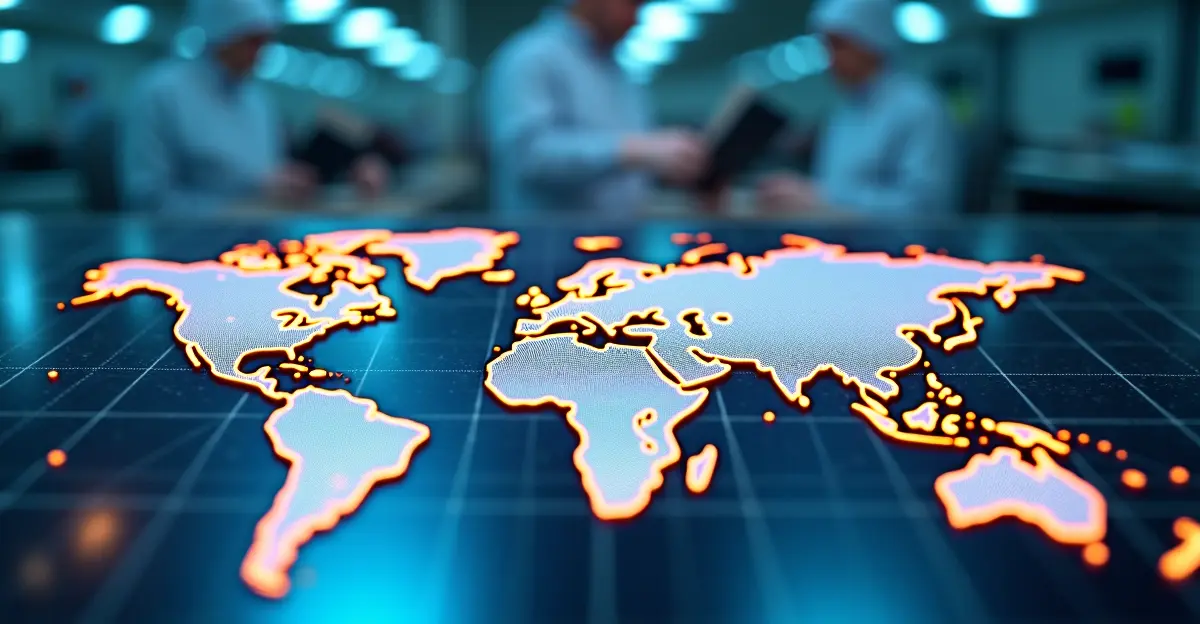
The semiconductor decoupling is creating what analysts term a "bifurcated global technology ecosystem" with distinct technological blocs emerging. This fragmentation increases costs, reduces efficiency, and potentially slows innovation as companies must maintain separate product lines and supply chains for different markets. The global chip shortage 2021-2023 demonstrated the vulnerabilities of concentrated supply chains, but current policies may be creating new forms of systemic risk through technological Balkanization.
Regionalization Trends
Countries worldwide are responding to semiconductor tensions by investing in domestic production capabilities. The European Union has launched its own chip initiatives, while Japan and South Korea are expanding their semiconductor manufacturing footprints. Taiwan remains a critical node in the global supply chain, but increasing geopolitical tensions have prompted companies to diversify production locations. This regionalization represents a fundamental shift from the efficiency-first globalization model that characterized the semiconductor industry for decades.
Strategic Implications and Policy Dilemmas
The semiconductor decoupling presents policymakers with complex trade-offs between national security objectives and economic competitiveness. While export controls may temporarily slow China's technological advancement, they also risk accelerating China's independence while weakening American companies through lost revenue and reduced scale. The CSIS analysis highlights concerns about a potential "death spiral" where reduced revenue leads to less R&D investment, further eroding U.S. competitiveness in this strategically vital industry.
Expert Perspectives
Industry analysts are divided on the long-term implications. Some argue that export controls are necessary to maintain U.S. technological leadership and protect national security interests. Others warn that the policies may be counterproductive, pushing China to develop alternative technologies that could eventually surpass Western capabilities. As one industry executive noted, "We're creating the very competitor we're trying to contain by forcing China to build its own semiconductor ecosystem from the ground up." The artificial intelligence arms race further complicates this dynamic, as semiconductors are foundational to AI development and deployment.
Future Outlook and Scenarios
Looking ahead, several scenarios could unfold. In an optimistic scenario, targeted export controls combined with domestic investment could strengthen U.S. technological leadership while maintaining some market access. In a pessimistic scenario, full decoupling could create two incompatible semiconductor ecosystems, increasing costs and slowing global innovation. Chinese industry leaders have already called for a national effort to develop a domestic alternative to Dutch chip-equipment giant ASML by 2030, acknowledging the challenges but demonstrating their long-term commitment to semiconductor independence.
FAQ: Semiconductor Export Controls Explained
What are semiconductor export controls?
Semiconductor export controls are U.S. government restrictions on the sale of advanced computing chips and manufacturing equipment to China, implemented to address national security concerns and limit China's technological advancement.
How much revenue could U.S. companies lose?
According to ITIF analysis, U.S. semiconductor firms could lose approximately $77 billion in sales in a full decoupling scenario, with significant impacts on R&D investment and employment.
Is China achieving semiconductor self-sufficiency?
China has accelerated its semiconductor independence efforts, reaching 28% domestic production self-sufficiency in Q4 2025 and making breakthroughs in 7nm chip production without EUV lithography equipment.
What are the global implications?
The decoupling is creating a bifurcated global technology ecosystem, increasing costs, reducing efficiency, and potentially slowing innovation as companies maintain separate supply chains for different markets.
Are export controls effective long-term?
Experts are divided. While controls may temporarily slow China's advancement, they risk accelerating China's independence while weakening American companies through lost revenue and reduced scale.



Follow Discussion