


 Deutsch
 English
 Español
 Français
 Nederlands
 Português


 Share
Share




What is the Shield of the Americas Summit?
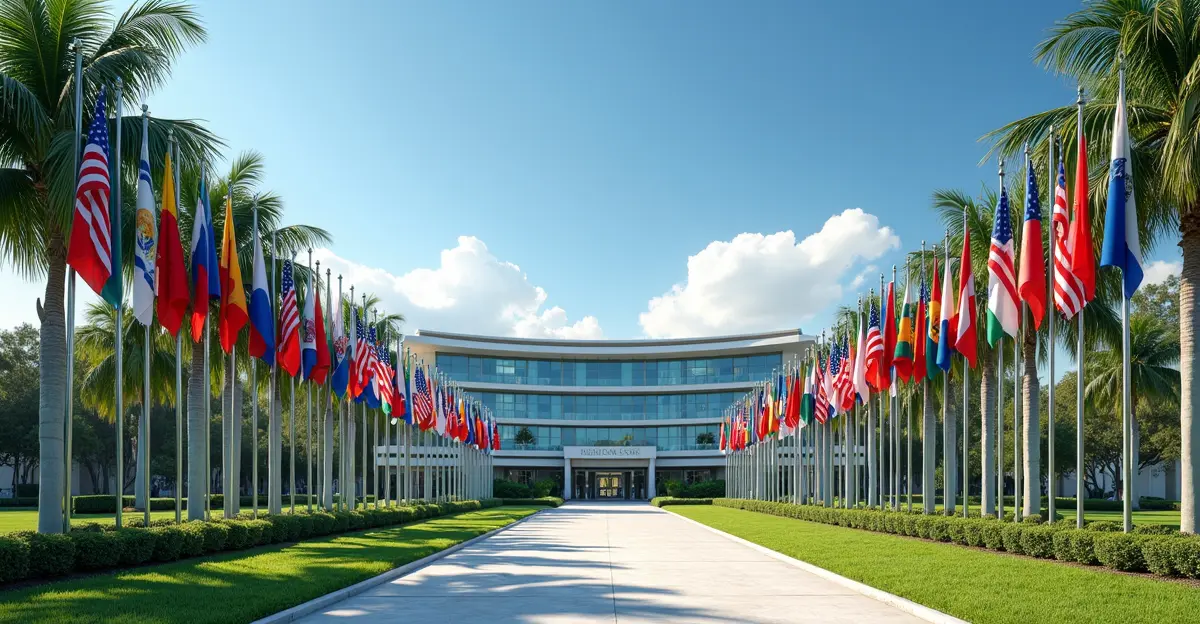
President Donald Trump convened a critical gathering of Latin American leaders in Miami on Saturday, March 7, 2026, calling for unprecedented regional cooperation to combat drug cartels threatening hemispheric security. The Shield of the Americas summit represents a major foreign policy initiative by the Trump administration to strengthen security partnerships across what Washington traditionally considers its sphere of influence. 'All leaders here today agree that we can no longer tolerate lawlessness in our hemisphere,' Trump declared at the Trump National Doral resort. 'The only way to defeat these enemies is by deploying the strength of our armed forces.'
Background: The Growing Cartel Threat
The summit comes amid escalating concerns about Mexican drug cartel operations and their expanding influence throughout Latin America. According to U.S. intelligence estimates, Mexican drug trafficking organizations generate between $13.6 and $49.4 billion annually from illicit drug sales, with much of this revenue flowing through networks that now extend deep into Central and South America. The Trump administration's focus on this issue follows the recent arrest of former Venezuelan president Nicolas Maduro and the subsequent U.S. takeover of Venezuela's oil industry, moves seen as part of a broader strategy to disrupt cartel financing.
Trump specifically targeted Mexican President Claudia Sheinbaum during the summit, stating, 'The cartels run Mexico. We can't have that.' This criticism reflects ongoing tensions between the two nations over security cooperation, particularly regarding Trump's proposal for U.S. forces to operate directly against cartels on Mexican soil—a proposal Sheinbaum has reportedly rejected.
Key Summit Participants and Agreements
The Miami gathering brought together leaders from Argentina, Bolivia, Chile, Costa Rica, the Dominican Republic, Ecuador, El Salvador, Honduras, Panama, Paraguay, and Trinidad and Tobago. Notably absent were several prominent left-leaning governments including Mexico, Colombia, and Brazil, highlighting the political divisions within the region.
Participants signed a charter affirming their right to determine their own destiny without interference while emphasizing democratic principles and private enterprise. The coalition is expected to develop strategies addressing both narcoterrorism and mass migration—two interconnected challenges facing the hemisphere.
The Geopolitical Context: Countering Chinese Influence
The summit forms part of a broader Trump administration effort to reinforce regional security cooperation ahead of the president's planned meeting with Chinese President Xi Jinping in Beijing this April. As part of his interpretation of the 19th-century Monroe Doctrine—which Trump calls the 'Donroe Doctrine'—the president is exerting heavy pressure on Latin American countries to embrace Washington over Beijing. This reflects growing U.S. concern about China's expanding influence in Latin America, where Beijing has made significant economic and diplomatic inroads in recent years.
'The government-Trump is strongly committed to greater American presence in what Washington has traditionally considered its backyard, but where American hegemony is increasingly challenged by growing Chinese influence,' noted regional analysts.
Iran War Shadow Over Summit
The week-old war in Iran cast a significant shadow over the proceedings, with Trump shortening his appearance at the event and appearing only briefly for photos with individual leaders—a move that reportedly irritated some of his counterparts. The conflict has already roiled financial markets, led to spikes in oil and gasoline prices, and caused Latin American countries to brace for economic consequences.
Countries like Chile and the Dominican Republic remain vulnerable to crude oil price spikes, which have risen as transit through the Strait of Hormuz—one of the world's most important energy supply waterways—has been virtually halted. The Iran conflict's impact on global oil markets represents a significant economic threat to energy-importing nations throughout Latin America.
Controversial Personnel Changes
Just days before the summit, Trump fired Homeland Security Secretary Kristi Noem and instead appointed her as special envoy for the Shield of the Americas initiative. This move left summit participants uncertain about her new role, though she was present at Saturday's meeting.
'It's not someone known as an expert on Latin America and who is strongly associated with one particular element that has shaped U.S. policy toward Latin America, namely migration,' said a researcher from the Carnegie Endowment for International Peace about Noem. 'It doesn't give the feeling that Trump really prioritizes this, because it was more likely that he had to remove Kristi Noem from that position and had to come up with something else for her, and that happens to be envoy for the Shield of Americas.'
Future Implications and Regional Response
The summit represents a significant shift in U.S.-Latin American relations, with the Trump administration seeking to establish a security architecture that could have lasting implications for regional governance. However, several South American delegations reportedly expressed frustration over what was seen as a lack of planning and preparation by the White House and State Department.
Officials provided few details about what the U.S. hopes to achieve at the summit beyond security cooperation for its military operations in the Caribbean and eastern Pacific. The coalition's effectiveness will likely depend on sustained commitment from participating nations and the resolution of underlying political differences that have kept key regional players like Mexico from joining the initiative.
Frequently Asked Questions
What is the Shield of the Americas summit?
The Shield of the Americas summit is a March 2026 gathering of Latin American leaders convened by President Donald Trump in Miami to strengthen regional security cooperation against drug cartels and other transnational threats.
Which countries participated in the summit?
Argentina, Bolivia, Chile, Costa Rica, Dominican Republic, Ecuador, El Salvador, Honduras, Panama, Paraguay, and Trinidad and Tobago participated. Notably absent were Mexico, Colombia, Brazil, Cuba, and Venezuela.
What did Trump say about Mexico at the summit?
Trump criticized Mexican President Claudia Sheinbaum, stating 'The cartels run Mexico' and expressing frustration that she rejected his proposal for U.S. forces to operate against cartels on Mexican soil.
How does the Iran war affect Latin America?
The Iran conflict has disrupted oil shipments through the Strait of Hormuz, causing oil price spikes that threaten energy-importing Latin American economies like Chile and the Dominican Republic.
What is the 'Donroe Doctrine' Trump mentioned?
The 'Donroe Doctrine' is Trump's interpretation of the Monroe Doctrine, emphasizing U.S. opposition to foreign influence in the Western Hemisphere and pressure on Latin American countries to align with Washington over Beijing.
Follow Discussion