Deutsch
 English
 Español
 Français
 Nederlands
 Português







Satellite Imagery Reveals New Deforestation Hotspots as Enforcement Deadline Looms
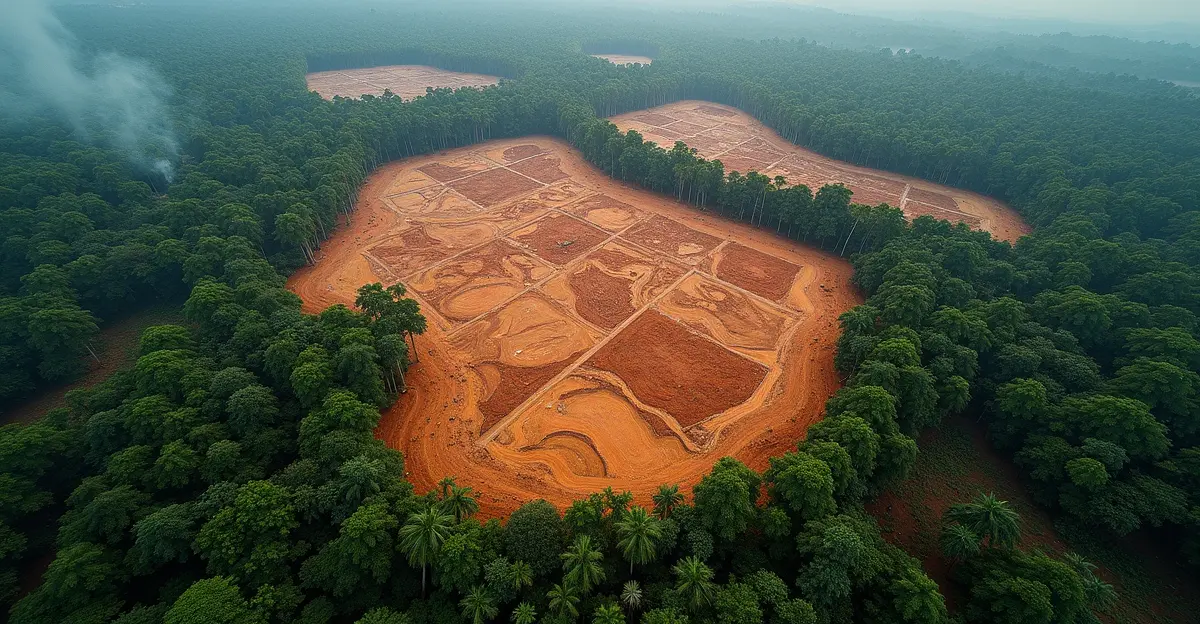
Advanced satellite monitoring systems are uncovering previously undetected deforestation hotspots across global supply chains, just as international regulatory pressure intensifies. With the EU Deforestation Regulation (EUDR) set to take full effect in late 2025, companies are scrambling to trace commodities back to their source plots and prove they're deforestation-free.
The Technology Revolutionizing Forest Monitoring
Satellite AI systems are achieving unprecedented accuracy in deforestation detection, with some platforms reporting up to 95.7% deforestation-free sourcing verification. 'What we're seeing is a technological revolution in supply chain transparency,' says Dr. Elena Rodriguez, a forest monitoring expert at the World Resources Institute. 'Satellite imagery combined with machine learning can now detect forest loss in near real-time, giving enforcement agencies and companies tools they never had before.'
Platforms like Global Forest Watch, Starling (developed by Airbus and Earthworm Foundation), and EOSDA LandViewer are providing comprehensive monitoring solutions. These systems integrate GPS mapping, satellite imagery, and blockchain technology to create verifiable supply chain records. According to recent analysis, AI-powered systems can achieve 95% accuracy in detecting supply chain disruptions and enable 97% traceability of raw materials.
Emerging Hotspots and Enforcement Challenges
The latest data reveals concerning trends in several regions. In the Amazon, deforestation surged 92% in May 2025 compared to 2024, with over half occurring in recently burned areas. 'This represents a dangerous new pattern,' notes Brazilian environmental analyst Carlos Mendes. 'Criminals are exploiting climate change-induced vulnerability, using fires as a less risky method for illegal land clearing.'
Meanwhile, Indonesia continues to face challenges despite previous progress, while new hotspots are emerging in the Congo Basin and parts of Southeast Asia. The EUDR requires companies to ensure products like beef, leather, wood, paper, soy, cocoa, coffee, palm oil, and rubber don't originate from land deforested after December 31, 2020.
Corporate Response and Supply Chain Transformation
Major corporations are investing heavily in compliance systems. Unilever's palm oil program across 20 million hectares demonstrates what's possible with comprehensive monitoring. 'We've seen companies reduce operational costs by 15-30% through route optimization and demand forecasting enabled by these systems,' explains supply chain consultant Maria Chen.
Implementation costs range from €200,000 to over €10 million, with payback periods typically 18-24 months. The six-step compliance process includes mapping supply chains, assessing risks, engaging suppliers, strengthening internal systems, monitoring verification, and documenting compliance.
International Pressure and Political Will
The upcoming COP30 climate summit in Belém, Brazil adds urgency to the situation. Brazil recently launched the Tropical Forest Forever Facility, raising $6.6 billion with contributions from Norway and Germany. 'Political will remains the most critical factor,' says climate policy expert Dr. James Wilson. 'We've seen Brazil reduce Amazon deforestation by 84% between 2004-2012 and Indonesia achieve 78% reduction from 2016-2021 when political leadership prioritized forest protection.'
However, enforcement remains challenging. The European Parliament recently voted to delay EUDR implementation to end of 2026 for large companies and mid-2027 for smaller operators, creating uncertainty for businesses that had already invested in compliance systems.
The Path Forward
As satellite technology becomes more sophisticated and accessible, the pressure on companies to clean up their supply chains will only increase. 'This isn't just about compliance anymore,' concludes sustainability director Lisa Park. 'Consumers, investors, and regulators are demanding transparency. Companies that can demonstrate deforestation-free supply chains will have competitive advantage in the global marketplace.'
The integration of satellite monitoring with supply chain management represents a fundamental shift in how we protect forests. With proper enforcement and corporate responsibility, these technological advances could finally turn the tide against global deforestation.