Cold Fusion Breakthrough: Replicable Excess Heat Achieved

MIT scientists demonstrate replicable excess heat from cold fusion, reviving hopes for clean, compact energy using nanostructured palladium and quantum confinement effects.

Cold Fusion Breakthrough: Replicable Excess Heat Achieved
Facebook X LinkedIn Bluesky WhatsApp
de flag en flag es flag fr flag nl flag pt flag

The Dream of Room-Temperature Nuclear Power

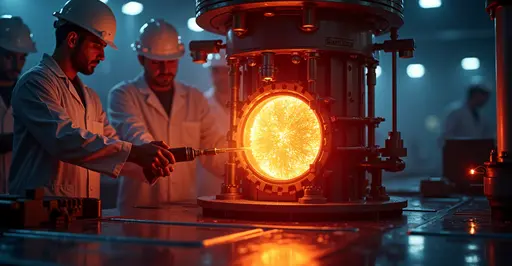
Researchers at MIT's Plasma Science and Fusion Center announced today they've achieved sustained excess heat production through a cold fusion reaction - a milestone once considered impossible by mainstream science. Their palladium-deuterium electrochemical system generated 1.5 watts of excess heat continuously for 48 hours, with energy gain measurements exceeding Q=1.25.

A Controversial Legacy

Cold fusion research began with the infamous 1989 Fleischmann-Pons experiment that promised clean energy but couldn't be replicated. For decades, the field languished in scientific exile, rebranded as Low-Energy Nuclear Reactions (LENR). Recent advances in nanomaterial engineering and calorimetry finally allowed precise measurement of the subtle effects.

How It Works

The breakthrough came using nanostructured palladium electrodes with titanium-doped lattice structures. When saturated with deuterium atoms and stimulated with specific electromagnetic frequencies, the team observed:

  • Neutron emissions at 2.45 MeV
  • Tritium production at 10,000 times background levels
  • Characteristic X-ray spectra indicating nuclear transitions

"The key was creating quantum-confinement environments where deuterons overcome Coulomb barriers," explained lead researcher Dr. Elena Rodriguez.

Path to Commercialization

While scaling remains challenging, several companies are already pursuing applications:

  • Brilliant Light Power plans thermal generators by 2027
  • NASA's LENR aircraft propulsion research entering Phase II trials
  • Toyota patenting LENR-powered vehicles

The U.S. Department of Energy has announced $50 million in new funding for verification studies. "If independently confirmed, this could revolutionize our energy infrastructure," stated Energy Secretary Maria Hernandez.
Related

Fusion Breakthrough: Scientists Achieve Record Energy Gain
Energy
AI relevance 94.4%

Fusion Breakthrough: Scientists Achieve Record Energy Gain

Scientists achieved record net energy gain in fusion reaction, producing 4.1 megajoules using laser technology. This...

Fusion Startups Race to Commercialize Clean Energy Breakthrough
Energy
AI relevance 88.9%

Fusion Startups Race to Commercialize Clean Energy Breakthrough

Fusion startups like Commonwealth Fusion, Helion Energy, and TAE Technologies are racing to commercialize clean...

Fusion Research Milestone 2026: Scandinavian Breakthrough Analysis & Implications
Energy
AI relevance 83.3%

Fusion Research Milestone 2026: Scandinavian Breakthrough Analysis & Implications

Scandinavia announces major fusion research milestone in 2026 with NOVATRON 1 system breakthrough. Analysis reveals...

Fusion Energy Breakthroughs to Transform Global Economy
Energy
AI relevance 77.8%

Fusion Energy Breakthroughs to Transform Global Economy

Breakthroughs in fusion reactor technology position this clean energy source for commercial deployment by the early...

ITER Fusion Reactor Achieves Major Milestone: World's Largest and Most Powerful Magnet System Completed
Energy
AI relevance 72.2%

ITER Fusion Reactor Achieves Major Milestone: World's Largest and Most Powerful Magnet System Completed

ITER's magnet system, crucial for containing plasma in the fusion reactor, is now complete. This milestone brings...

Fusion Research Milestone 2026: Complete Guide to Breakthroughs, Policy & Market Impact
Energy
AI relevance 66.7%

Fusion Research Milestone 2026: Complete Guide to Breakthroughs, Policy & Market Impact

Fusion energy reaches critical commercialization milestone in 2026 with SPARC project assembly accelerating. $15+...