
 Deutsch
 English
 Español
 Français
 Nederlands
 Português






The 2026 Supply Chain Reconfiguration: From Global Efficiency to Regional Resilience
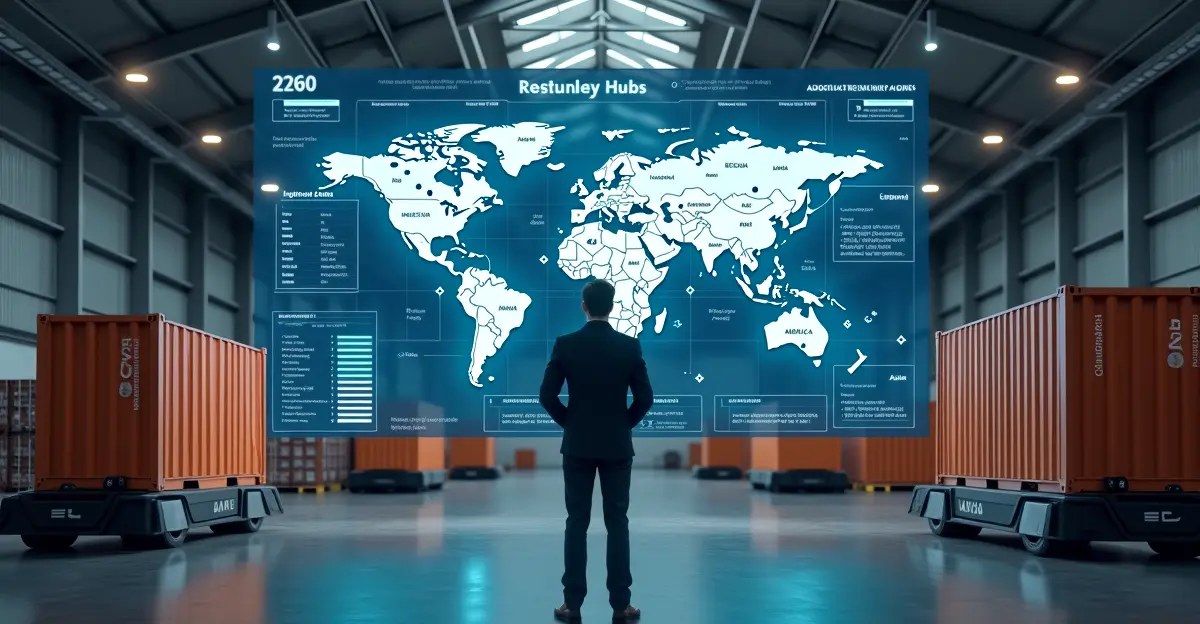
As geopolitical tensions and strategic policy shifts accelerate, global supply chains are undergoing a fundamental transformation from globally optimized 'just-in-time' models to regionally resilient 'local-for-local' configurations. Recent World Economic Forum analysis identifies 2026 as a pivotal year where supply chain regionalization becomes mainstream, with businesses making strategic shifts in response to geopolitical tensions and trade policy uncertainties that demand immediate strategic adaptation. This comprehensive analysis examines how companies are embedding geopolitical strategy into operations to achieve readiness rather than mere resilience in a power-based global economy.
What is Supply Chain Regionalization?
Supply chain regionalization represents a strategic shift from globalized, efficiency-focused models to localized, resilience-driven configurations. Unlike traditional global supply chains that prioritize cost optimization through centralized manufacturing in low-cost regions, regionalized 'local-for-local' models emphasize proximity to consumers, reduced geopolitical exposure, and enhanced agility. According to the World Economic Forum, this transition is driven by three primary factors: escalating geopolitical tensions, increasing trade policy uncertainty, and growing recognition that supply chain resilience has become a critical competitive advantage in volatile markets.
The Strategic Drivers of 2026's Transformation
Geopolitical Tensions Reshaping Trade Dynamics
The acceleration of supply chain regionalization in 2026 stems from intensifying geopolitical conflicts and strategic competition. Recent data reveals that 74% of logistics managers now identify geopolitical instability as the most serious supply chain risk—a dramatic increase from just 33% in 2024. The transport and logistics sector is increasingly recognized as a key pillar of European security under the 'dual-use' concept, reflecting how supply chain infrastructure has become intertwined with national security considerations. A case study from the September 2025 border crisis at Małaszewicze, Poland demonstrates supply chain fragility, where a two-week border closure caused €450 million in EU economic losses and accelerated China's development of alternative routes.
Policy Shifts and Regulatory Pressures
Governments worldwide are implementing policies that incentivize regionalization through tariffs, subsidies, and strategic industrial policies. The EU carbon border tax and similar measures are creating new cost structures that favor regional production. According to industry analysis, EU climate policies (ETS2) are expected to increase transport costs by 20-30% by 2027, further driving the economic case for regionalization. These policy shifts are fundamentally altering the calculus of global supply chain design, making regional configurations increasingly economically viable.
Business Strategy Evolution: From Scale to Resilience
Capital Expenditure Reallocation
Companies are fundamentally rethinking their capital expenditure strategies in response to supply chain regionalization. Rather than investing in massive centralized facilities in low-cost regions, businesses are allocating capital to build distributed regional manufacturing hubs. This shift represents a profound change in investment philosophy—from maximizing scale economies to optimizing for resilience and market proximity. Research indicates that companies are increasingly using supply chain network design technology to model various scenarios and evaluate CapEx decisions, addressing capacity constraints and exploring facility expansion options through greenfield analysis.
M&A Strategy Evolution
Mergers and acquisitions strategy is evolving from a tool for achieving scale to a mechanism for building resilience and diversification. Companies are pursuing strategic partnerships and acquisitions that enhance regional capabilities rather than simply increasing market share. This represents a fundamental shift in M&A philosophy, with supply chain synergies becoming a primary consideration in deal evaluation. Despite record M&A activity reaching $5.9 trillion in 2021, failure rates remain high at 50-90%, often due to neglecting supply chain synergies and redundancies. Successful companies are now integrating supply chain design into their M&A planning to assess financial impacts, service level effects, and risks before implementation.
Integrating Geopolitical Risk Assessment into Core Operations
The most significant transformation in 2026 is the integration of geopolitical risk assessment into core business decision-making processes. Companies are moving beyond traditional probability-based risk models to implement sophisticated scenario planning for low-probability, high-impact events. This represents a shift from reactive risk management to proactive strategic readiness. According to World Economic Forum analysis, enterprise risk management is transforming from probability-based models to scenario planning that anticipates geopolitical disruptions before they occur.
Digital transformation is emerging as the primary remedy for geopolitical supply chain challenges, shifting focus from physical redundancy to intelligence, visibility, and collaboration. Open logistics platforms like CargoON are enabling real-time supply chain visibility and coordination across regions. AI-powered supply chains are transitioning from mere visibility to decision autonomy, allowing systems to sense risks and rebalance in real time. BearingPoint research indicates that over 90% of executives expect AI to significantly reshape supply chains by 2030, though only 8% have fully integrated AI-driven planning across their networks.
The Impact on Corporate Governance and Leadership
Corporate governance is undergoing profound change as boards take active strategic roles in supply chain resilience. The 2025 economic crisis demonstrated that supply chain disruptions can have existential consequences for companies, leading to increased board-level oversight of supply chain strategy. Companies are now requiring geopolitical expertise at the board level and establishing dedicated committees to oversee supply chain resilience. This represents a fundamental shift in corporate governance, with supply chain strategy moving from operational consideration to board-level strategic priority.
The transport and logistics sector's recognition as a key pillar of European security reflects how supply chain infrastructure has become intertwined with national security considerations. This dual-use concept means that companies must now consider not only commercial factors but also strategic national interests when designing their supply chain networks.
Future Outlook: Toward Anti-Fragility
Looking ahead to 2027 and beyond, the supply chain sector faces dual challenges of rising geopolitical tensions and increasingly stringent climate policies. The most forward-thinking companies are moving beyond resilience toward 'anti-fragility'—the ability to grow because of disruptions rather than just survive them. This represents the next evolution in supply chain strategy, where companies design systems that actually benefit from volatility and uncertainty.
Sustainability is becoming integrated into core operations, with 44% of executives treating circularity as a strategic investment priority. The key challenge is ensuring these AI-enabled, regionalized supply chains remain inclusive, interoperable, and trusted across regions to prevent fragmentation into incompatible systems. The artificial intelligence regulation landscape will play a crucial role in determining how these technologies are deployed across different regions.
Frequently Asked Questions
What is the difference between supply chain resilience and readiness?
Resilience refers to the ability to recover from disruptions, while readiness involves proactive preparation and adaptation to anticipate and mitigate disruptions before they occur. Readiness represents a more advanced strategic approach that integrates geopolitical intelligence into core operations.
How are companies funding the transition to regional supply chains?
Companies are reallocating capital expenditure from centralized global facilities to distributed regional hubs, often using a combination of internal funds, strategic partnerships, and government incentives designed to promote regional manufacturing and supply chain resilience.
What role does artificial intelligence play in supply chain regionalization?
AI enables the transition from mere visibility to decision autonomy, allowing supply chains to sense risks and rebalance in real time. AI-powered systems help optimize regional network design, predict disruptions, and automate response strategies across distributed regional hubs.
How does the 'local-for-local' model differ from traditional globalization?
Traditional globalization prioritizes cost optimization through centralized manufacturing in low-cost regions, while 'local-for-local' models emphasize proximity to consumers, reduced geopolitical exposure, and enhanced agility through regional production and distribution networks.
What are the main risks of supply chain regionalization?
Key risks include increased capital requirements for building regional infrastructure, potential loss of scale economies, regulatory fragmentation across regions, and the challenge of maintaining consistent quality and standards across distributed manufacturing hubs.
Sources
World Economic Forum: Navigating Trade in 2026
Supply Chain Digital: Geopolitical Resilience 2026
Local-for-Local Supply Chain Strategy
Supply Chain Design in CapEx and M&A Planning



Follow Discussion