


 Deutsch
 English
 Español
 Français
 Nederlands
 Português


 Share
Share




What is the COP29 Climate Finance Compromise?
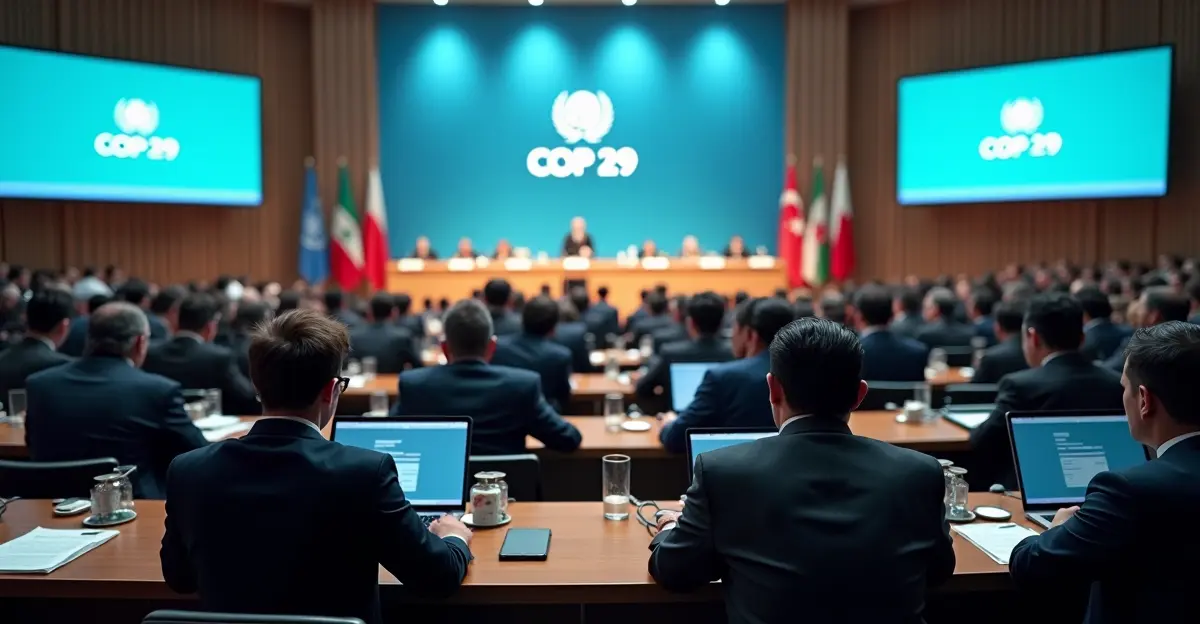
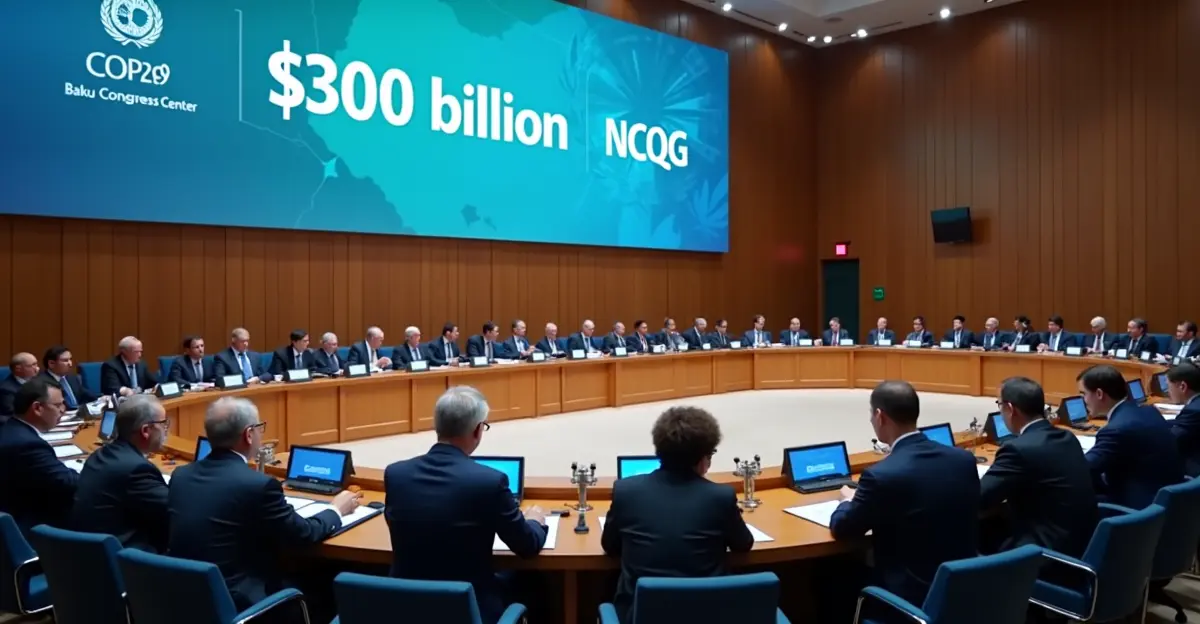
The COP29 climate conference in Baku, Azerbaijan concluded in November 2024 with a landmark agreement establishing a $300 billion annual climate finance target for developing nations by 2035. This New Collective Quantified Goal (NCQG) triples the previous $100 billion commitment and represents the most significant climate funding breakthrough since the Paris Agreement 2015. However, the compromise reveals deep geopolitical tensions between developed and developing nations, with the latter having demanded over $1 trillion annually to address climate impacts they contributed least to create.
The Geopolitical Context of Climate Finance Negotiations
The COP29 negotiations unfolded against a backdrop of intensifying North-South tensions and shifting global power dynamics. Developing nations, led by the G77+China bloc, entered negotiations demanding $1.3 trillion annually, citing the UNFCCC climate assessments that estimate developing countries need $5.8-5.9 trillion by 2030 for climate adaptation and mitigation. The final $300 billion compromise represents less than 6% of this estimated need, creating what African negotiators called a 'strategic gap' in climate justice.
'The $300 billion target is insultingly low and represents a betrayal of vulnerable nations,' stated a negotiator from the Alliance of Small Island States (AOSIS). 'We are being asked to accept a placebo while our nations face existential threats from sea-level rise and extreme weather events.'
The agreement includes two interconnected financial targets: a binding $300 billion annual commitment from developed nations and an aspirational $1.3 trillion total mobilization target from all sources including private investment. This dual structure reflects the compromise nature of the deal, balancing developed nations' fiscal constraints with developing countries' urgent needs.
Economic Implications and Implementation Challenges
Funding Allocation and Sector Priorities
The $300 billion annual commitment will be allocated according to a framework established at COP29: 45% for mitigation (reducing emissions), 35% for adaptation (building resilience), and 20% for loss and damage (addressing irreversible climate impacts). Key technology priorities identified include:
- Green hydrogen development: $45 billion
- Advanced nuclear energy: $30 billion
- Grid modernization: $60 billion
- Energy storage systems: $40 billion
- Climate-resilient agriculture: $35 billion
However, analysis from Carbon Brief reveals the target may be less ambitious than it appears. Pre-existing national pledges and multilateral development bank plans will already bring climate finance to around $200 billion by 2030, meaning the target could be nearly met before the 2035 deadline with minimal additional effort from wealthy nations.
Implementation Mechanisms and Transparency
The agreement establishes the 'Baku to Belém Roadmap' outlining five priority action areas to mobilize the full $1.3 trillion by 2035. These include leveraging multilateral development banks, creating innovative financing instruments, and enhancing private sector participation. However, significant challenges remain regarding:
- Transparency in fund allocation and disbursement
- Ensuring equitable access for least developed countries
- Balancing grants versus loans to avoid debt burdens
- Technology transfer alongside financial support
Strategic Implications for Global Climate Leadership
The COP29 outcome reveals shifting power dynamics in global climate governance. While the agreement maintains the traditional North-South framework, it also acknowledges the growing role of emerging economies. China's potential contributions to the $300 billion target create new geopolitical leverage points, particularly around critical mineral supply chains essential for renewable energy technologies.
The compromise has strategic implications for several key actors:
| Nation/Bloc | Strategic Position | Key Interests |
|---|---|---|
| European Union | Climate leadership credibility | Energy transition investments, carbon market rules |
| United States | Domestic political constraints | Technology exports, private sector opportunities |
| China | Emerging climate financier | Belt and Road alignment, technology dominance |
| African Union | Climate justice advocacy | Adaptation funding, debt relief mechanisms |
| Small Island States | Existential survival focus | Loss and damage financing, coastal resilience |
According to analysis from Informed Clearly, the agreement moves climate finance toward leveraging wider public finance and policy shifts to unlock larger private investment flows. This represents a strategic shift from pure grant-based approaches to more complex financial engineering.
Impact on Energy Transition Investments
The $300 billion framework creates new investment signals for the global energy transition. While insufficient to meet total needs, the commitment provides crucial de-risking capital that can mobilize additional private investment. The agreement intersects with semiconductor geopolitics and critical mineral supply chains, potentially reshaping global energy dynamics.
Key investment implications include:
- Accelerated deployment of renewable energy in developing markets
- Increased focus on grid infrastructure and energy storage
- Growing importance of climate adaptation technologies
- Enhanced role for multilateral development banks as intermediaries
The compromise also establishes comprehensive rules for international carbon markets under Article 6 of the Paris Agreement, creating new carbon trading mechanisms that could reduce decarbonization costs by up to 50% according to UN estimates.
Expert Perspectives on the Compromise
UN Secretary-General António Guterres expressed mixed feelings about the outcome: 'The $300 billion agreement provides a base to build on, but falls far short of what science demands and justice requires. We must use this foundation to push for greater ambition at COP30 in Belém.'
Climate finance experts note the agreement's strategic ambiguity. 'The dual target structure creates political cover for all sides,' explains Dr. Maria Chen, climate policy analyst at the World Resources Institute. 'Developed nations can point to the binding $300 billion commitment, while developing countries can focus on the aspirational $1.3 trillion target. This ambiguity may prove strategically useful in maintaining climate cooperation amid growing geopolitical tensions.'
Frequently Asked Questions
What is the COP29 climate finance agreement?
The COP29 agreement establishes a $300 billion annual climate finance target for developing nations by 2035, tripling the previous $100 billion commitment. It includes both a binding $300 billion annual commitment and an aspirational $1.3 trillion total mobilization target from all sources.
How does the $300 billion compare to actual needs?
The $300 billion represents less than 6% of the estimated $5.8-5.9 trillion developing countries need by 2030 for climate action. UN assessments indicate vulnerable nations require at least $1.3 trillion annually by 2035 for adequate adaptation and mitigation.
Which countries benefit most from the agreement?
Least developed countries and small island developing states are prioritized for funding, though all developing nations are eligible. The allocation framework directs 35% to adaptation, which primarily benefits climate-vulnerable nations.
When will the funds be disbursed?
The agreement establishes a phased implementation with increasing annual commitments leading to the full $300 billion by 2035. Initial disbursements are expected to begin in 2025 through existing climate funds and multilateral development banks.
What are the main criticisms of the agreement?
Developing nations criticize the amount as insufficient, the heavy reliance on loans rather than grants, inadequate funding for adaptation and loss/damage, and lack of concrete implementation mechanisms for the larger $1.3 trillion target.
Future Outlook and COP30 Implications
The COP29 compromise sets the stage for intensified negotiations at COP30 in Belém, Brazil in 2025. Key issues deferred from Baku include concrete plans for fossil fuel transition, enhanced adaptation finance targets, and operational details for the Loss and Damage Fund. The strategic gap between developed and developing nations' positions suggests continued tension in North-South climate relations, with the 2025 climate negotiations likely focusing on implementation mechanisms rather than new financial targets.
As nations begin implementing the COP29 framework in 2025, the strategic implications will become clearer. The compromise represents both a pragmatic step forward in maintaining climate cooperation and a failure of ambition that could undermine trust in multilateral climate governance. Its ultimate success will depend on whether the $300 billion commitment mobilizes additional investment or becomes a ceiling rather than a floor for climate finance ambition.


Follow Discussion