


 Deutsch
 English
 Español
 Français
 Nederlands
 Português


 Share
Share




The Rise of Autonomous Weapons Systems
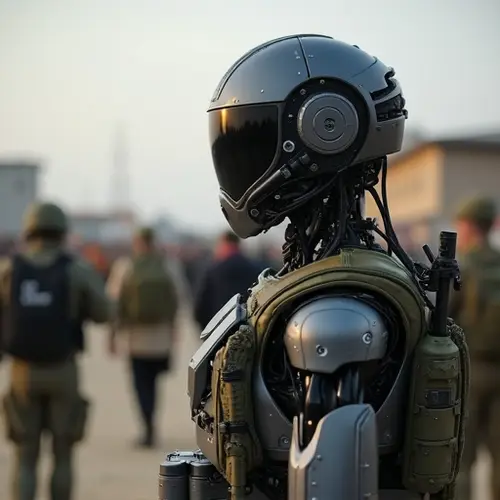
As nations race to develop increasingly sophisticated artificial intelligence for military applications, the international community faces unprecedented challenges in regulating lethal autonomous weapons systems (LAWS). These AI-powered systems, capable of selecting and engaging targets without direct human intervention, are rapidly advancing beyond theoretical discussions to actual battlefield deployment.
'Machines cannot uphold the principle of distinction required by international humanitarian law,' warned UN Secretary-General Antonio Guterres in recent statements. 'We risk creating systems that make life-and-death decisions based on potentially biased algorithms.'
Regulatory Gaps and Geopolitical Tensions
Despite a decade of discussions through the Convention on Certain Conventional Weapons (CCW) since 2016, regulatory progress has been slow due to geopolitical tensions and substantive disagreements among nations. The United Nations has been facilitating ongoing discussions through the Group of Governmental Experts on Emerging Technologies in LAWS, with the Secretary-General calling for a legally binding treaty by 2026 to prohibit systems that function without human control.
According to recent analysis, early use of autonomous systems in conflicts like Ukraine and Gaza demonstrates how technological development is outpacing regulatory frameworks. The Martens clause, which calls for public conscience to guide acceptable warfare standards, faces new challenges as AI systems become more sophisticated.
Export Controls and Accountability Debates
The United States recently released America's AI Action Plan, outlining a comprehensive strategy to use export controls to position the U.S. as the dominant AI player globally while constraining foreign adversaries. The plan focuses on exporting AI technology to allies through secure deals while strengthening enforcement to deny advanced chips to adversaries.
'We must ensure meaningful human control over lethal force decisions,' emphasized a senior defense official speaking on condition of anonymity. 'The accountability gap created by autonomous systems represents one of our greatest legal and ethical challenges.'
International Legal Frameworks
Currently, there is no single global regulation for AI in weapon systems, creating a patchwork of legal frameworks across different jurisdictions. The EU's AI Act excludes military applications, but member states must comply with International Humanitarian Law (IHL). NATO has established an AI Strategy with six principles: legality, accountability, traceability, reliability, controllability, and fairness.
Human Rights Watch's recent report 'A Hazard to Human Rights' examines how autonomous weapons systems fundamentally violate international human rights law by making arbitrary lethal force decisions without human judgment for necessity and proportionality.
The Path Forward
Experts warn that without swift political leadership and regulatory action, the opportunity to establish legal guardrails may be lost as these systems become widely deployed. The development of AI-powered robotic drone swarms capable of striking multiple targets simultaneously on a large scale particularly challenges principles of proportionality and precaution in warfare.
As one international law professor noted, 'The time for theoretical debates has passed. We need concrete action to ensure human dignity and accountability in the age of autonomous warfare.' The coming year will be critical for determining whether the international community can establish effective oversight mechanisms before autonomous weapons become commonplace on battlefields worldwide.





Follow Discussion