


 Deutsch
 English
 Español
 Français
 Nederlands
 Português


 Share





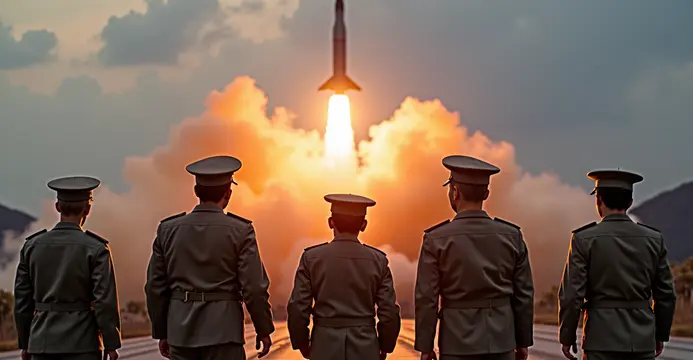
North Korea fired roughly ten short-range ballistic missiles toward the Sea of Japan on Thursday, October 29, 2026, according to South Korea's Joint Chiefs of Staff. The launch, from the Wonsan area on the east coast, is the latest sign that North Korea-South Korea tensions have entered a dangerous new phase, with Pyongyang accelerating missile and drone development in partnership with Russia.
What is driving the new Korean arms race?
The missile barrage did not happen in isolation. Tensions on the Korean peninsula have been rising for months. Pyongyang is modernizing its armed forces at high speed and increasingly seeking confrontation with Seoul, according to a NOS report. Military cooperation with Russia appears to be giving the North both confidence and new technological expertise.
Earlier this month, North Korea tested several ballistic missiles that Pyongyang described as part of a hypersonic weapons system — missiles that travel far faster than the speed of sound. Experts warn that the system may be in its final development stage, moving beyond mere power projection. Days later, South Korea tested its own hypersonic weapon for the first time, with President Lee Jae-myung attending the launch. Local media said Lee wanted to send a warning to Pyongyang, a notable shift for a leader who had previously sought to reduce tensions. North Korea responded with another round of missile launches.
Border landmines and loudspeakers
Rocket fire is not the only flashpoint. Last month, three South Korean soldiers were wounded in landmine explosions near the border while clearing a route to inspect possibly illegally placed mines. The border area is littered with landmines, many laid during and after the 1950–1953 Korean War. North Korea has been rapidly re-arming the zone, with an estimated nearly one million mines added since 2024, some on the South Korean side of the line.
A joint investigation by South Korea's military and the UN Command in Korea found the exploded mine was of North Korean manufacture. It remains unclear whether the mine was deliberately placed on the southern side, as landslides or poor border markings may explain its location. Seoul demanded an immediate apology and an end to North Korean border fortifications; Pyongyang denied involvement and continued building. Kim Yo-jong, the sister of leader Kim Jong-un, said last week that loudspeakers are ready along the entire border for psychological warfare, reversing an earlier decision to remove them to ease tensions.
Russia's role in North Korea's military upgrade
The military self-confidence of North Korea has soared since the expansion of cooperation with Russia. While Pyongyang supplies troops and weapons to fight in Ukraine, it receives combat experience and weapons knowledge in return. Drone technology is the biggest gain. Pyongyang appears to have learned from the war in Ukraine that cheap drones can overwhelm expensive air-defense systems.
Photos of Kim Jong-un visiting a drone factory last month indicate that North Korea has started mass production of drones. According to NK News, Russia has also sent officers to North Korea to train drone operators. During a North Korean exercise last month, a swarm of drones attacked a target island while cruise missiles and ballistic missiles struck simultaneously from different directions — a tactic that echoes the Russia-Ukraine drone warfare playbook.
What this means for South Korea and US troops
If North Korea succeeds in producing large numbers of drones, it would have major consequences for the air defenses of South Korea and the American troops stationed there. South Korea's drone division is currently being reorganized and faces budget cuts, leaving its response to the fast-moving drone threat lagging. Last year, the defense minister announced a goal to train 500,000 "drone warriors," but experts question whether that will be enough to counter the hypersonic missile arms race emerging across the region.
FAQ
Why is North Korea firing missiles now?
North Korea is modernizing its military and testing hypersonic and drone capabilities, partly with Russian technical help, while tensions over border landmines and South Korea's own missile tests escalate.
What did Russia give North Korea?
Russia has shared drone technology, missile telemetry and combat experience in exchange for North Korean troops and artillery for the Ukraine war.
What happened at the DMZ?
Three South Korean soldiers were wounded by a North Korean-made landmine in September 2026, prompting Seoul to demand an apology and halt to border fortifications.
Is South Korea responding militarily?
Yes, South Korea tested its first hypersonic missile in October 2026 and is planning to train 500,000 drone operators, though its drone division faces budget cuts.


Follow Discussion