


 Deutsch
 English
 Español
 Français
 Nederlands
 Português


 Share
Share




The World Economic Forum's Global Risks Report 2026, published on January 14, 2026, has ranked geoeconomic confrontation as the overriding near-term threat to global stability for the first time. With 50% of over 1,300 surveyed leaders expecting a turbulent or stormy outlook over the next two years, the report signals a fundamental shift in the global order. Major powers are increasingly weaponizing tariffs, sanctions, and capital controls, fragmenting markets and forcing nations and corporations to choose between efficiency and strategic autonomy. This article examines how the new age of economic competition is rewiring global trade through 2026 and beyond.
The Rise of Geoeconomic Confrontation
Geoeconomic confrontation — defined as the use of economic tools such as tariffs, export controls, and financial sanctions to achieve geopolitical objectives — has climbed eight positions in the WEF risk ranking to claim the top spot. It surpasses state-based armed conflict (14%), extreme weather, societal polarization, and misinformation. According to the report, 18% of respondents identified geoeconomic confrontation as the risk most likely to trigger a material global crisis in 2026. The WEF Global Risks Report 2026 highlights that economic risks — including downturn and inflation — have surged eight positions year-on-year, reflecting the deepening entanglement of geopolitics and economics.
Marsh CEO John Doyle described the current moment as one of 'poly-crises,' involving trade wars, technology upheaval, and extreme weather. "We are witnessing an age of competition where multilateralism is retreating and nations are prioritizing national security over economic efficiency," said Saadia Zahidi, Managing Director of the World Economic Forum.
Tariffs as a Weapon: U.S. Revenue Surges 300%
The most visible manifestation of geoeconomic confrontation is the dramatic escalation of tariff policies. U.S. tariff revenue has surged to unprecedented levels. According to data from the U.S. Treasury, the government collected roughly $30 billion in customs duties in January 2026 alone, bringing fiscal year-to-date tariff revenue to $124 billion — a 304% increase compared to the same period in 2025. In fiscal year 2025, total tariff revenue reached $195 billion, a 150% increase over FY 2024, driven by President Trump's across-the-board tariffs first levied in April 2025 under the International Emergency Economic Powers Act (IEEPA).
The average applied tariff rate on U.S. imports has risen to 15.8%, the highest since World War II. However, these gains face legal uncertainty. The U.S. Supreme Court is set to hear oral arguments on the legality of the IEEPA tariffs, with a ruling expected later in 2026. If the tariffs are struck down, roughly $90 billion in collected duties may need to be refunded, and future monthly revenue could fall by more than half. The US tariff policy legal challenges underscore the fragility of the current trade regime.
Supply Chains Shift from 'Just-in-Time' to 'Just-in-Case'
In response to tariff volatility and geopolitical uncertainty, global supply chains are undergoing their most dramatic restructuring in decades. The Thomson Reuters Global Trade Report 2026 reveals that 72% of trade professionals now identify U.S. tariff volatility as the most impactful regulatory change, up from 41% a year ago. A staggering 65% of companies are changing sourcing patterns, 57% are renegotiating supplier contracts, and 51% are pursuing nearshoring or reshoring strategies.
The traditional 'just-in-time' model — focused on lean inventories and cost efficiency — is being replaced by a 'just-in-case' approach that prioritizes resilience through contingencies. Companies are maintaining higher stock levels of raw materials and finished goods, diversifying suppliers across multiple geopolitical regions, and investing in digital twin technology for predictive maintenance. The global supply chain restructuring 2026 is projected to increase operational costs by 15-25%, but firms view this as the price of stability.
According to the World Bank's Global Supply Chain Stress Index, container shipping disruptions remain elevated, while UNCTAD's Global Trade Update (January 2026) reports that global trade growth has slowed to 2.2%, down from 3.5% in 2024. Regionalization is accelerating: the 'China Plus Many' strategy is replacing 'China Plus One,' with manufacturing hubs being established in at least three geopolitical regions. Nearshoring is being boosted by incentives such as the U.S. CHIPS Act, projected to increase North American manufacturing capacity by 15% by 2030.
Inflation, Investment, and Industrial Policy
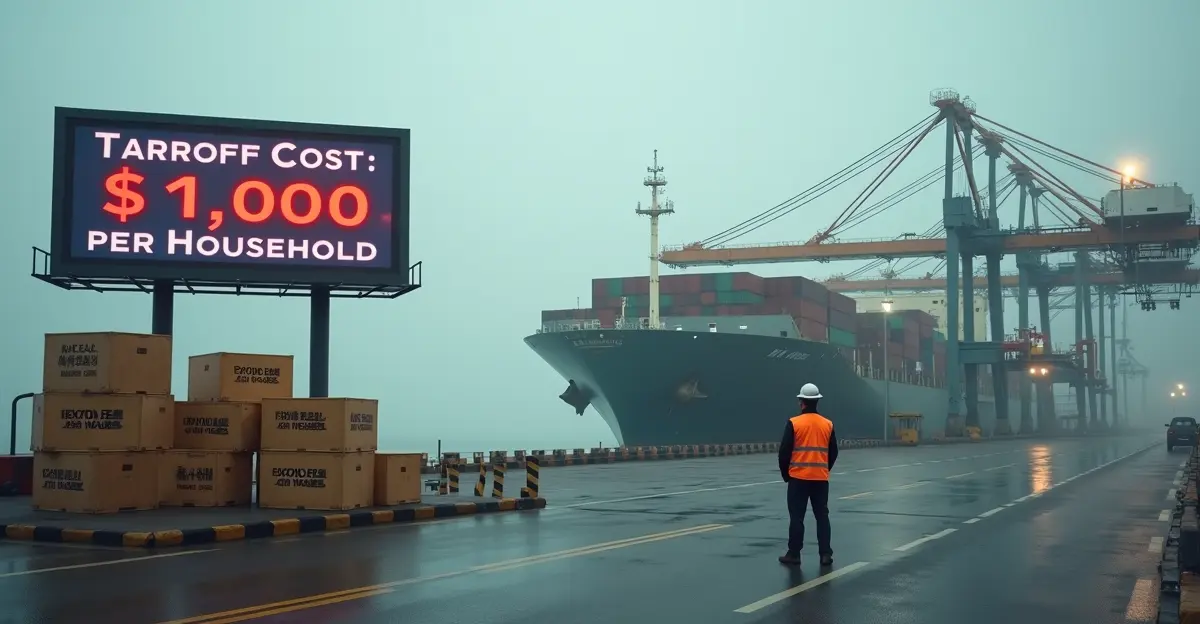
The realignment of global trade is having profound effects on inflation and investment flows. The WEF report notes that economic downturn and inflation both jumped eight positions in the risk ranking. U.S. households are feeling the pinch: the average tariff-driven tax increase was $1,100 per household in 2025, projected to reach $1,500 in 2026. Foreign retaliation and economic damage are expected to reduce projected ten-year tariff revenue from $2.2 trillion to $1.7 trillion.
Investment flows are being redirected along geopolitical lines. The dollar's share in global reserves has dipped below 60%, while BRICS+ nations are building alternative payment infrastructure. Trade departments have gained unprecedented influence within corporations, with 43% reporting enhanced procurement decision-making authority. Technology adoption is accelerating, with 40% of companies exploring AI or blockchain for supply chain management — a dramatic jump from just 6% in 2024. The industrial policy realignment 2026 is reshaping competitive dynamics across sectors.
Expert Perspectives
Industry leaders and analysts are sounding alarms about the long-term implications. "The weaponization of trade is creating a fragmented global economy where efficiency is sacrificed for security," said a senior economist at the World Bank. "We are moving toward a world of regional blocs, with the U.S., China, and the EU each building their own supply chain ecosystems."
Thomson Reuters trade analysts note that 76% of professionals now view U.S. tariffs as a permanent structural change rather than a temporary adjustment. The shift from cost optimization toward resilience is expected to persist regardless of legal outcomes, as companies have already incurred significant sunk costs in restructuring.
FAQ
What is geoeconomic confrontation?
Geoeconomic confrontation refers to the use of economic tools — such as tariffs, sanctions, export controls, and capital restrictions — by nations to achieve geopolitical objectives. It has become the top global risk in 2026 according to the WEF Global Risks Report.
How much have U.S. tariffs increased?
U.S. tariff revenue surged 304% in the first months of fiscal 2026 compared to the same period in 2025, reaching $124 billion. The average applied tariff rate on imports is now 15.8%, the highest since WWII.
What is the 'just-in-case' supply chain model?
The 'just-in-case' model prioritizes resilience over efficiency by maintaining higher inventory levels, diversifying suppliers across multiple regions, and investing in contingency planning. It replaces the traditional 'just-in-time' approach that focused on lean inventories.
How are companies responding to tariff volatility?
According to the Thomson Reuters Global Trade Report, 65% of companies are changing sourcing patterns, 57% are renegotiating contracts, and 51% are pursuing nearshoring or reshoring. Technology adoption is also accelerating, with 40% exploring AI or blockchain solutions.
What is the outlook for global trade in 2026?
Global trade growth has slowed to 2.2%, and 50% of WEF survey respondents expect a turbulent outlook over the next two years. Regionalization is accelerating, with trade flows increasingly organized along geopolitical bloc lines.
Conclusion
The WEF Global Risks Report 2026 has crystallized what many have suspected: geoeconomic confrontation is now the defining feature of the global landscape. As tariffs, sanctions, and supply chain weaponization reshape trade, nations and corporations must navigate a world where efficiency and strategic autonomy are increasingly at odds. The outcome of pending legal challenges, the evolution of regional blocs, and the pace of technological adaptation will determine whether the global economy fragments further or finds a new equilibrium. For now, the age of competition is here to stay.
Sources
- World Economic Forum, Global Risks Report 2026, January 14, 2026
- Thomson Reuters, 2026 Global Trade Report, November 2025
- U.S. Treasury Department, Monthly Treasury Statement, January 2026
- Committee for a Responsible Federal Budget, Tariff Revenue Analysis, 2025
- World Bank, Global Supply Chain Stress Index, 2025
- UNCTAD, Global Trade Update, January 2026
- CNBC, 'Tariffs, AI top World Economic Forum 2026 risks report,' January 14, 2026




Follow Discussion