


 Deutsch
 English
 Español
 Français
 Nederlands
 Português


 Share
Share




What is the MATCH Act and How Will It Impact ASML?
In a significant escalation of the global semiconductor trade war, bipartisan U.S. senators have introduced the MATCH Act (Multilateral Alignment of Technology Controls on Hardware) on April 2, 2026, which could impose severe new export restrictions on Dutch chipmaker ASML Holding NV. The legislation aims to close critical loopholes in America's AI export controls by expanding bans on advanced semiconductor manufacturing equipment to China and other countries of concern. This development comes as ASML, Europe's most valuable technology company with a market capitalization of approximately $527 billion, faces increasing geopolitical pressure that could reshape global chip supply chains.
The Bipartisan Push for Tighter Export Controls
The MATCH Act represents a coordinated effort by both Republican and Democratic lawmakers to strengthen U.S. technological leadership while limiting China's access to advanced semiconductor capabilities. Senators Pete Ricketts (R-NE) and Andy Kim (D-NJ) are leading the legislative push, with additional support from Senators Jim Risch (R-ID) and Chuck Schumer (D-NY). The bill specifically targets deep ultraviolet immersion lithography (DUV) machines that ASML continues to sell to Chinese customers, which lawmakers describe as the 'workhorses' of semiconductor manufacturing.
'This legislation aims to prevent adversaries like China from acquiring chokepoint technologies they cannot produce themselves,' explained Senator Ricketts in a statement. The MATCH Act takes a diplomacy-first approach, giving the administration 150 days to push allies like the Netherlands to adopt tighter measures before implementing unilateral restrictions. If diplomatic efforts fail, the bill would allow the U.S. to restrict exports of American components used in foreign-made chip equipment.
Key Provisions of the MATCH Act
- Country-wide prohibitions: Banning advanced chipmaking tools to countries of concern
- Entity-specific restrictions: Tighter controls on Chinese semiconductor companies including ChangXin Memory Technologies, Hua Hong, Huawei, SMIC, and YMTC
- Allied alignment requirement: Mandating that U.S. allies implement export controls as stringent as those applied to American companies
- Component restrictions: Potential limitations on U.S.-made parts used in foreign semiconductor equipment
- Service prohibitions: Banning engineers from maintaining and repairing tools at certain Chinese facilities
ASML's Position in the Global Semiconductor Landscape
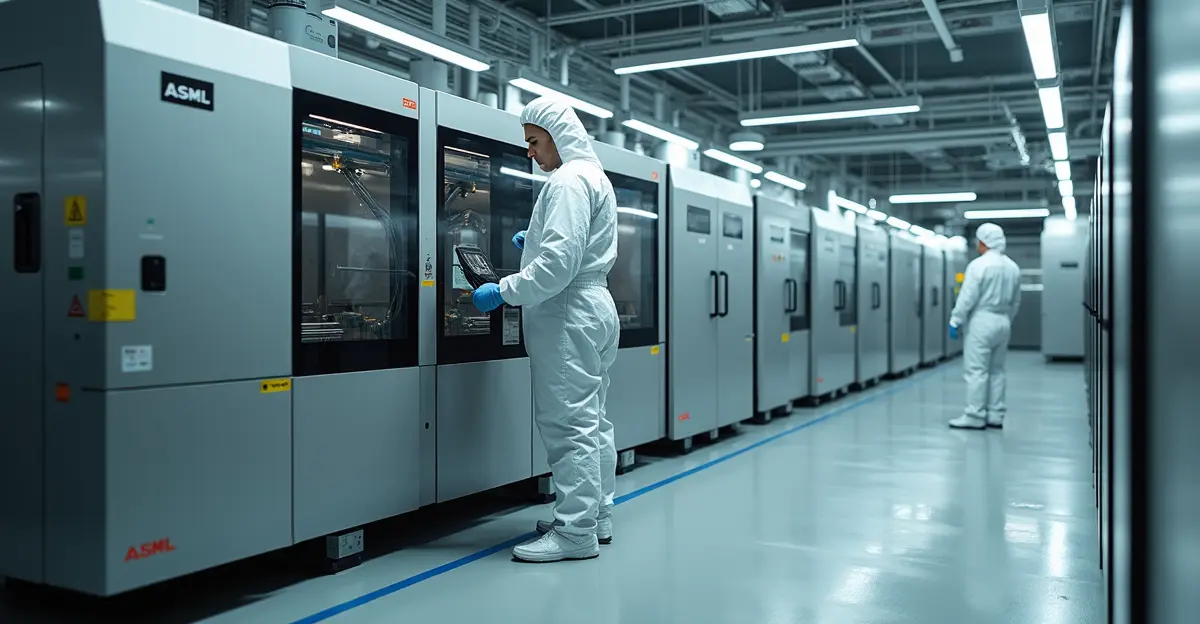
ASML Holding NV, headquartered in Veldhoven, Netherlands, dominates the global lithography machine market with an 83% worldwide sales share. The company's photolithography machines are essential for producing integrated circuits, with their extreme ultraviolet lithography (EUV) machines representing the most advanced technology available. While ASML has never been permitted to export EUV machines to China, the company continues to sell older DUV machines to Chinese customers, generating significant revenue from the world's largest semiconductor market.
The Dutch government previously tightened export controls in 2023, restricting ASML's sales of more advanced DUV machines to China. However, the MATCH Act would go further by potentially covering all DUV machines, including older models that currently remain unrestricted. This development comes amid broader global semiconductor trade tensions that have reshaped international technology policies over the past decade.
DUV vs. EUV: Understanding ASML's Technology Portfolio
| Technology | Wavelength | Capabilities | Export Status to China |
|---|---|---|---|
| Deep Ultraviolet (DUV) | 193 nm | Produces features down to 32 nanometers | Restricted for advanced models |
| Extreme Ultraviolet (EUV) | 13.5 nm | Etches patterns as small as 8 nanometers | Completely banned |
Financial and Market Implications
ASML's stock opened down 3.44% on April 2, 2026, reflecting investor concerns about the proposed legislation. The company reported $36.83 billion in annual revenue and $10.83 billion net profit in its most recent financial year, ranking 7th and 4th respectively in the Technology Equipment industry. However, CEO Christophe Fouquet has warned of possible zero growth in 2026 due to macroeconomic and geopolitical uncertainties, despite strong fundamentals in AI customer demand.
The MATCH Act could significantly impact ASML's Chinese business, which represents approximately 15% of total revenue. Chinese semiconductor manufacturers have been acquiring DUV machines in large quantities to overcome restrictions on the highest-quality chips by scaling production of slightly less advanced chips. This strategy has allowed China to continue developing its domestic semiconductor industry despite existing export controls.
Global Semiconductor Supply Chain Implications
The proposed legislation represents the latest development in Washington's yearslong push to limit China's access to semiconductor manufacturing technology. Experts warn that without stronger controls, China could develop a fully domestic AI supply chain, potentially undermining U.S. technological leadership. The MATCH Act addresses what lawmakers call 'allied asymmetry' – the situation where allies provide tools that U.S. firms cannot sell to certain markets.
The legislation also targets entity-based gaps that allow front companies to bypass restrictions, reflecting lessons learned from previous export control regimes. This comprehensive approach to technology export regulation represents a significant evolution in U.S. trade policy, moving beyond unilateral measures toward coordinated international action.
Diplomatic and International Relations Considerations
The MATCH Act's 150-day diplomatic window creates an opportunity for negotiations between the U.S., Netherlands, and other allies. Dutch officials have previously expressed concerns about the economic impact of further restrictions on ASML, which employs more than 42,000 people worldwide and relies on a network of nearly 5,000 tier 1 suppliers. The Netherlands must balance its economic interests with security concerns and alliance commitments.
European Union officials are monitoring the situation closely, as the legislation could set precedents for future technology export controls. The timing coincides with broader discussions about European technological sovereignty and the continent's position in the U.S.-China technology competition. Similar to the EU digital sovereignty initiatives, this legislation highlights growing concerns about technological dependencies and strategic autonomy.
Frequently Asked Questions (FAQ)
What is the MATCH Act?
The MATCH Act (Multilateral Alignment of Technology Controls on Hardware) is bipartisan U.S. legislation introduced in April 2026 that aims to strengthen export controls on advanced semiconductor manufacturing equipment, particularly targeting sales to China.
How will the MATCH Act affect ASML?
The legislation could restrict ASML's sales of deep ultraviolet (DUV) lithography machines to China, potentially covering all DUV models rather than just advanced versions currently restricted.
What is the timeline for the MATCH Act?
The bill gives the administration 150 days to negotiate with allies for aligned export controls before implementing unilateral restrictions if diplomatic efforts fail.
Why are DUV machines important?
DUV machines are considered the 'workhorses' of semiconductor manufacturing, capable of producing chips with features as small as 32 nanometers, which are essential for many electronic devices.
How has ASML stock reacted?
ASML stock dropped 3.44% on April 2, 2026, following the announcement, reflecting investor concerns about potential revenue impacts from new export restrictions.




Follow Discussion