


 Deutsch
 English
 Español
 Français
 Nederlands
 Português


 Share
Share




What is Trump's New Trade War Strategy?
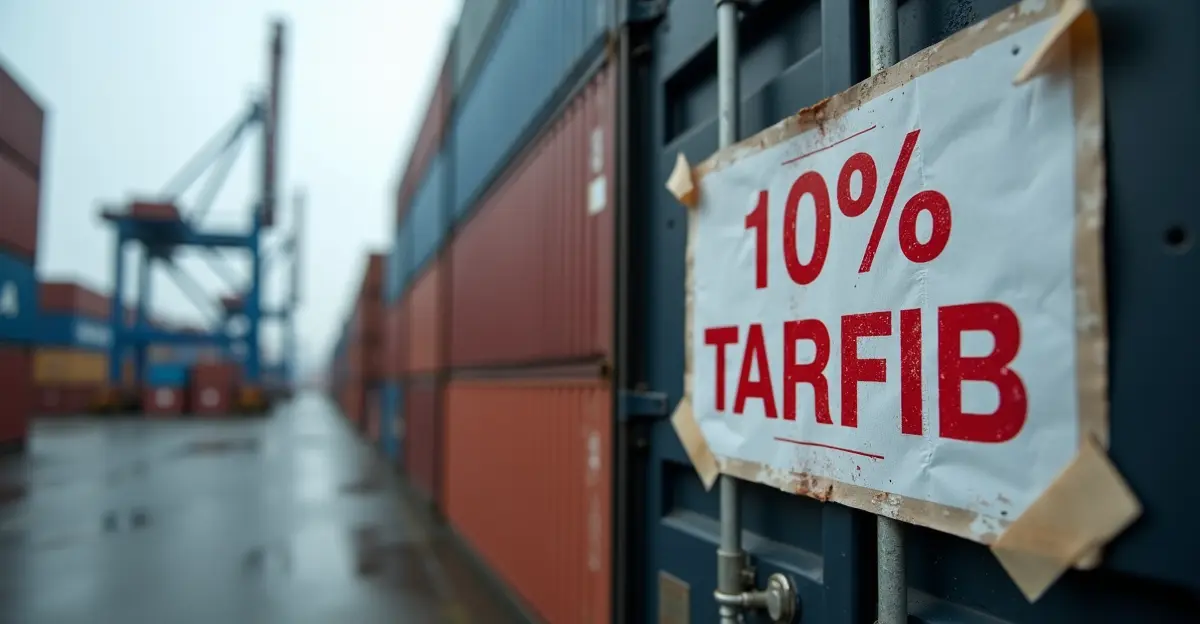
Former President Donald Trump has launched a new chapter in his ongoing trade war, implementing a 10% global tariff using a previously unused 1974 trade law after the U.S. Supreme Court struck down his previous import levies. The February 20, 2026 Supreme Court ruling declared that Trump's earlier tariffs exceeded presidential authority, but within hours, the former president pivoted to Section 122 of the Trade Act of 1974 to impose temporary 10% tariffs on all imports for 150 days. This move creates renewed uncertainty for global businesses and threatens to unravel the fragile EU-US trade deal negotiated just months earlier.
Supreme Court Rejection and Immediate Response
In a landmark 6-3 decision, the Supreme Court ruled that Trump's sweeping global tariffs imposed through executive order violated constitutional limits on presidential power. The court found that the International Emergency Economic Powers Act (IEEPA) does not authorize tariffs, striking down what had been a cornerstone of Trump's trade policy. 'Foreign countries that have been cheating us for years are thrilled. They're so happy. They're dancing in the streets, but that won't last long, I can assure you,' Trump said angrily in response to the ruling.
The Section 122 Solution
Trump immediately turned to Section 122 of the Trade Act of 1974, a provision never before used by any president. This statute allows the president to impose temporary tariffs of up to 15% for 150 days to address 'large and serious' balance-of-payments deficits. Unlike the IEEPA, Section 122 explicitly permits temporary tariffs without requiring formal investigations or national emergency declarations. Trump chose 10% rather than the maximum 15%, with the measures set to expire in late July 2026 unless Congress votes to extend them.
Impact on EU-US Trade Relations
The new tariffs threaten the delicate EU-US trade deal negotiated in July 2025, which established a 15% tariff ceiling for most EU exports including autos, semiconductors, and pharmaceuticals. Under that agreement, auto tariffs were reduced from 25% to 15% for European manufacturers. 'Europe could say: we stop now with the deal. That's possible, but what happens then with those auto tariffs? If Europe doesn't keep the agreement, what will the US do?' said Rabobank economist Maartje Wijffelaars.
Business Reactions and Uncertainty
European businesses initially celebrated the Supreme Court decision, only to face renewed uncertainty with Trump's latest move. 'For us, that's fantastic,' said Harm-Jan van Dijk of Fishtales, a company selling sustainably preserved fish to the U.S. market. Marcel Beelen, director of agricultural machinery seller FineField, noted they were 'basically positive' about the news, adding 'Every tariff less is better.' However, the 150-day certainty provided by Section 122 offers only temporary relief, with businesses facing potential new investigations under Section 301 for chips and pharmaceutical products.
Legal and Economic Implications
Three-Pronged Legal Strategy
Trump is pursuing a three-pronged legal strategy for his trade policies:
- Section 122 (1974 Trade Act): 10% global tariff for 150 days
- Section 301 (1974 Trade Act): Tariffs for unfair trade practices after investigations
- Sector-Specific Tariffs: Existing 15% tariffs on aluminum, steel, and autos remain in place
Comparison: Old vs New Tariff Approach
| Aspect | Previous Tariffs (Struck Down) | New Section 122 Tariffs |
|---|---|---|
| Legal Basis | IEEPA (Emergency Powers) | Trade Act of 1974, Section 122 |
| Rate | Up to 20% (EU target) | 10% globally |
| Duration | Indefinite | 150 days maximum |
| Congressional Role | None required | Must approve extensions |
| Targeting | Country-specific | Uniform application required |
Global Trade Chaos and Future Outlook
The latest development creates what economists describe as 'maximum uncertainty' for global trade. While businesses have 150 days of certainty with the 10% tariff, the period beyond July 2026 remains completely unpredictable. 'There are still many uncertainties. The chance that they completely disappear and that nothing replaces them is small,' Wijffelaars noted. The situation mirrors previous global trade disruptions but with added legal complexity.
Trump's use of Section 122 represents a significant legal innovation in trade policy. The statute requires only presidential determination that a 'large and serious' balance-of-payments deficit exists, but any measures must be applied uniformly across all trading partners. This prevents the country-specific targeting that characterized Trump's earlier trade policies but creates broader economic impacts.
Frequently Asked Questions
What is Section 122 of the Trade Act of 1974?
Section 122 (19 U.S.C. § 2132) authorizes the president to impose temporary import surcharges up to 15% for 150 days when the U.S. faces fundamental international payments problems affecting the dollar's value.
How long will Trump's new 10% tariffs last?
The tariffs will remain in effect for 150 days (approximately 5 months) from February 20, 2026, expiring in late July 2026 unless Congress votes to extend them.
What happens to the EU-US trade deal now?
The July 2025 agreement establishing 15% tariff ceilings remains technically in effect, but the new 10% global tariff creates confusion about whether Europe might withdraw from the deal, potentially triggering a return to higher auto tariffs.
Can businesses challenge these new tariffs in court?
Yes, but Section 122 provides clearer statutory authority than the IEEPA provisions struck down by the Supreme Court, making legal challenges more difficult.
What other trade tools does Trump have available?
Beyond Section 122, Trump can use Section 301 for unfair trade practice investigations and maintain existing sector-specific tariffs on aluminum, steel, and autos that weren't affected by the Supreme Court ruling.



Follow Discussion