


 Deutsch
 English
 Español
 Français
 Nederlands
 Português


 Share
Share




IBM's prediction that 2026 will mark the first practical quantum supremacy milestone using their 120-qubit Nighthawk processor represents a strategic inflection point with global implications. This breakthrough will enable quantum computers to outperform classical systems on real-world problems in pharmaceuticals, materials science, and financial services. The achievement carries profound national security consequences as quantum capabilities threaten current encryption standards, creating 'harvest now, decrypt later' vulnerabilities that are reshaping US-China technological competition.
What is Practical Quantum Supremacy?
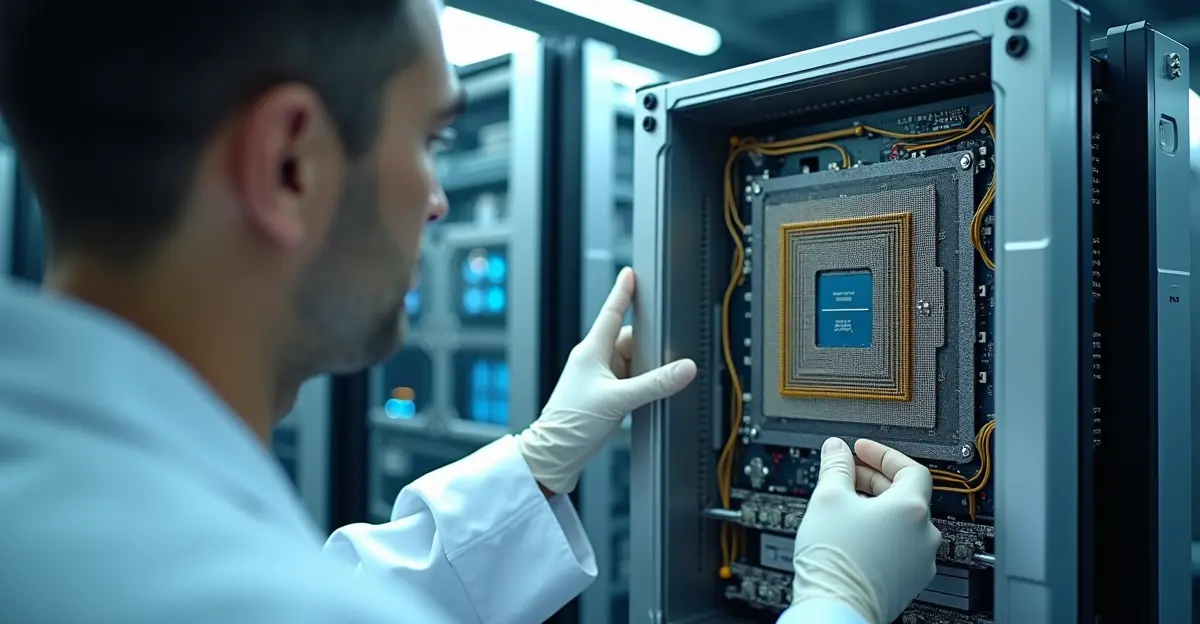
Practical quantum supremacy refers to the point at which a quantum computer can solve a commercially or scientifically valuable problem faster or more accurately than any classical computer. Unlike earlier demonstrations of quantum advantage on abstract tasks, IBM's 2026 milestone targets real-world applications. The company's Nighthawk processor, a 120-qubit device with 218 tunable couplers and median T1 coherence of 350 microseconds, is designed for complex workloads in drug discovery, materials simulation, and financial optimization. IBM has also contributed to a community-led quantum advantage tracker to ensure independent verification of claims, collaborating with Algorithmiq, the Flatiron Institute, and BlueQubit.
Industry Transformations on the Horizon
Pharmaceuticals and Drug Discovery
Quantum computing promises to revolutionize pharmaceutical research by simulating molecular interactions at an unprecedented level of detail. McKinsey estimates that quantum-assisted simulations could significantly reduce the time and cost of bringing new drugs to market, enabling faster lead optimization for small-to-medium molecules. By 2026, hybrid workflows pairing quantum solvers like VQE and QAOA with classical pre- and post-processing are expected to accelerate drug-target interaction modeling and protein folding analysis. The quantum revolution in pharma is already attracting major investments from biotech firms.
Materials Science and Financial Services
In materials science, quantum computers can model complex chemical reactions and material properties that classical systems cannot handle, potentially leading to breakthroughs in battery technology, superconductors, and lightweight composites. Financial institutions are applying quantum subroutines for derivative pricing, risk scenario simulation, and portfolio optimization. Logistics firms use hybrid optimizers to improve routing and scheduling. These applications represent the early commercial deployments of quantum computing, with most production use involving hybrid architectures that pair quantum accelerators with classical systems exposed through familiar Python libraries and cloud APIs.
National Security Implications: The 'Harvest Now, Decrypt Later' Threat
The advent of practical quantum supremacy carries urgent national security consequences. Intelligence agencies, including those of China, Russia, and the NSA, are already intercepting and storing encrypted internet traffic under a strategy known as 'harvest now, decrypt later' (HNDL). Adversaries collect encrypted data today with the intention of decrypting it once quantum computers become powerful enough to break current cryptographic standards such as RSA-2048 and ECC. The NSA's Utah Data Center can store yottabytes of data, and storage is cheap. Experts estimate quantum computers could break today's encryption between 2030 and 2035, but the migration to post-quantum cryptography (PQC) takes 7-10 years for complex organizations. NIST finalized its first three PQC standards (ML-KEM, ML-DSA, SLH-DSA) in August 2024, yet fewer than 5% of companies have started the transition. The harvest now decrypt later crisis demands immediate action from governments and enterprises.
US-China Quantum Competition
The race for quantum supremacy is a central front in US-China technological competition. A November 2025 report from the U.S.-China Economic and Security Review Commission highlights that quantum supremacy will be a critical national asset, enabling transformative advances in encryption, materials science, medical research, and intelligence collection. The U.S. leads in most quantum research through its distributed innovation ecosystem of agencies, firms, and universities. However, China has deployed industrial-scale funding and centralized state coordination to seize dominance in quantum communications and is making rapid progress in computing and sensing. Beijing's secrecy around quantum research raises concerns about miscalculation. The 2026 US Annual Threat Assessment identifies quantum computing as central to national security strategy, with China as the most prominent competitor. The US China quantum computing race is intensifying as both nations vie for technological supremacy.
Expert Perspectives
IBM's 2026 timeline for practical quantum advantage is not just a technical milestone; it is a strategic inflection point that will reshape industries and national security frameworks. The community-led advantage tracker ensures that claims are independently verified, building trust in quantum capabilities. — Jay Gambetta, IBM Vice President of Quantum. Organizations not beginning migration to post-quantum cryptography by 2026 are making an unacknowledged gamble. The governance challenge is comparable to climate risk disclosure, where consequences are predictable but deferred, making inaction individually rational yet collectively catastrophic. — Dr. Vladimir Tsakanyan, cybersecurity expert.
Frequently Asked Questions
What is practical quantum supremacy?
Practical quantum supremacy is the point at which a quantum computer solves a commercially or scientifically valuable problem faster or more accurately than any classical computer, moving beyond abstract tasks to real-world applications.
When will IBM achieve practical quantum supremacy?
IBM predicts that the wider quantum community will confirm quantum advantage by the end of 2026, using its 120-qubit Nighthawk processor and other systems.
What is 'harvest now, decrypt later'?
It is a strategy where adversaries collect encrypted data today and store it for future decryption once quantum computers become powerful enough to break current encryption standards like RSA and ECC.
How does quantum computing affect US-China competition?
Quantum supremacy is a critical national asset, with both nations investing heavily. The U.S. leads in research innovation, while China deploys industrial-scale funding and state coordination, particularly in quantum communications.
What industries will quantum computing transform first?
Pharmaceuticals, materials science, financial services, and logistics are expected to see early commercial deployments, with hybrid quantum-classical workflows accelerating drug discovery, materials simulation, and optimization problems.
Conclusion and Future Outlook
IBM's 2026 practical quantum supremacy milestone represents a watershed moment for technology, industry, and global security. As quantum computers begin to outperform classical systems on real-world problems, the imperative for post-quantum cryptography migration becomes urgent. The quantum computing national security implications will continue to drive policy decisions and investment. Organizations that prepare now—by adopting hybrid quantum architectures, migrating to PQC, and monitoring the quantum advantage tracker—will be best positioned to harness the transformative power of quantum computing while mitigating its risks.




Follow Discussion