


 Deutsch
 English
 Español
 Français
 Nederlands
 Português


 Share
Share




The 2026 Quantum Computing Milestone: When Quantum Advantage Reshapes Global Security and Finance
As 2026 approaches, the quantum computing industry stands at a historic inflection point where quantum computers are poised to begin outperforming classical supercomputers for specific, commercially valuable tasks. IBM and other industry leaders predict this breakthrough year will trigger immediate strategic shifts in global cryptography, financial markets, and national security postures. The quantum computing revolution is no longer theoretical—it's becoming operational reality, forcing organizations worldwide to confront the 'harvest now, decrypt later' threat to current encryption standards while preparing for quantum advantage in optimization problems that could disrupt financial modeling, drug discovery, and materials science within the next 12-24 months.
What is Quantum Advantage and Why Does 2026 Matter?
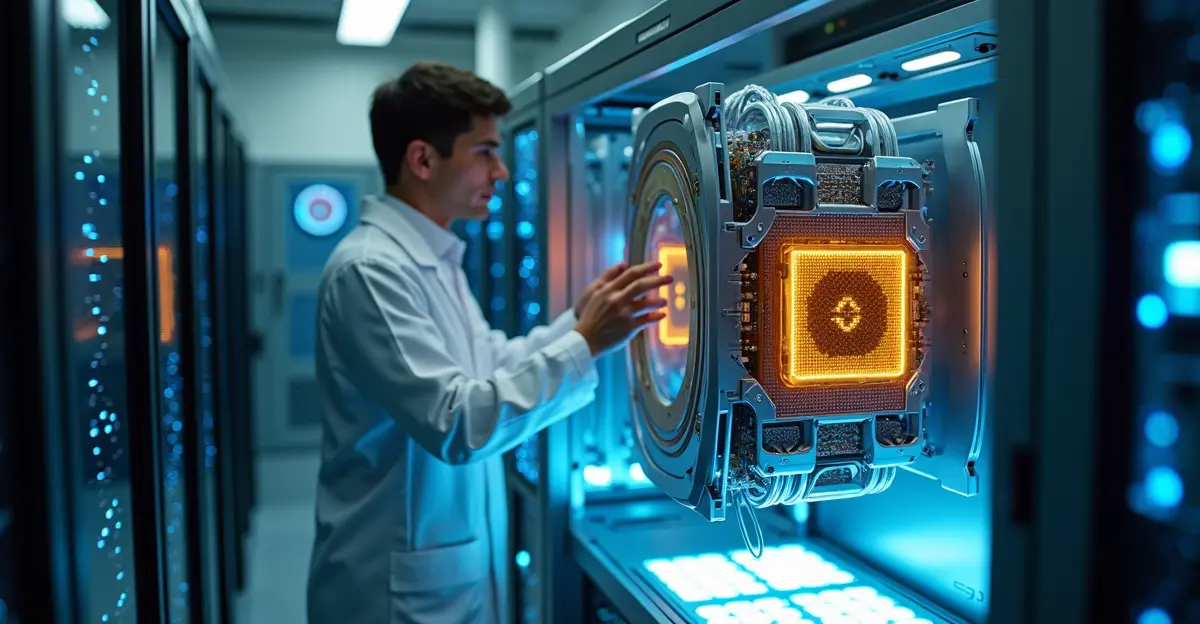
Quantum advantage refers to the moment when quantum computers solve practical problems faster or more efficiently than classical computers can. Unlike quantum supremacy—which demonstrated theoretical superiority on contrived problems—quantum advantage represents commercially meaningful breakthroughs. IBM's 2026 roadmap targets 'verified quantum advantage' using their Nighthawk processor featuring up to 360 qubits across three 120-qubit modules, capable of running 7,500 gates. This pre-fault-tolerant quantum computer will work alongside High Performance Computing (HPC) systems to unlock scientific advantages for users and partners.
According to IBM's official roadmap, the company will develop a use case benchmarking toolkit to evaluate quantum advantage candidates and deliver mapping/profiling tools for quantum+HPC workflows. The quantum computing market is projected to grow from USD 3.52 billion in 2025 to USD 20.20 billion by 2030, representing a compound annual growth rate (CAGR) of 41.8%, with optimization applications accounting for the largest market share and banking/finance being the leading end-user sector.
The 'Harvest Now, Decrypt Later' Threat to Global Security
Current Encryption Under Siege
The most immediate threat from quantum computing advancement is to current cryptographic systems. Adversaries are already employing 'harvest now, decrypt later' (HNDL) strategies, collecting encrypted data today that will become vulnerable once quantum systems mature. Intelligence agencies including China, Russia, and likely the NSA are currently intercepting and storing encrypted internet traffic, waiting for quantum computers powerful enough to break today's standard encryption (RSA-2048, ECC).
As noted in a Check Point security analysis, 'Traditional approaches to post-quantum cryptography (PQC) migration are insufficient due to unknown dependencies, legacy systems, and undocumented services.' High-value targets include diplomatic cables, military communications, medical records, financial transactions, and encrypted messaging that remains sensitive for years.
The Race for Quantum-Resistant Cryptography
On August 13, 2024, NIST released final versions of the first three Post Quantum Crypto Standards: FIPS 203, FIPS 204, and FIPS 205. However, fewer than 5% of companies have started transitioning to quantum-resistant encryption. The NSA requires all national security systems to migrate by 2035, but widespread adoption remains slow despite the urgent threat to long-term data security.
Organizations need crypto agility—the ability to discover, manage, and rapidly replace cryptographic assets across hybrid environments. The transition requires hybrid cryptography combining NIST-recommended post-quantum algorithms with symmetric encryption. 'PQC migration is now a board-level strategic risk, and delaying action risks irreversible data breaches, regulatory penalties, and reputational damage,' warns cybersecurity experts.
Quantum Advantage in Finance and Industry
Financial Markets Transformation
Quantum computing's ability to solve complex optimization problems will revolutionize financial markets. Portfolio optimization, risk analysis, derivative pricing, and algorithmic trading strategies that currently take classical computers days or weeks to solve could be completed in minutes or hours. The financial technology sector is preparing for this disruption, with major banks establishing quantum computing research divisions and partnerships with quantum hardware providers.
According to the QED-C State of the Global Quantum Industry 2026 report, the quantum technology sector shows significant growth with 7,420 quantum-engaged organizations (14% growth), 556 pure-play quantum companies (8% growth), and a $1.9 billion market size with 30% average annual growth. Investment surged dramatically with $12.7 billion in new government funding commitments (310% increase) and $4.9 billion in new private venture capital (192% increase).
Drug Discovery and Materials Science Breakthroughs
Quantum computers excel at simulating molecular interactions and material properties—tasks that are exponentially difficult for classical computers. By 2026, quantum advantage in chemistry simulations could accelerate drug discovery timelines from years to months, potentially revolutionizing pharmaceutical development. Materials science applications include designing more efficient batteries, superconductors, and catalysts for clean energy technologies.
Early applications are expected in 3-5 years in materials science, drug discovery, and optimization problems. Market forecasts project quantum sensing growing from $470M to $1.1B by 2028, while quantum computing scales from $1.4B to over $3B in the same period.
Global Strategic Implications and National Security
The 2026 quantum milestone has profound implications for national security and global power dynamics. Nations leading in quantum technology will gain strategic advantages in intelligence, defense, and economic competitiveness. The United States, China, and European Union are investing billions in quantum research, recognizing that quantum superiority could determine future geopolitical influence.
The national security implications extend beyond cryptography to quantum sensing for submarine detection, quantum navigation systems that don't rely on GPS, and quantum-enhanced surveillance capabilities. Military applications include optimizing logistics, simulating battlefield scenarios, and developing new materials for defense systems.
Industry Perspectives and Expert Analysis
Industry experts offer mixed perspectives on the 2026 timeline. While IBM has committed to delivering 'verified quantum advantage' by the end of 2026, prediction markets remain skeptical about this aggressive timeline. According to analysis from Byteiota, 'Industry experts and prediction markets remain overwhelmingly skeptical about this timeline, viewing 2026 as a year of steady technical progress rather than revolutionary breakthroughs.'
IBM's 'utility-first' strategy contrasts with Google's 'fidelity-first' approach, with IBM focusing on rapid scaling while Google prioritizes error correction. Quantum advantage, if achieved, will be narrow and task-specific—primarily for chemistry simulations, optimization tasks, and drug discovery applications—rather than general-purpose computing. Fault-tolerant quantum computing remains a decade-long journey, with IBM targeting 2029 for its Quantum Starling system.
Frequently Asked Questions About Quantum Computing 2026
What exactly is quantum advantage?
Quantum advantage occurs when quantum computers solve practical, commercially valuable problems faster or more efficiently than classical computers can. Unlike quantum supremacy (theoretical superiority on artificial problems), advantage represents meaningful real-world breakthroughs.
Why is 2026 considered the breakthrough year?
IBM and other industry leaders have identified 2026 as when quantum computers will achieve practical advantage over classical systems for specific tasks. IBM's roadmap targets verified quantum advantage using their 360-qubit Nighthawk processor working alongside high-performance computing systems.
What is 'harvest now, decrypt later'?
This strategy involves adversaries collecting encrypted data today that will become vulnerable when quantum computers mature enough to break current encryption standards. Intelligence agencies are already intercepting and storing encrypted communications for future decryption.
How will quantum computing affect financial markets?
Quantum computers will revolutionize portfolio optimization, risk analysis, derivative pricing, and algorithmic trading by solving complex optimization problems exponentially faster than classical computers, potentially transforming financial modeling and market strategies.
What industries will benefit first from quantum advantage?
Finance, pharmaceuticals, materials science, and logistics will see early benefits. Drug discovery, battery design, financial optimization, and supply chain management are among the first applications expected to demonstrate quantum advantage.
Is current encryption already vulnerable?
While current encryption remains secure against today's quantum computers, the 'harvest now, decrypt later' threat means encrypted data collected today could be decrypted in the future when quantum capabilities mature, making migration to quantum-resistant cryptography urgent.
Conclusion: Preparing for the Quantum Era
As 2026 approaches, organizations across finance, defense, healthcare, and critical infrastructure must prepare for the quantum computing revolution. The transition requires both immediate action on cryptography migration and strategic planning for quantum advantage applications. The technological transformation represents both unprecedented risks and opportunities, with early adopters positioned to gain competitive advantages while laggards face existential threats to data security and operational efficiency.
The quantum computing market's projected growth from $3.52 billion in 2025 to $20.20 billion by 2030 underscores the accelerating pace of development. Whether 2026 marks the definitive breakthrough or represents another step in the gradual evolution of quantum technology, one thing is certain: the quantum era is dawning, and its impact on global security, finance, and industry will be profound and irreversible.
Sources
IBM Quantum Roadmap 2026, Check Point Security Analysis, QED-C Global Quantum Industry Report 2026, NIST Post-Quantum Cryptography Standards, Byteiota Industry Analysis, MarketsandMarkets Quantum Computing Market Report




Follow Discussion