

 Deutsch
 English
 Español
 Français
 Nederlands
 Português







The Quantum Computing Tipping Point: How 2026's Hardware Breakthroughs Redefine Global Security and Economic Competition
In a historic technological milestone, 2026 marks the year quantum computers will first outperform classical supercomputers for specific, practical business applications, according to IBM's definitive roadmap and industry predictions. This quantum advantage breakthrough represents more than just a technical achievement—it signals a fundamental shift in global security architecture, economic competitiveness, and scientific discovery that will reshape international relations and industrial landscapes for decades to come. The convergence of advanced quantum hardware, sophisticated error correction, and practical algorithms creates unprecedented opportunities and vulnerabilities across every sector of the global economy.
What is Quantum Advantage and Why Does 2026 Matter?
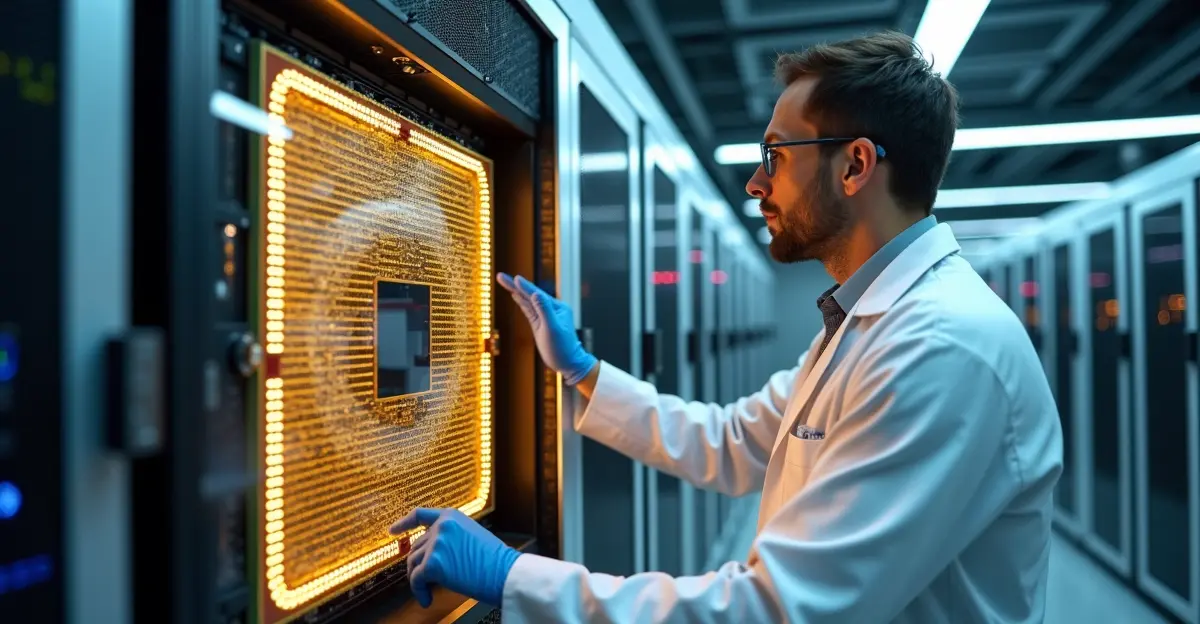
Quantum advantage, sometimes called quantum supremacy, occurs when a quantum computer solves a problem faster, cheaper, or more accurately than any classical computer could manage. Unlike previous demonstrations on specialized academic tasks, 2026's breakthrough involves "real business applications that matter to industries worldwide," as IBM executives have confirmed. The company's Quantum Nighthawk processor, featuring 120 qubits and 5,000 two-qubit gate operations, represents the hardware foundation for this achievement. IBM has shifted to 300mm wafer fabrication facilities, doubling chip development speed while improving reliability through proven semiconductor techniques. This manufacturing breakthrough enables the complexity needed for practical quantum advantage.
The Geopolitical Quantum Race: US, China, and EU Strategies
The global competition for quantum supremacy has become a critical arena of great-power competition, with nations investing over $40 billion globally to secure strategic advantages. According to a U.S.-China Economic and Security Review Commission report, while America leads in most quantum research, China has deployed industrial-scale funding and centralized coordination to achieve dominance in quantum systems. China currently leads the world in quantum communications and is making rapid progress in quantum computing and sensing. The United States employs a private-sector-driven approach through its National Quantum Initiative, leveraging companies like IBM and Google, while China pursues a state-directed strategy with massive government investment. The European Union focuses on collaborative research through its Quantum Flagship program, creating a three-way technological race with profound implications for future economic leadership.
National Security Implications: The Encryption Crisis
The most immediate threat from quantum computing involves cryptography. Current encryption standards like RSA and elliptic-curve algorithms, which protect everything from financial transactions to military communications, could be broken by sufficiently powerful quantum computers. The G7 Cyber Expert Group, co-chaired by the U.S. Treasury and Bank of England, has issued a landmark roadmap warning that quantum computers capable of breaking current encryption could emerge by the early-to-mid 2030s, creating urgent risks through 'harvest now, decrypt later' attacks. This means adversaries could be collecting encrypted data today to decrypt it once quantum computers become powerful enough. The guidance targets 2035 as the overall completion date for migration to quantum-resistant cryptography across financial systems, with critical infrastructure prioritized for protection by 2030-2032.
Economic Transformation: Industries Poised for Disruption
Pharmaceuticals and Drug Discovery
Quantum computing promises to revolutionize drug discovery by enabling more accurate molecular modeling and simulation of complex biological systems. According to research published in Nature, quantum approaches can explore the vast chemical space of potential drug compounds (estimated at 10^60 molecules) more efficiently than classical methods, potentially reducing the typical decade-long, billion-dollar drug development timeline. Quantum Phase Estimation (QPE) for molecular energy calculations and Variational Quantum Eigensolver (VQE) for electronic structure problems represent key quantum methods that could transform pharmaceutical innovation.
Materials Science and Logistics Optimization
Beyond pharmaceuticals, quantum computing offers transformative potential for materials science, enabling the discovery of new materials with specific properties for energy storage, electronics, and manufacturing. Supply chain logistics represents another critical application area, where quantum algorithms could optimize complex routing and scheduling problems that currently challenge even the most powerful classical supercomputers. The financial sector's quantum transition will require massive infrastructure changes as institutions prepare for post-quantum cryptography standards.
Strategic Policy Responses Required
The quantum transition demands coordinated policy responses across multiple domains. Governments must balance innovation promotion with security considerations, develop workforce training programs for quantum-literate professionals, and establish international standards for quantum-safe cryptography. The U.S. National Quantum Initiative provides a model for public-private partnerships, but global coordination remains essential to prevent fragmentation and ensure interoperability. Policy makers face the dual challenge of accelerating beneficial quantum applications while mitigating security risks through timely adoption of post-quantum cryptographic standards.
Investment and Infrastructure Requirements
The quantum revolution requires substantial investment in both hardware infrastructure and software ecosystems. IBM's roadmap includes achieving fault-tolerant quantum computing by 2029 with the 'Starling' system featuring 1,000 qubits and 200 error-corrected logical qubits. This progression from quantum advantage to fault tolerance represents the next critical milestone, enabling more reliable and scalable quantum applications. Organizations must begin planning now for quantum integration, developing hybrid quantum-classical workflows that leverage each technology's strengths.
Expert Perspectives on the Quantum Transition
"The 2026 quantum advantage milestone represents a fundamental shift in computational capability," explains Dr. Sarah Chen, quantum computing researcher at Stanford University. "Unlike previous technological transitions, quantum computing doesn't just make calculations faster—it enables entirely new classes of problems to be solved that were previously intractable." Industry leaders emphasize the urgency of preparation, noting that organizations delaying quantum readiness initiatives risk being left behind in both security and competitive positioning.
Frequently Asked Questions About Quantum Computing 2026
What exactly will quantum computers do better than classical computers in 2026?
In 2026, quantum computers will demonstrate advantage on specific practical problems including molecular simulations for drug discovery, optimization problems in logistics and finance, and certain cryptographic calculations. These won't be academic exercises but real business applications with measurable economic impact.
How soon do organizations need to adopt post-quantum cryptography?
Organizations should begin planning immediately, with critical infrastructure requiring protection by 2030-2032 according to G7 recommendations. The 'harvest now, decrypt later' threat means encrypted data being transmitted today could be vulnerable once quantum computers reach sufficient power.
Which country is winning the quantum computing race?
The United States currently leads in quantum research and private sector innovation, while China leads in quantum communications and has made rapid progress through state-directed investment. The European Union maintains strong collaborative research through its Quantum Flagship program, creating a competitive three-way race.
Will quantum computers replace classical computers?
No, quantum computers will work alongside classical systems as specialized accelerators for specific problem classes where quantum mechanics provides inherent advantages. Most computing tasks will continue to run on classical hardware for the foreseeable future.
What industries will benefit first from quantum computing?
Pharmaceuticals, materials science, financial services, and logistics will see the earliest practical benefits, followed by energy, chemicals, and artificial intelligence as quantum hardware and algorithms mature.
Conclusion: Navigating the Quantum Future
The 2026 quantum advantage milestone represents more than a technical achievement—it marks the beginning of a new computational era with profound implications for global security, economic competitiveness, and scientific discovery. Organizations and nations that proactively prepare for this transition will gain significant advantages, while those that delay risk exposure to security vulnerabilities and competitive disadvantages. The technological sovereignty debate will intensify as quantum capabilities become increasingly strategic assets. As IBM's roadmap demonstrates, the path from quantum advantage to fault-tolerant quantum computing is now clearly defined, providing a framework for strategic planning across government, industry, and academia. The quantum future is arriving faster than many anticipated, demanding urgent attention and coordinated action at global scale.
Sources
IBM Quantum Roadmap 2026, U.S.-China Economic and Security Review Commission Report, G7 Cyber Expert Group Post-Quantum Cryptography Roadmap, Nature Quantum Computing in Drug Discovery Research, McKinsey Quantum Revolution in Pharma Analysis, Forbes IBM Quantum Advantage Timeline Report





Follow Discussion