


 Deutsch
 English
 Español
 Français
 Nederlands
 Português


 Share
Share




What is the Quantum Computing 2030 Deadline?
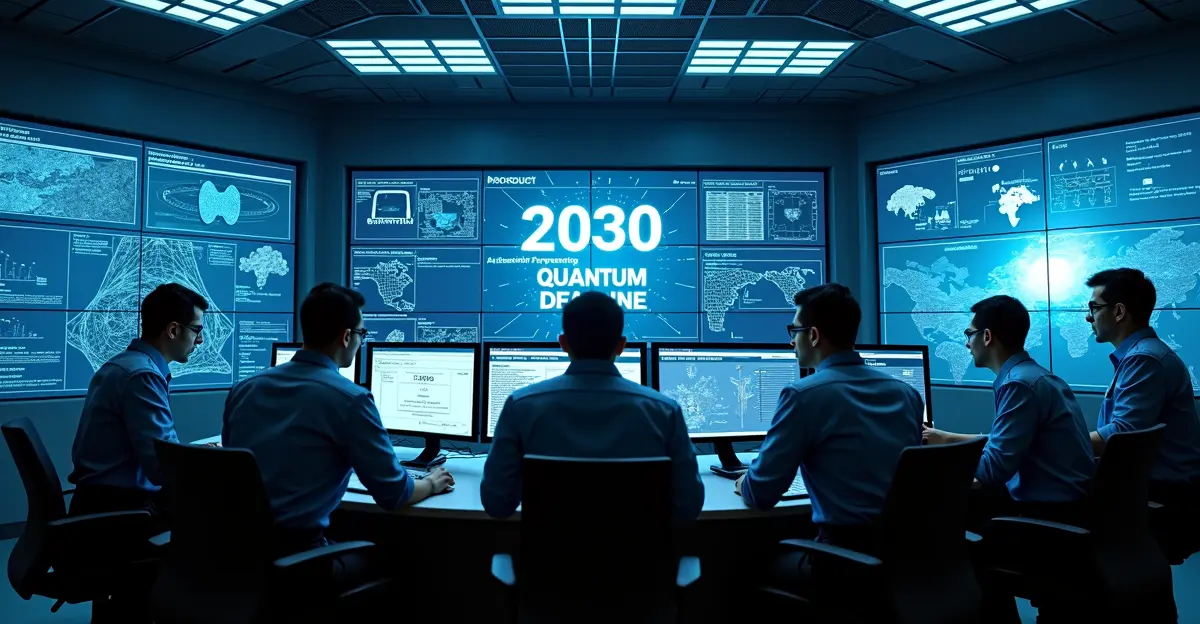
The quantum computing 2030 deadline represents a critical inflection point in global security, marking the projected timeframe when quantum computers are expected to break current encryption standards that protect everything from financial transactions to military communications. Recent GAO reports and Pentagon assessments indicate 2025-2026 as pivotal years for post-quantum risk modeling, creating urgent strategic pressure on governments worldwide to quantum-proof their critical infrastructure before this technological threshold is crossed. This looming deadline has sparked an intense global race among major powers to secure their digital foundations against what experts describe as the most significant cryptographic threat in modern history.
The Global Quantum Arms Race Intensifies
Nations are now engaged in what security analysts term a 'quantum arms race,' with the United States, China, and European Union implementing aggressive national strategies to achieve quantum resilience. The stakes couldn't be higher: quantum computers capable of breaking public-key encryption would compromise national security systems, financial networks, energy grids, and communication infrastructure simultaneously. According to a June 2025 GAO report titled 'Quantum Computing: Leadership Needed to Coordinate Cyber Threat Mitigation Strategy,' the window for preparation is narrowing rapidly, with the 'harvest now, decrypt later' threat already active as adversaries collect encrypted data today for future decryption.
United States: Pentagon's Quantum Resilience Timeline
The United States has established a comprehensive framework through the Quantum Computing Cybersecurity Preparedness Act, requiring federal agencies to inventory quantum-vulnerable systems. The Pentagon's strategy includes three key pillars: the National Security Memorandum-10's 2035 migration target, NIST's finalized FIPS standards for post-quantum cryptography, and CISA's product category list for critical infrastructure protection. The U.S. approach emphasizes a distributed innovation ecosystem, with the National Institute of Standards and Technology (NIST) leading development of quantum-resistant encryption standards expected to be finalized by 2024. However, recent assessments suggest the threat may be more imminent than previously estimated, with some experts warning that cryptography-breaking quantum computers could emerge within 5-10 years rather than the 10-20 year timeline suggested in some government reports.
China's $5 Billion Quantum Investment Strategy
China has emerged as a quantum superpower through a government-led strategy featuring massive public investment exceeding $5 billion and comprehensive long-term planning. The country's approach focuses on five primary quantum areas: computing/supercomputing, communication, sensing, materials, and quantum AI/data centers. China's national quantum communication network already spans 12,000 kilometers with 145 nodes across 17 provinces, including two dedicated quantum satellites. Unlike the U.S.'s distributed model, China employs centralized coordination through state research labs, defense-affiliated firms, and military procurement systems, enabling rapid scaling of successful technologies. The country's 14th Five-Year Plan identifies quantum technologies as strategic priorities, with plans for a National Venture Guidance Fund approaching 1 trillion yuan ($138 billion) to support quantum startups and innovation.
European Union's Quantum Resilience Framework
The European Commission has adopted its Quantum Europe Strategy titled 'Quantum Europe in a Changing World' (COM/2025/363 final), positioning Europe as a global leader in quantum technologies. The EU's comprehensive strategy addresses current fragmentation and aims to accelerate industrial deployment across five key areas: Research and Innovation, Quantum Infrastructures, Strengthening the EU Quantum Ecosystem, Market Creation and Adoption, and International Cooperation. Europe currently boasts the world's largest concentration of quantum talent and approximately one-third of all quantum companies worldwide, though it ranks only third in quantum patents. The strategy builds on Europe's €11 billion investment in quantum technologies over the past five years and sets the stage for a forthcoming Quantum Act in 2026, focusing on coordinated investment, open-access testbeds, and collaborative projects.
Strategic Vulnerabilities in Critical Infrastructure
The quantum threat exposes fundamental vulnerabilities across multiple sectors of critical infrastructure. Financial systems face particular risk, with the World Economic Forum warning that uneven adoption of post-quantum cryptography could create a two-tier global financial system. Studies show limited quantum readiness in sectors like India's financial services, with post-quantum readiness averaging just 2.4 out of 5. Defense networks are equally vulnerable, as quantum computers could potentially decrypt classified military communications and compromise command-and-control systems. Energy grids, transportation networks, and healthcare systems all rely on digital communications protected by current encryption methods that quantum computers could break.
The emerging quantum arms race presents unique challenges compared to traditional military competitions. Quantum capabilities can be quietly integrated into existing systems, potentially creating sudden strategic effects before international governance frameworks are established. Key destabilizing applications include quantum computing breaking public-key cryptography, quantum sensing threatening deterrence stability (especially subsea systems), and quantum communications creating security disparities between nations. According to security analysts, quantum-enabled advantages combined with artificial intelligence could reduce crisis decision-making timeframes and increase misperception risks in international relations.
Geopolitical Implications and Global Security Architecture
The race for quantum supremacy is reshaping the global security architecture, with the first country to achieve it gaining disproportionate advantages in encryption, materials science, energy production, medical research, intelligence collection, and precision targeting. Unlike previous technological competitions, quantum capabilities are inherently dual-use, with civilian and military applications developing simultaneously. This creates complex governance challenges as nations balance innovation with security concerns.
NATO has developed its first quantum strategy, viewing these technologies as key elements of strategic competition in the 21st century. The alliance recognizes that quantum supremacy will be a critical national asset, potentially altering the balance of power in ways reminiscent of the nuclear age. However, the distributed nature of quantum research presents challenges for traditional alliance structures, as technological breakthroughs can occur in academic institutions, private companies, or government labs across multiple nations.
The global financial system's vulnerability to quantum attacks represents a particularly urgent concern. The 'harvest now, decrypt later' threat means that sensitive financial data transmitted today could be decrypted years later when quantum computers become available. This creates immediate pressure on financial institutions to transition to quantum-resistant encryption, even before the actual quantum threat materializes. The solution, according to experts, requires treating quantum security as shared financial infrastructure rather than a competitive advantage, using AI-driven automation to help smaller institutions transition.
Expert Perspectives on the 2030 Timeline
Security experts are divided on the precise timeline for quantum threats, but agree on the urgency of preparation. 'The real danger isn't quantum computers breaking encryption tomorrow, but the uneven adoption of post-quantum cryptography that could create security disparities between nations,' explains Dr. Elena Rodriguez, a quantum security analyst at the Center for International Security Studies. '2026 is emerging as a critical planning year, as migration to quantum-safe systems takes years and must begin well before quantum computers become capable of breaking current encryption standards.'
Pentagon assessments emphasize that 2025-2026 represent critical years for post-quantum risk modeling, with the transition to quantum-resistant systems requiring extensive testing and implementation across complex government and private sector networks. The U.S. approach includes establishing strong federal leadership through the Office of the National Cyber Director, developing a quantum-capable workforce, investing in post-quantum readiness, and securing the quantum technology supply chain.
FAQ: Quantum Computing's 2030 Deadline
What is the quantum computing 2030 deadline?
The 2030 deadline refers to the projected timeframe when quantum computers are expected to become capable of breaking current public-key encryption standards, threatening the security of digital communications, financial transactions, and critical infrastructure worldwide.
Which countries are leading the quantum race?
The United States, China, and European Union are currently leading the quantum race, with China investing over $5 billion in quantum technologies, the U.S. implementing comprehensive regulatory frameworks, and the EU developing its Quantum Europe Strategy with €11 billion in investments.
What is 'harvest now, decrypt later'?
This refers to the practice where adversaries collect encrypted data today with the intention of decrypting it later when quantum computers become available, making current encrypted communications vulnerable even before quantum computers exist.
How are financial systems preparing for quantum threats?
Financial institutions are beginning to transition to post-quantum cryptography, with major banks and payment systems testing quantum-resistant algorithms. However, adoption remains uneven, risking a two-tier financial system where wealthy nations and large corporations are protected while smaller institutions remain vulnerable.
What can organizations do to prepare?
Organizations should start by inventorying systems using public-key cryptography, testing new quantum-resistant standards in lab environments, creating transition plans, and developing quantum-capable cybersecurity teams. CISA recommends beginning preparation immediately, as migration to quantum-safe systems takes several years.
Conclusion: The Critical Window for Action
The quantum computing 2030 deadline represents one of the most significant security challenges of the digital age, requiring coordinated global action to protect critical infrastructure. With major powers racing to implement quantum resilience strategies, the next 2-4 years will determine whether nations can secure their digital foundations before quantum computers render current encryption obsolete. The strategic vulnerabilities in financial systems, defense networks, and energy grids demand immediate attention, with 2025-2026 emerging as critical planning years for governments and private sector organizations worldwide. As the quantum arms race intensifies, international cooperation on standards and governance will be essential to prevent security disparities that could destabilize the global order.





Follow Discussion