
 Deutsch
 English
 Español
 Français
 Nederlands
 Português






What is the Cat Righting Reflex?
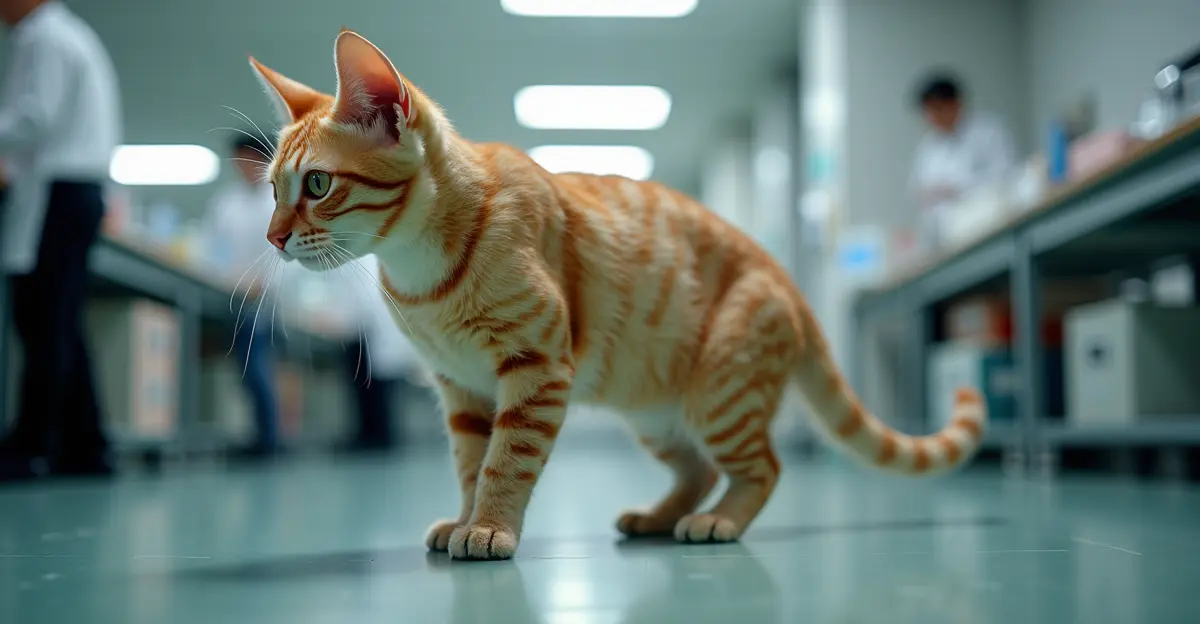
The cat righting reflex is a feline's remarkable innate ability to orient itself during a fall to land on its feet. This acrobatic phenomenon, which has fascinated scientists for centuries, involves complex biomechanics that allow cats to rotate their bodies mid-air without violating the conservation of angular momentum. Recent research from Yamaguchi University reveals new insights into this reflex that could have significant implications for veterinary medicine and advanced robotics systems.
Groundbreaking Research from Yamaguchi University
Researchers at Japan's Yamaguchi University conducted comprehensive anatomical and mechanical studies to understand the precise mechanisms behind the cat righting reflex. Their methodology involved both mechanical testing on deceased cats to analyze spinal flexibility and high-speed camera analysis of living cats to observe the reflex in action. The study, published in the journal Anatomical Record, represents one of the most detailed examinations of this phenomenon to date.
The Secret: Asymmetrical Spinal Flexibility
The key discovery centers on the cat's asymmetrical spinal flexibility. The thoracic (chest) vertebrae demonstrate extreme flexibility, capable of rotating up to 50 degrees, while the lumbar (lower back) vertebrae remain relatively stiff, providing essential stability. This combination creates a controlled rotational mechanism that enables the cat to execute its famous mid-air correction.
'The thoracic spine acts as a flexible rotor while the lumbar spine serves as a stabilizing anchor,' explained lead researcher Dr. Hiroshi Tanaka. 'This differential flexibility allows for the precise, sequential rotation that characterizes the righting reflex.'
How Cats Land on Their Feet: The Four-Step Process
The research identified a specific four-step sequence that cats follow during the righting reflex:
- Initial orientation: The cat determines which way is down using its vestibular system and vision
- Front-half rotation: The flexible thoracic spine rotates the head and front legs toward the ground
- Rear-half adjustment: The stiffer lumbar spine helps stabilize while the rear legs follow
- Final positioning: All four legs extend to prepare for impact distribution
This process typically occurs within 0.3 to 0.5 seconds for an average domestic cat falling from moderate heights.
Robotics Applications: From Cats to Cutting-Edge Technology
The most promising application of this research lies in robotics development. The Yamaguchi University team suggests that understanding the cat righting reflex could lead to:
- Self-righting robots: Machines that can automatically correct their orientation during falls
- Improved stability systems: Enhanced balance mechanisms for walking and climbing robots
- Search and rescue robotics: Drones and ground robots that can recover from unexpected tumbles
- Biomimetic design: Robotic systems that mimic biological movement patterns
These applications could revolutionize fields ranging from disaster response to space exploration, where autonomous robotic systems must maintain functionality in unpredictable environments.
Veterinary Medicine Implications
Beyond robotics, the research has significant implications for veterinary medicine. Understanding the precise biomechanics of spinal movement could help veterinarians:
- Better diagnose and treat spinal injuries in cats
- Develop improved rehabilitation protocols for injured felines
- Create more effective pain management strategies for spinal conditions
- Enhance surgical techniques for spinal procedures
The study's findings about differential spinal flexibility could lead to breakthroughs in treating conditions like intervertebral disc disease, which affects many domestic cats.
The Physics Behind the Phenomenon
What makes the cat righting reflex particularly fascinating from a physics perspective is how it appears to defy the conservation of angular momentum. Since cats begin their falls with zero angular momentum, they shouldn't be able to rotate without pushing against something. However, the solution lies in the cat's ability to change its moment of inertia by extending and retracting different body parts at different times.
By bending at the middle and manipulating their front and rear halves independently, cats create two separate rotational systems that can turn in opposite directions while maintaining overall angular momentum at zero. This sophisticated physical manipulation demonstrates nature's elegant engineering solutions.
Historical Context and Future Research
The cat righting reflex has been studied since at least the 19th century, with French scientist Étienne-Jules Marey using chronophotography in the 1890s to capture the phenomenon. Modern research builds on this foundation with advanced imaging technology and computational modeling.
Future research directions identified by the Yamaguchi team include:
- Quantifying the reflex across different cat breeds and ages
- Developing mathematical models for robotic implementation
- Studying similar reflexes in other animals for comparative biomechanics
- Exploring applications in human prosthetics and exoskeletons
Frequently Asked Questions
Do all cats have the righting reflex?
Yes, all healthy cats develop this reflex between 3-9 weeks of age. It becomes fully developed by approximately 7 weeks and remains throughout their lives, though aging or injury can affect its efficiency.
Can cats always land safely from any height?
No. While the righting reflex helps cats land on their feet, they can still sustain serious injuries from falls. Research shows that falls from 5-7 stories typically cause the most severe injuries, while falls from greater heights sometimes result in fewer injuries due to terminal velocity and relaxation before impact.
How quickly can a cat right itself during a fall?
An average domestic cat can complete the righting reflex in approximately 0.3-0.5 seconds, depending on the height of the fall and the cat's physical condition.
Do tailless cats have the same righting ability?
Yes. While the tail assists with balance, it's not essential for the righting reflex. Cats without tails use their legs and spinal rotation to accomplish the same maneuver.
When will we see cat-inspired robots?
Early prototypes already exist in research laboratories. The Yamaguchi team estimates that practical applications in commercial and rescue robotics could emerge within 3-5 years as the biomechanical principles are translated into engineering specifications.
Sources
Yamaguchi University Research Publication
Wikipedia: Cat Righting Reflex
Wikipedia: Yamaguchi University


Follow Discussion