
 Deutsch
 English
 Español
 Français
 Nederlands
 Português






European Council President Delivers Sharp Rebuke to US Security Strategy
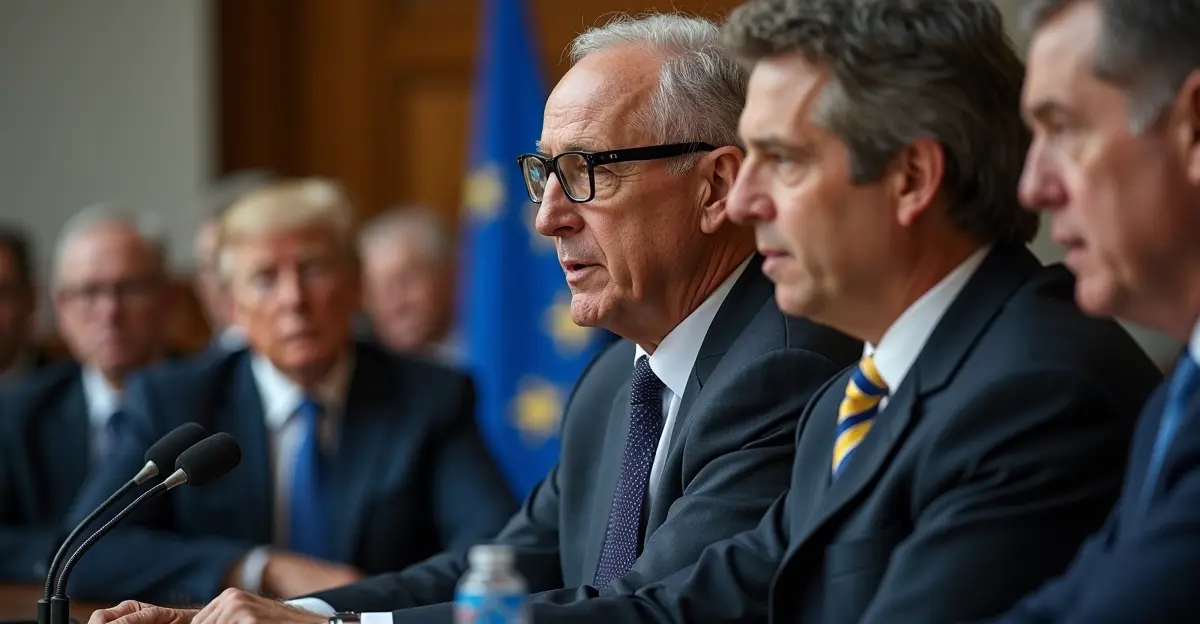
European Council President Antonio Costa has issued a stern warning to the United States, telling Washington it must not interfere in European political affairs. The Portuguese leader's comments come in response to the Trump administration's newly released National Security Strategy, which has drawn sharp criticism from European capitals for its portrayal of the European Union as a declining power facing 'civilizational erasure.'
A Direct Challenge to Washington
In a strongly worded statement, Costa declared: 'We cannot accept this threat of interference in our political life.' The European Council President was responding specifically to sections of the 33-page American document that describe EU activities as 'one of the major problems Europe now faces' and accuse the bloc of undermining political freedom, restricting free speech, and engaging in censorship.
Costa, who assumed the European Council presidency in December 2024 after serving as Portugal's prime minister for nearly a decade, emphasized Europe's commitment to democratic principles. 'Our history has taught us that there is no freedom of expression without freedom of information,' he stated. 'And there will be no freedom of expression if citizens' freedom of information is sacrificed to defend the tech oligarchs in the United States.'
The Controversial US Strategy Document
The Trump administration's National Security Strategy, released in early December 2025, represents a significant departure from previous American foreign policy approaches. According to NPR's analysis, the document accuses European nations of facing 'civilizational erasure' due to immigration policies, declining birthrates, and suppression of free speech. It questions Europe's long-term reliability as an American partner and suggests the US may withdraw its security umbrella over the continent.
Perhaps most controversially, the strategy expresses support for right-wing populist parties in Europe while criticizing the European Union itself. The document states that 'the growing influence of patriotic European parties is a source of great optimism' - a position that European leaders see as direct interference in their democratic processes.
Broader Transatlantic Tensions
The security strategy controversy comes amid growing tensions between Washington and Brussels on multiple fronts. Costa specifically referenced recent anger in the US after the European Commission fined X (formerly Twitter) €120 million for misleading blue checkmarks. American officials including Vice President Vance and Secretary of State Rubio had called the fine 'an attack on American companies.'
'If we are allies, we must also behave as allies,' Costa emphasized. 'They do not threaten interference in the democratic life or domestic political choices of other allies.' The European leader noted that while Europe is still mentioned as an ally in the American strategy, the relationship has clearly changed since the post-World War II era.
Russia's Welcome and European Concerns
Adding to European concerns, the American strategy has been warmly received in Moscow. Kremlin spokesperson Dmitry Peskov said the document 'largely corresponds with our vision.' Costa acknowledged this alignment, noting: 'If we read the section on Ukraine carefully, we can understand why Moscow shares this vision.'
The European Council President expressed particular concern about the strategy's approach to ending the war in Ukraine. 'The goal of this strategy is not a fair and sustainable peace,' he said. 'It is only about ending hostilities and stabilizing relations with Russia.' Costa added that while everyone wants stable relations with Russia, 'we cannot have stable relations with Russia as long as Russia poses a threat to our security.'
Fundamental Differences in Worldview
Costa highlighted what he sees as fundamental philosophical differences between the European and American approaches. 'The United States no longer believes in international cooperation (multilateralism) and a rules-based world order,' he stated. 'They also deny that there is climate change. We have a different view of the world.'
Other European leaders have joined Costa in criticizing the American strategy. German government officials have described some criticisms as 'ideology rather than strategy' and expressed disagreement with the document's failure to classify Russia as a threat. As reported by Al Jazeera, European leaders are increasingly concerned about Washington's shifting priorities and what they perceive as abandonment of shared democratic values.
Looking Forward: European Strategic Autonomy
The controversy has reignited discussions about European strategic autonomy - the concept that Europe should develop its own defense capabilities independent of the United States. Costa's strong stance reflects growing sentiment among European leaders that the continent must assert its sovereignty more forcefully in international affairs.
As the European Council President put it: 'The United States cannot decide for European citizens what good and bad parties are.' This statement captures the essence of the current transatlantic divide - a fundamental disagreement about sovereignty, democratic processes, and the future of the Western alliance in an increasingly multipolar world.
The coming months will test whether this diplomatic confrontation leads to a permanent rift or whether both sides can find common ground on issues ranging from Ukraine to climate change to digital regulation. What's clear is that the traditional transatlantic relationship, forged in the aftermath of World War II, is undergoing its most significant transformation in decades.



Follow Discussion