


 English


 Share
Share




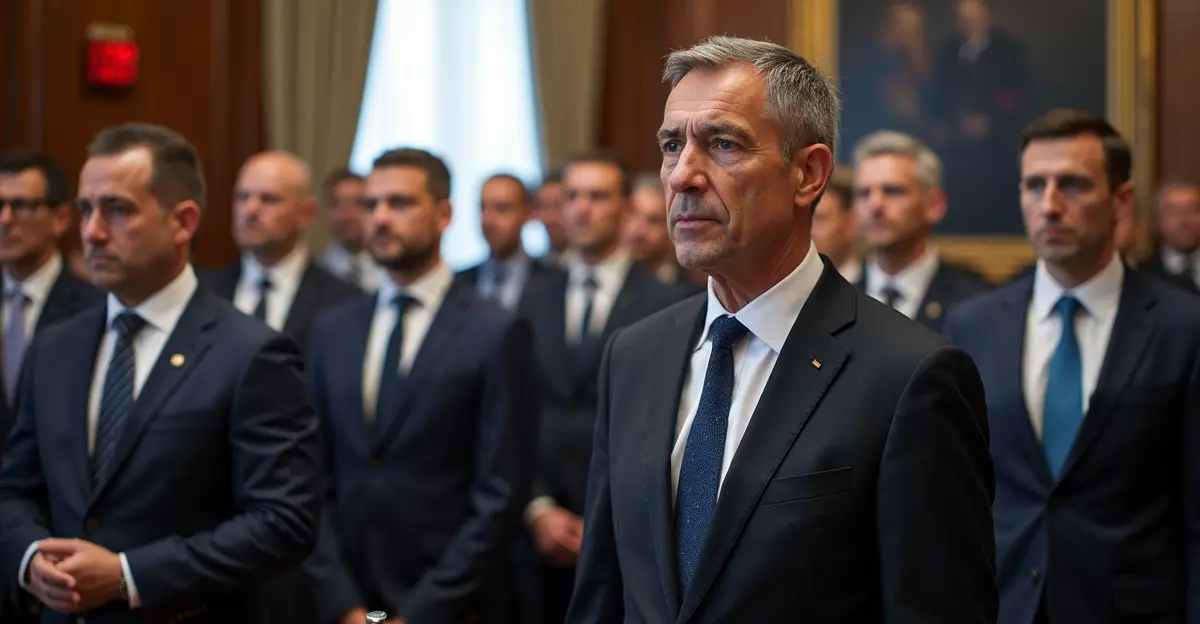
WARSAW — NATO's Supreme Allied Commander Europe, General Alexus Grynkewich, unveiled his "theory of victory" at the Warsaw Security Forum on October 12, 2026, seeking to reassure the alliance's 1 billion citizens that a Russian attack would be "utterly futile." But despite the confident message, lingering doubts about Washington's commitment to NATO remained the dominant topic in the corridors.
What is Grynkewich's "Theory of Victory"?
Speaking at the annual security summit, the four-star U.S. Air Force general outlined a three-phase military strategy — block, blunt and break — designed to deter and, if necessary, defeat any assault on NATO territory. He said NATO forces would halt an invasion at the point of attack, seize control of the air, sea, space and cyber domains, and then dismantle an adversary's logistics, communications and command systems. 'We got this,' Grynkewich told the audience, adding that NATO would not shy away from military action. 'And we will win.'
The speech was intended to reassure populations across all NATO member states, especially amid rising tensions including sabotage accusations, drone incursions and cyberattacks. However, the general stopped short of naming Russia directly, though the target was clear to everyone in the room.
Doubt over US role persists despite assurances
Even as Grynkewich delivered his message of unity, the question on many minds was whether the United States would actually come to Europe's defense. That skepticism has been fueled by President Donald Trump's recent actions, including a diesel supply agreement with Russian President Vladimir Putin announced just days before the summit. The contradiction was not lost on attendees.
'The doubt that exists within the alliance — will the Americans really be there for us? — has not been removed,' said Bob Deen, director of the Clingendael Institute. 'This general is a military professional, but ultimately he must follow the political orders of the U.S. government. You could see that doubt in the room.'
When pressed on the apparent contradiction during a panel discussion, Grynkewich insisted he stood with Trump's permission and that no one should question U.S. commitment to NATO. Asked whether American soldiers would fight if Russia attacked, he replied that it was ultimately a political decision but that doubt was unnecessary: 'I mean, I'm here.'
Article 5 and the politics of reassurance
Grynkewich reaffirmed NATO's Article 5 commitment — an attack on one is an attack on all — but experts note the real test is political will. Former Dutch Chief of Defence Rob Bauer, attending the summit in Warsaw, said the general's message effectively signaled: 'We stand for Article 5. We'll go all the way if necessary.' Yet Bauer also warned against focusing too heavily on the credibility question, asking rhetorically, 'Whom do we help by asking that question?' His answer: Putin.
Dutch Defence Minister Dilan Yeşilgöz-Zegerius, also present, called the speech powerful and clear. She acknowledged that 'sometimes things happen that seem to clash,' but pointed instead to Ukrainian President Volodymyr Zelensky's earlier appeal for the U.S.-Russia diesel deal to spare Ukraine's energy infrastructure. 'I think we should focus on that,' she said.
The EU defense strategy has become increasingly central to these debates, as European allies weigh greater self-reliance. Meanwhile, the US-Russia diesel agreement has raised new questions about the transatlantic security relationship at a critical moment.
How Moscow is likely to read the speech
In Moscow, the speech will almost certainly be interpreted as aggressive, analysts said. Bauer predicted Russian officials would focus on the announcement that enemies would be dealt with harshly. 'They will use that internally to mobilize for the war in Ukraine,' he said, noting Russia's difficulty recruiting enough soldiers.
Clingendael's Deen agreed Putin was watching closely. 'The main question he will have is: is it all true? Is that unity in the alliance really that strong? He will keep testing that in the coming months.' Grynkewich's speech, Deen said, was aimed squarely at Moscow: any attack would be blocked and ultimately broken.
FAQ: NATO's Victory Theory and US Role
What is NATO's "theory of victory"?
It is a three-phase military strategy — block, blunt and break — outlined by SACEUR General Alexus Grynkewich to deter and defeat any attack on NATO territory.
Did Grynkewich reassure NATO members?
He aimed to reassure 1 billion citizens, but many politicians and experts say doubt about U.S. commitment remains, especially after President Trump's diesel deal with Russia.
Does the US still support NATO's Article 5?
Grynkewich reaffirmed Article 5, but acknowledged that deploying American troops in a conflict would ultimately be a political decision.
How will Russia respond to the speech?
Analysts expect Moscow to portray it as aggressive and use it for domestic mobilization, while continuing to test alliance unity.



Follow Discussion