
 Deutsch
 English
 Español
 Français
 Nederlands
 Português

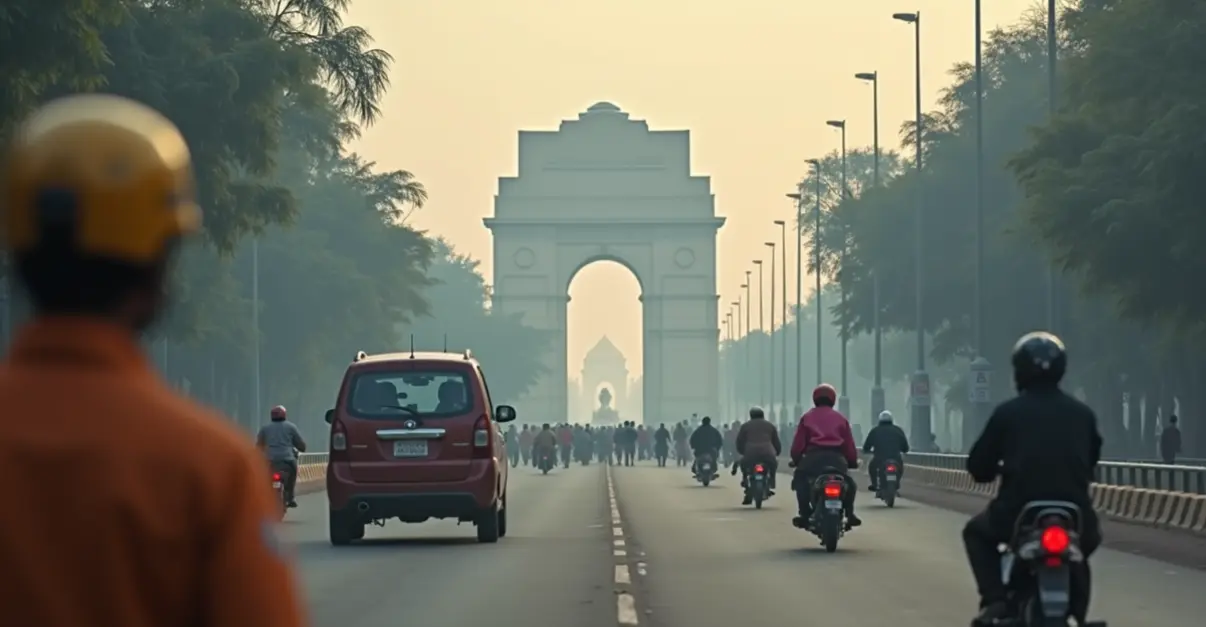





Delhi's Air Quality Crisis Triggers Emergency Response
Delhi, India's capital, has plunged into a severe air pollution crisis, prompting authorities to implement emergency measures including school closures and strict pollution controls. The city's Air Quality Index (AQI) has consistently hovered in the 'severe' category, reaching levels as high as 425, forcing the Commission for Air Quality Management (CAQM) to invoke Stage III and IV measures under the Graded Response Action Plan (GRAP).
School Closures and Public Health Emergency
In a dramatic move to protect children's health, authorities have ordered the closure of elementary schools for students up to Class 5, with classes shifting to online platforms. For older students in Classes VI to IX and Class XI, a hybrid learning model has been implemented. 'Breathing is killing us,' read signs at unprecedented protests at India Gate, where demonstrators wore gas masks to highlight the severity of the crisis.
Medical experts are sounding alarms about the health impacts. Dr. Arvind Kumar, a leading pulmonologist at Sir Ganga Ram Hospital, advised vulnerable individuals to leave Delhi if possible, stating, 'The toxic air is causing irreversible damage to lungs, especially in children. We're seeing a surge in respiratory emergencies.' According to a Lancet report, India recorded 1.72 million air pollution-related deaths in 2022, marking a 38% increase since 2010.
Pollution Sources: Beyond Stubble Burning
While seasonal farm fires have traditionally been blamed, recent data reveals a more complex picture. A Right to Information (RTI) response from the Central Pollution Control Board (CPCB) shows stubble burning contributed only 3.5% to Delhi's PM2.5 levels in 2025, down from 13% in 2020. Instead, vehicles have emerged as the dominant local source, accounting for nearly half of all emissions within Delhi.
A Centre for Science and Environment (CSE) analysis found that PM2.5 levels actually increased by 29% in December after stubble burning ended. 'The problem is regional and year-round,' explained Anumita Roychowdhury, executive director of research at CSE. 'While farm fires cause episodic spikes, sustained winter pollution is driven by urban and regional emission sources requiring coordinated airshed-level action.'
Emergency Measures and Mitigation Steps
The current emergency restrictions include halting all non-essential construction activities, shutting down high-polluting industrial units, banning BS-3 petrol and BS-4 diesel vehicles from roads, suspending diesel-powered inter-state buses, and implementing work-from-home advisories for offices. The Delhi government is also installing air purifiers in 10,000 government school classrooms.
Chief Minister Rekha Gupta announced that once GRAP measures are lifted, the government will begin constructing nearly 400 km of roads across Delhi to reduce dust pollution. 'We're expanding mist spray systems to neutralize dust particles and improving traffic flow to reduce vehicular emissions,' she stated in a recent press conference.
Long-term Solutions and Constitutional Rights
Environmental activists argue that temporary measures like GRAP are insufficient. 'Delhi residents face capital punishment from year-round toxic air exposure,' said environmental lawyer Ritwick Dutta. 'The right to clean air is protected under Article 21 of the Constitution, yet we've ignored Supreme Court orders dating back to 1985.'
According to Wikipedia data, air pollution in Delhi has been found to be the most harmful of any major city in the world, with poor air quality irreversibly damaging the lungs of 2.2 million children. India's Ministry of Earth Sciences attributes 41% of air pollution to vehicular emissions, 21.5% to dust, and 18% to industrial emissions.
Looking ahead, authorities are considering ambitious projects like a 1,600 km long green ecological corridor along the Aravalli Range, which would involve planting 1.35 billion native trees over 10 years. However, immediate relief remains elusive as Delhi residents brace for continued hazardous air quality through the new year.

Follow Discussion