


 Deutsch
 English
 Español
 Français
 Nederlands
 Português


 Share
Share




Energy R&D Shifts From Climate to Geopolitical Competition
The International Energy Agency's landmark State of Energy Innovation 2026 report, published in February 2026, reveals a fundamental strategic realignment: energy research and development is now driven primarily by competitiveness and national security, not emissions reduction. With Chinese companies accounting for roughly 60% of global corporate energy R&D and energy storage representing 40% of all energy patenting, the climate agenda has been absorbed into a broader contest over technological sovereignty and economic leadership. The report arrives as the World Economic Forum's Global Risks Report 2026 simultaneously ranks geoeconomic confrontation as the top global crisis trigger, making this convergence of energy, security, and industrial competition the defining strategic dynamic of the year.
Context: The New Geopolitics of Energy Innovation
The IEA report draws on over 150 innovation highlights from 2025 and a survey of practitioners across more than 40 countries. It updates progress on 18 IEA 'Races to First' — key technology milestones for energy security, sustainability, and economic benefit achievable by 2030. The global energy transition is no longer a climate project; it is a race for industrial dominance. According to the report, 80% of global energy practitioners ranked energy security among their top three innovation drivers in 2025, up from just over half in the previous edition.
Meanwhile, the WEF's Global Risks Report 2026, released in January, places geoeconomic confrontation — driven by tariffs, trade wars, and strategic economic rivalry — as the world's most significant near-term threat. State-based armed conflict follows closely, as geopolitical rivalries spill into military confrontations that disrupt supply chains and energy markets. The geopolitical risks to energy supply chains are now front and center for policymakers.
Key Findings: China's Dominance and Western Underinvestment
Corporate R&D: China Leads by a Wide Margin
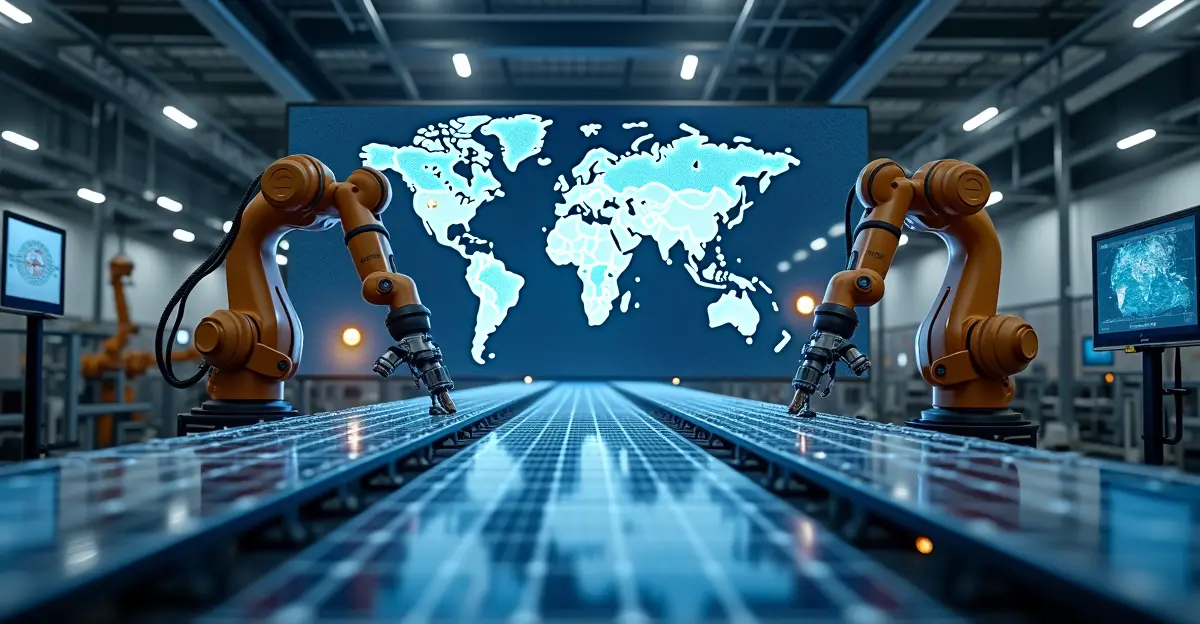
Perhaps the most striking finding is that Chinese companies now account for roughly 60% of global corporate energy R&D. This dominance extends across solar, wind, batteries, electric vehicles, and heat pumps. China manufactures 80% of the world's solar panels and 60% of wind turbines, according to Ember's China Energy Transition Review 2025. The country's corporate sector has outspent the rest of the world combined on energy innovation for several years running.
Energy Storage: 40% of All Energy Patenting
Energy storage has become the single largest category of energy patents, representing 40% of all energy-related patenting in 2023, with preliminary data showing further growth in 2024 and 2025. This reflects the critical role of batteries, long-duration storage technologies like iron-air and vanadium flow batteries, and compressed air energy storage in enabling grid flexibility and electric mobility. The energy storage patent race is intensifying as companies vie for intellectual property advantages.
Public R&D: Half of Post-1970s Levels
Despite the heightened strategic importance of energy innovation, public energy R&D across IEA countries sits at just 0.05% of GDP — half the level seen after the 1970s oil shocks. Global public energy RD&D spending dipped to approximately USD 55 billion in 2025, according to the IEA. This is a fraction of what many analysts argue is needed to compete with China's state-backed innovation machine. The public energy R&D funding gap is a growing concern among policymakers.
Impact and Implications: A New Strategic Landscape
The convergence of energy innovation with national security has profound implications. The IEA report notes that the share of emissions reductions depending on not-yet-commercial technologies has fallen from 35% to about 25%, signaling meaningful technological maturation. However, global venture capital investment in energy fell to USD 27 billion for the third consecutive year, as nearly 30% of VC funding flows to artificial intelligence instead. This capital reallocation risks slowing the deployment of breakthrough energy technologies precisely when the race for technological sovereignty is accelerating.
The WEF report warns that retreat from multilateralism and a 'new age of competition' threaten the cooperation needed to address climate change, pandemics, and other global challenges. The climate security nexus in geopolitics is becoming increasingly difficult to navigate as countries prioritize short-term economic advantage over long-term collective action.
Expert Perspectives
"The context for energy innovation is tilting toward competitiveness and security," the IEA report states. "Many 2025 policies were promoting technological strength, and the climate imperative has been absorbed into a broader contest over economic leadership."
Ford CEO Jim Farley acknowledged the stakes bluntly in 2025: "We are in a global competition with China... if we lose this, we do not have a future Ford." Such sentiments echo across boardrooms and government ministries in the West, where the realization is dawning that energy technology leadership is synonymous with economic and military power.
FAQ
What is the IEA State of Energy Innovation 2026 report?
It is the second edition of the IEA's comprehensive assessment of global energy technology development, published in February 2026. It analyzes trends in public and corporate R&D spending, venture capital, patenting, and policy, covering over 150 innovation highlights from 2025.
Why is energy innovation now driven by security rather than climate?
Geopolitical tensions, trade wars, and the strategic importance of energy supply chains have elevated energy technology to a matter of national security. The WEF's 2026 Global Risks Report ranks geoeconomic confrontation as the top global risk, reinforcing this shift.
How much of global corporate energy R&D does China account for?
Chinese companies account for roughly 60% of global corporate energy R&D, according to the IEA report, reflecting China's dominance in solar, wind, batteries, and electric vehicles.
What is the share of energy storage in energy patenting?
Energy storage represents 40% of all energy-related patents, making it the largest category. This share is expected to grow further in 2024 and 2025.
How does public energy R&D spending compare to historical levels?
Public energy R&D across IEA countries is at 0.05% of GDP, half the level seen after the 1970s oil shocks. Global public energy RD&D spending was about USD 55 billion in 2025.
Conclusion: The Race Ahead
The IEA's 2026 report makes clear that the energy innovation race is no longer just about climate — it is about technological sovereignty, economic competitiveness, and national security. With China holding a commanding lead in corporate R&D and patenting, and Western public investment lagging at historically low levels, the strategic challenge for governments is immense. The WEF's warning that geoeconomic confrontation is the top global risk underscores the urgency. Without a significant increase in public R&D investment and a coordinated industrial strategy, Western economies risk falling behind in the very technologies that will define the 21st century. The future of energy innovation policy will determine not just the climate outcome, but the balance of global economic power.




Follow Discussion