


 Deutsch
 English
 Español
 Français
 Nederlands
 Português


 Share
Share




OPEC's Fourth Consecutive Demand Downgrade: What It Means
OPEC has just released its fourth consecutive downward revision of oil demand growth forecasts for both 2024 and 2025, marking a significant shift in global energy market expectations. The organization now projects 2024 demand growth at 1.82 million barrels per day (down from 1.93 million bpd) and 2025 growth at 1.54 million bpd (down from 1.64 million bpd). This persistent downgrade reflects accelerating structural shifts in global energy consumption patterns and has prompted strategic production decisions by OPEC+ members, who recently postponed plans to raise output in December due to falling prices. The global energy transition is now visibly impacting traditional demand patterns, creating new challenges for producer economies.
Structural Shifts Behind Weakening Demand
The downward revisions are primarily driven by weakening demand in China, India, and other key Asian markets. China accounts for most of the 2024 downgrade, with OPEC trimming its Chinese growth forecast to 450,000 bpd from 580,000 bpd. This adjustment reflects deeper economic and industrial transformations occurring across Asia's largest economies.
China's Diesel Consumption Decline
China's diesel consumption has fallen for seven consecutive months, with June 2024 showing an 11% year-over-year decline to 3.9 million barrels per day - the largest monthly decline since July 2021. This persistent decline reflects two main factors: slowing economic activity, particularly in building and housing construction, and fuel substitution where liquefied natural gas (LNG) is replacing diesel in heavy-duty trucks. LNG trucks now account for about 20% of new truck sales in China, displacing diesel consumption despite still representing a small portion of the total fleet. According to the International Energy Agency, China's demand for oil-based fuels (gasoline, jet fuel, and diesel) has reached a plateau, marking the end of rapid growth in this sector.
Broader Economic Transformations
The diesel consumption decline is symptomatic of broader structural shifts in China's economy. China's GDP grew 4.7% in Q2 2024, below the government's 5% target and slower than pre-pandemic growth rates. The construction slowdown directly impacts diesel demand, while government policies promoting energy security and pollution control, expansion of high-speed rail networks, and competitive electric vehicle manufacturing are reshaping energy consumption patterns. Since 2019, various substitutions have avoided about 15% of potential oil demand growth, equivalent to 1.2 million barrels per day.
OPEC+'s Strategic Response
Faced with these demand challenges, OPEC+ has implemented a strategic response by delaying production cut unwinding. The alliance, led by Saudi Arabia and Russia, has maintained production reductions totaling approximately 5.86 million barrels per day as of late 2024. These cuts include voluntary reductions by key members like Saudi Arabia (1 million bpd), Russia (500,000 bpd), and other OPEC+ nations.
Production Cut Timeline
OPEC+ recently announced it will begin unwinding voluntary production cuts in October 2025, restoring 137,000 barrels per day next month. This marks the start of rolling back a 1.65 million b/d tranche originally scheduled to last until 2026. The decision defied expectations of a pause and signals confidence that markets can absorb more supply, with Brent crude trading steady around $66/barrel. However, actual additional supply will be limited - only about 70Kbd of the announced 137Kbd may materialize, as Saudi Arabia and UAE hold most spare capacity.
Broader Energy Transition Trends
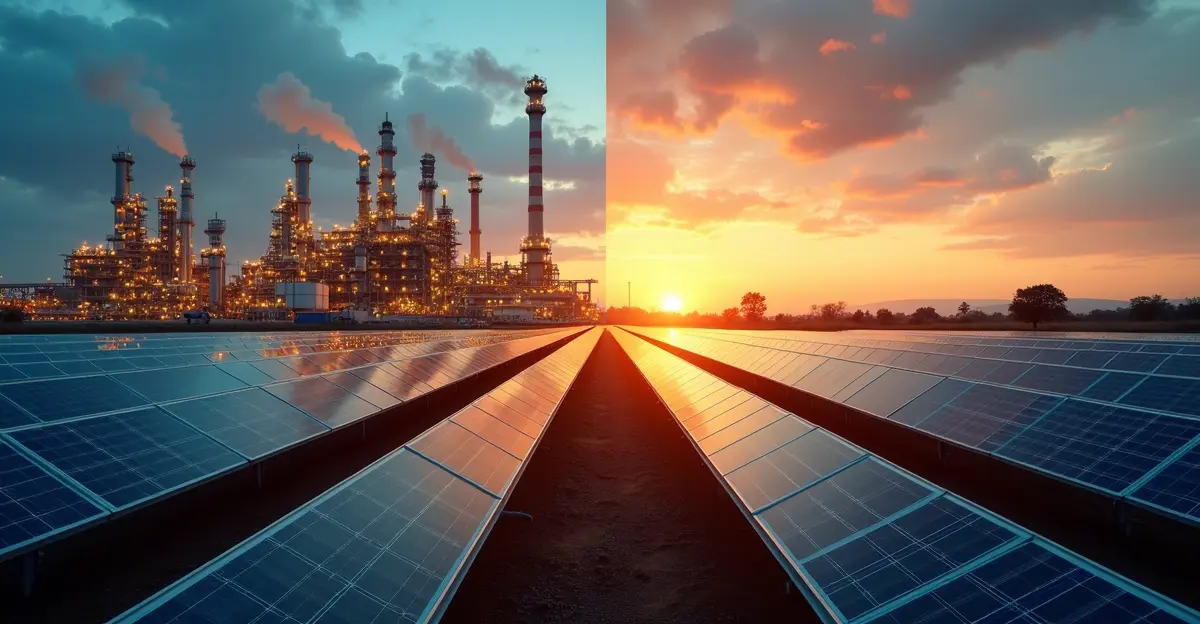
The OPEC demand downgrades occur against the backdrop of accelerating global energy transition trends. According to the IEA's Global Energy Review 2025, global energy demand accelerated to 2.2% growth in 2024, significantly faster than the 2013-2023 average of 1.3%. However, the composition of this growth has shifted dramatically.
Non-OPEC Supply Growth
Non-OPEC supply continues to grow, creating additional pressure on traditional producer economies. The power sector accounted for three-fifths of total energy demand growth, with renewables leading energy supply growth at 38%, followed by natural gas (28%), coal (15%), oil (11%), and nuclear (8%). This diversification of energy sources reduces reliance on traditional oil markets and creates new competitive dynamics. The U.S. shale industry faces pressure with WTI prices around $57-$60 per barrel, below breakeven for many wells, leading to reduced drilling activity and a projected 1.1% production decline in 2025.
Geopolitical Implications
The sustained lower demand projections have significant geopolitical implications for producer economies and global energy security. Research examining how geopolitical risks impact the global energy transition finds that geopolitical risks significantly inhibit structural transformation of energy systems by exacerbating price volatility, disrupting supply chains, and altering policy priorities.
Producer Economy Challenges
Resource-dependent economies face greater delays in their energy transitions and must navigate the complex interplay between maintaining oil revenues and diversifying their economies. Countries with strong renewable energy capacity, sound fiscal mechanisms, and flexible labor markets can better mitigate these negative effects. The move by OPEC+ represents a strategic signal rather than a supply shock, showing unity and indicating demand is stronger than some predict, but maintaining flexibility to pivot back to cuts if market conditions deteriorate.
Expert Perspectives
Energy analysts note that OPEC's fourth consecutive downgrade represents more than just cyclical economic weakness. 'This is structural transformation in real-time,' says Lucas Martin, energy market analyst. 'The diesel consumption decline in China isn't temporary - it reflects fundamental shifts in industrial activity, transportation fuel choices, and economic priorities. OPEC+ recognizes this and is adjusting its strategy accordingly.' The group maintains flexibility to pivot back to cuts if market conditions deteriorate, particularly if structure flips from backwardation to contango.
FAQ: OPEC Demand Downgrades Explained
What is OPEC's current demand forecast?
OPEC now projects 2024 oil demand growth at 1.82 million barrels per day (down from 1.93 million bpd) and 2025 growth at 1.54 million bpd (down from 1.64 million bpd).
Why is China's diesel consumption declining?
China's diesel consumption has fallen for seven consecutive months due to slowing construction activity and fuel substitution where LNG is replacing diesel in heavy-duty trucks (LNG trucks now represent 20% of new truck sales).
How is OPEC+ responding to weaker demand?
OPEC+ has delayed unwinding production cuts, maintaining approximately 5.86 million barrels per day in reductions and planning to begin gradual restoration in October 2025 rather than earlier timelines.
What are the geopolitical implications?
Sustained lower demand projections challenge resource-dependent economies, create energy security considerations, and influence global power dynamics as countries transition to diversified energy mixes.
How does this affect global energy transition?
The demand downgrades accelerate energy transition pressures, encouraging investment in renewables and alternative fuels while challenging traditional oil-dependent economic models.
Future Outlook
The fourth consecutive demand downgrade signals a new era for global energy markets. As structural shifts in consumption patterns accelerate, traditional producer economies must adapt their strategies. The energy market volatility of recent years may become more pronounced as transition dynamics interact with geopolitical tensions and economic transformations. OPEC+'s flexible approach - maintaining production discipline while signaling future adjustments - reflects the complex balancing act required in this evolving landscape. Total world oil demand is still expected to reach 104.0 million bpd in 2024, supported by transportation fuel demand and economic growth in non-OECD countries, but the growth trajectory has fundamentally changed.


Follow Discussion