


 Deutsch
 English
 Español
 Français
 Nederlands
 Português


 Share
Share




What Are Perovskite Solar Cells?
Perovskite solar cells (PSCs) represent a revolutionary photovoltaic technology using perovskite-structured compounds, typically hybrid organic-inorganic lead or tin halide materials as light-harvesting layers. These cells have achieved remarkable efficiency improvements, rising from 3.8% in 2009 to 27% in 2025 for single-junction architectures, with silicon-based tandem cells reaching 34.85% efficiency. The technology offers low production costs, simple manufacturing processes, high absorption coefficients enabling ultrathin films (~500nm), and excellent optoelectrical properties. However, as the industry approaches commercial scale, durability testing has become the critical bottleneck determining whether perovskite solar can transition from laboratory breakthroughs to mainstream energy solutions.
The Durability Challenge: Why Testing Matters Now
While perovskite solar cells have demonstrated impressive efficiency gains, their long-term stability remains the primary obstacle to commercialization. Traditional silicon solar panels require 20-30 year lifespans for utility-scale projects, but perovskite cells face complex stressors including visible/ultraviolet light, heat, humidity, mechanical stress, and electric potential. According to a Nature Energy perspective, durability research is crucial for commercializing perovskite solar cells, requiring demonstration of decent durability under real-world conditions. The current generation of perovskite modules shows promising results with 5-12% power loss after 1,000-2,000 hours of damp heat testing, approaching IEC certification thresholds.
The Department of Energy's Solar Energy Technologies Office (SETO) has identified four primary challenges for commercializing perovskite solar cells: stability, power conversion efficiency at scale, manufacturability, and standardized testing. Current research shows progress with minimodules maintaining 80% of initial efficiency after 5 months outdoors. The solar industry transformation toward next-generation technologies depends heavily on resolving these durability concerns through comprehensive testing protocols.
2026 Manufacturing Readiness: From Lab to Factory
Commercial Production Milestones
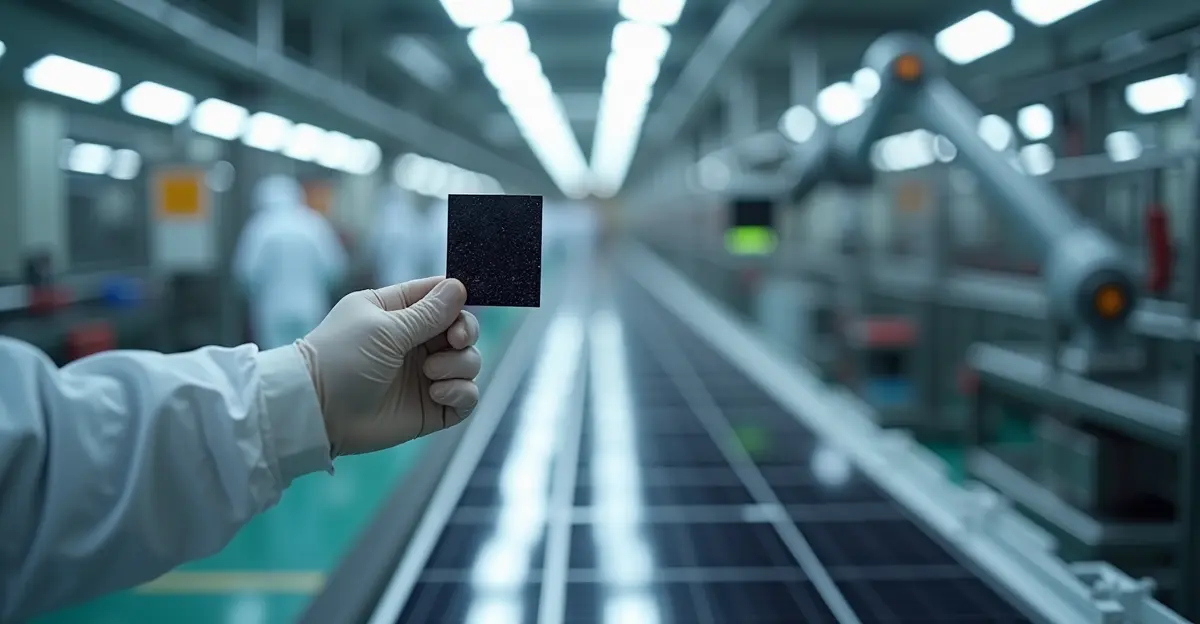
Perovskite-silicon tandem solar cells have reached commercial production in 2026, with LONGi holding the NREL-certified world record at 34.85% efficiency. Oxford PV shipped its first 24.5% efficiency commercial modules to U.S. utility customers in September 2024, while Hanwha Qcells achieved 28.6% efficiency using mass-production processes. Manufacturing costs are projected at $0.29-0.42/W for tandem modules achieving 25-30% efficiency, making the technology increasingly competitive with conventional silicon.
Scalability and Production Methods
Two primary fabrication techniques are emerging for industrial-scale production: vapor-phase deposition and solution processing. Solution processing methods, particularly using non-hazardous or less-hazardous solvents, show promise for scalable manufacturing. The solar industry is undergoing a major technology shift with over 15 U.S. companies actively investing in perovskite technology, including startups like Tandem PV achieving 28% module efficiency and established manufacturers like Qcells reaching 28.6% efficiency for silicon-perovskite tandem cells.
The renewable energy manufacturing landscape is evolving rapidly, with First Solar making significant investments through acquisitions and new R&D facilities, positioning thin-film tandem technology as the next battleground. However, commercialization faces challenges including the need for standardized testing protocols (IEC 60904-1-4), accurate characterization methods using LED-based solar simulators, and stability concerns.
Current Durability Trials and Testing Protocols
Field Testing Initiatives
Field testing has become essential to demonstrate real-world performance and identify field-relevant failure modes. Researchers advocate for a durability learning cycle integrating photovoltaic module engineering with field testing, accelerated testing, and preconditioning/performance engineering. While first commercial modules with 10-year guarantees have entered the market, long-term durability remains a critical hurdle being addressed through programs like NREL's PACT initiative and improved encapsulation techniques.
Accelerated Testing Standards
The development of accelerated and qualification tests must account for device metastability, material composition variations, and different processing methods. These practices are more difficult but more important than simply pursuing higher initial efficiencies. Key testing areas include:
- Damp heat testing (85°C/85% relative humidity)
- Thermal cycling (-40°C to 85°C)
- UV exposure testing
- Mechanical stress testing
- Light-induced degradation studies
The solar technology certification process for perovskites requires establishing new standards that reflect the unique characteristics of these materials, including their sensitivity to moisture, oxygen, and thermal cycling.
Commercial Prospects and Market Outlook
The technology is now investable for early adopters and specialized applications like building-integrated photovoltaics (BIPV) and rooftops, with full bankability for utility projects expected by 2027-2029. Key players include Oxford PV (Germany/UK), Hanwha Qcells (Korea/USA), and LONGi (China), with commercial modules now shipping to select customers. The market outlook for 2026-2030 includes:
| Application | Market Readiness | Key Challenges |
|---|---|---|
| Building-Integrated PV | Early Commercial | Aesthetics, installation methods |
| Residential Rooftops | Pilot Projects | Warranty requirements, bankability |
| Utility-Scale Projects | Demonstration Phase | Long-term stability, financing |
| Specialty Applications | Commercial Now | Cost optimization, supply chain |
Manufacturing costs are projected at $0.29-0.42/W for tandem modules achieving 25-30% efficiency, making perovskite technology increasingly competitive. The clean energy transition could accelerate significantly if durability trials confirm the long-term viability of perovskite solar cells.
Expert Perspectives on the Path Forward
"Durability research is pivotal for perovskite photovoltaics," emphasizes recent research from the Department of Energy. While these cells have achieved promising power conversion efficiencies, commercialization requires demonstrating decent durability under real-world conditions. Solar cells face complex stressors including visible/ultraviolet light, heat, humidity, mechanical stress, and electric potential, complicating failure mechanism understanding.
According to industry analysts, "The solar industry is on the brink of a major technological shift with perovskite solar technology emerging as the next generation of photovoltaic innovation." Since their discovery in 2008, perovskite solar cells have achieved remarkable efficiency gains from 3.8% to over 25% in single-junction devices, but the durability question remains the final frontier.
Frequently Asked Questions
What is a perovskite solar cell?
Perovskite solar cells are an emerging photovoltaic technology using perovskite-structured compounds, typically hybrid organic-inorganic lead or tin halide materials as light-harvesting layers. They offer high efficiency potential, low manufacturing costs, and compatibility with flexible substrates.
How durable are perovskite solar cells currently?
Current perovskite modules show 5-12% power loss after 1,000-2,000 hours of damp heat testing, approaching IEC certification thresholds. Minimodules have maintained 80% of initial efficiency after 5 months outdoors in recent trials.
When will perovskite solar be commercially available?
Perovskite-silicon tandem cells reached commercial production in 2026, with modules already shipping to select customers. Full bankability for utility projects is expected by 2027-2029 as durability testing continues.
What are the main challenges for perovskite commercialization?
The primary challenges include long-term stability against moisture, heat, and light; scaling up manufacturing processes; establishing standardized testing protocols; and addressing environmental concerns related to lead content.
How do perovskite costs compare to traditional silicon?
Manufacturing costs are projected at $0.29-0.42/W for tandem modules achieving 25-30% efficiency, making them increasingly competitive with conventional silicon solar panels.
Conclusion: The Future of Solar Energy
As perovskite solar durability trials progress through 2026, the technology stands at a critical juncture. With manufacturing readiness achieved and commercial modules entering the market, the focus has shifted decisively to proving long-term reliability. The success of these durability trials will determine whether perovskite solar can fulfill its promise as a transformative energy technology or remain limited to niche applications. With major investments from both startups and established manufacturers, and with efficiency records continuing to climb, the solar industry appears poised for its next major evolution—provided durability testing confirms what efficiency gains have already demonstrated.



Follow Discussion