

 Deutsch
 English
 Español
 Français
 Nederlands
 Português

 Share
Share Facebook
 X
X LinkedIn
 Bluesky
 WhatsApp
Fire at Darmstadt Research Center Disrupts Cutting-Edge Physics
A major fire broke out early Thursday morning at the prestigious GSI Helmholtz Centre for Heavy Ion Research in Darmstadt, Germany, causing significant damage to one of Europe's most important particle accelerator facilities. The blaze, which started around 6:30 AM on February 5, 2026, sent thick plumes of smoke visible for kilometers across the region and has forced the indefinite postponement of critical research projects.
Emergency Response and Damage Assessment
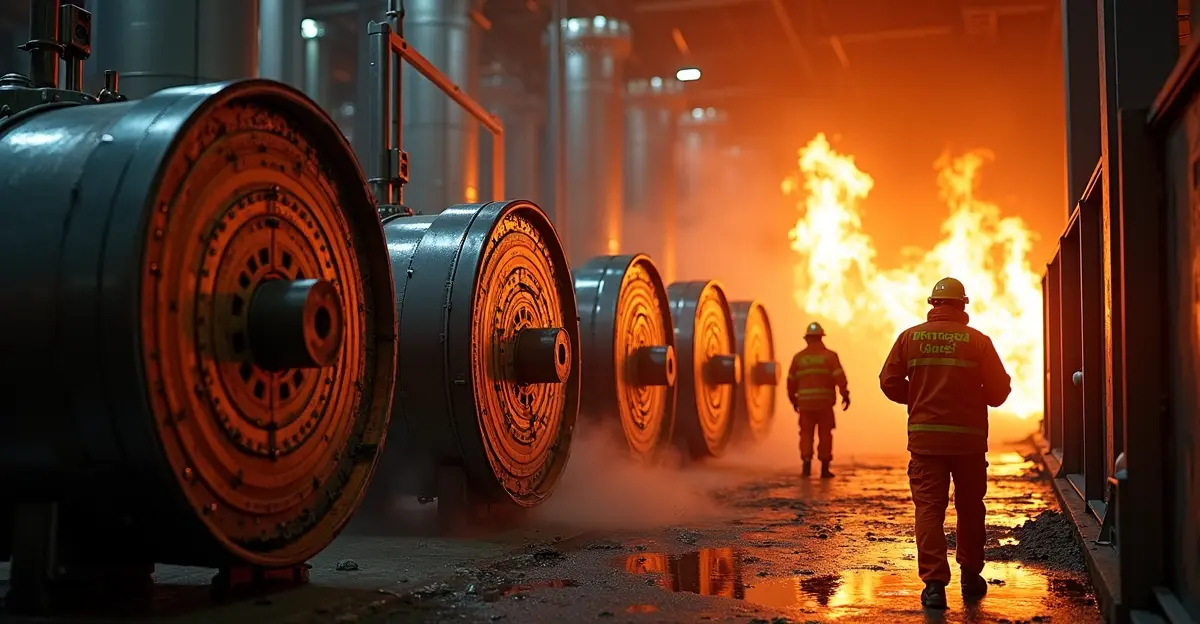
More than 100 firefighters from multiple jurisdictions responded to the industrial hall fire at the research complex in Darmstadt-Wixhausen. While no injuries were reported, the fire caused substantial damage to the power supply of the existing UNILAC linear accelerator facility. Fire officials expected operations to continue into the late evening as they worked to fully extinguish the blaze and assess the extent of the damage.
Hesse's Minister for Science and Research, Timon Gremmels, called the incident 'a black day for Hessen's scientific community' in a statement to reporters. 'This is a serious setback for fundamental research in Germany and internationally,' Gremmels added, emphasizing the center's importance to the global scientific community.
Impact on FAIR Particle Accelerator Project
The fire has forced the indefinite postponement of the planned December test phase for the new €3.3 billion FAIR (Facility for Antiproton and Ion Research) particle accelerator, which was under construction at the same site. The FAIR project, scheduled to begin experiments in late 2027 with full operation by late 2028, represents one of Europe's largest research infrastructure projects.
According to GSI's official website, FAIR will provide scientists worldwide with unprecedented opportunities to explore the structure of matter and the evolution of the universe. The 1.1-kilometer accelerator ring was designed to produce intense beams of antiprotons and ions for groundbreaking research in nuclear physics, astrophysics, and materials science.
Research Center's Scientific Legacy
The GSI Helmholtz Centre, founded in 1969, has been at the forefront of heavy ion research for over half a century. The facility has discovered six chemical elements: bohrium (1981), meitnerium (1982), hassium (1984), darmstadtium (1994), roentgenium (1994), and copernicium (1996). Two of these elements—darmstadtium and hassium—are named after the city of Darmstadt and the state of Hesse where the research center is located.
The center employs approximately 1,500 workers and hosts hundreds of international scientists annually who conduct research into fundamental questions about the universe's composition. Their work includes studying superheavy elements that don't occur naturally and investigating conditions similar to those microseconds after the Big Bang.
Safety Measures and Investigation
Authorities advised nearby residents to keep windows and doors closed initially due to concerns about potentially harmful substances, though subsequent air quality measurements detected no hazardous materials in the surrounding area. The fire department confirmed that the new FAIR construction site was not directly affected by the blaze.
The cause of the fire is still under investigation, though preliminary reports suggest it may have started from a short circuit in the high-voltage power supply during preparations to power up the facility. Research director Dr. Thomas Nilsson stated, 'We are working closely with investigators to determine exactly what happened and how we can prevent such incidents in the future.'
The incident highlights the vulnerability of major scientific infrastructure and raises questions about safety protocols at research facilities handling complex electrical systems and experimental equipment.


Follow Discussion