


 Deutsch
 English
 Español
 Français
 Nederlands
 Português


 Share
Share




Hong Kong's Deadliest Fire Sparks Media Crackdown
China's national security office in Hong Kong has summoned foreign media organizations and warned them against spreading what it calls 'false information' about the devastating Wang Fuk Court fire that killed at least 159 people last month. This marks the first time foreign media have been gathered en masse for criticism by the national security office since Beijing imposed the national security law in 2020.
The Office for Safeguarding National Security (OSNS) called in journalists from outlets including The New York Times and Bloomberg, threatening consequences under China's 2020 Hong Kong national security law for coverage that paints Beijing's disaster response in a negative light. Reuters reported that international media were warned not to conduct a 'smear campaign' against how authorities handled the deadliest fire in Hong Kong in seventy years.
Unprecedented Media Pressure
According to media analysts, it's extremely rare for a group of foreign media to be summoned specifically for their coverage of a single news event in Hong Kong. 'This represents a significant escalation in media control,' said Hong Kong media expert Dr. Li Wei. 'Previously, authorities might issue statements or hold press conferences, but summoning journalists individually to warn them about specific reporting is a new level of intimidation.'
The meeting was held based on the 2020 national security law, which was implemented after massive pro-democracy protests and gives the government broad powers to take action against foreign entities. The law established four particular crimes: secession, subversion, terrorism, and collusion with foreign organizations.
The Wang Fuk Court Tragedy
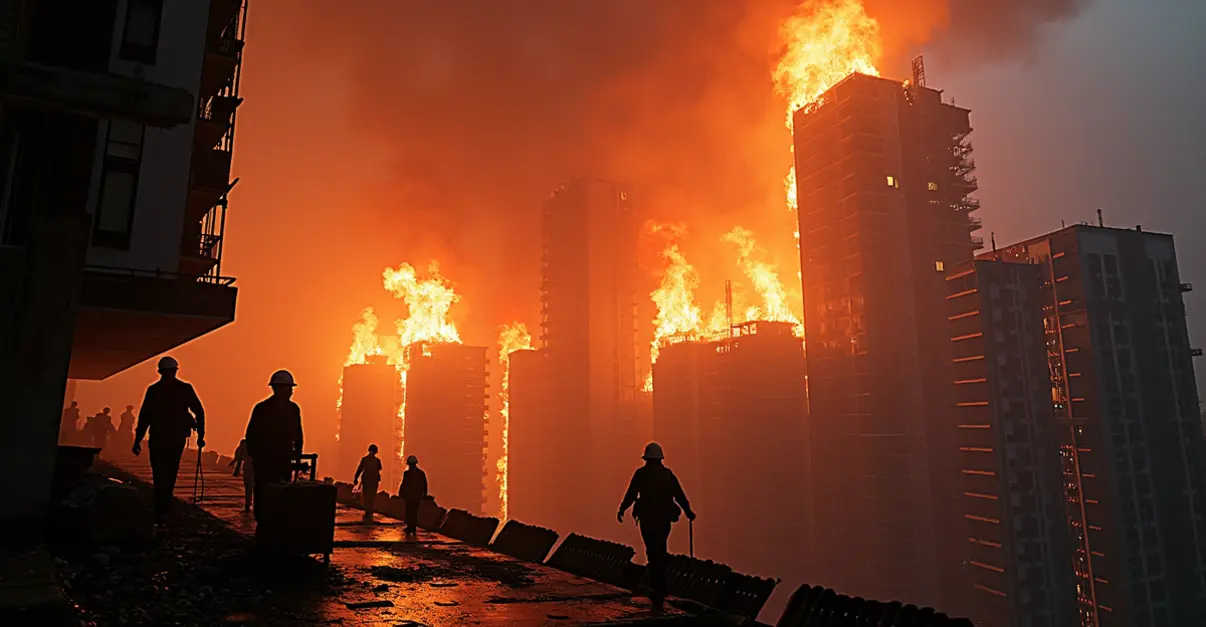
The fire at Wang Fuk Court residential complex in Tai Po district on November 26, 2025, has become Hong Kong's deadliest since 1948. The blaze started in Wang Cheong House (Block F) and quickly spread through seven of the eight buildings in the complex, fueled by flammable expanded polystyrene foam boards covering windows and construction safety netting.
The apartment complex was undergoing major exterior wall repairs with bamboo scaffolding wrapped in safety nets. According to Channel News Asia, authorities believe the fire was worsened by netting that didn't meet fire-resistance standards, and have ordered all Hong Kong buildings undergoing major maintenance to remove their netting.
Police have arrested 21 people total, including construction company bosses on suspicion of manslaughter and others related to malfunctioning fire alarms. The tragedy has sparked public grief and calls for accountability, with mourners placing hundreds of bouquets and notes at a nearby park for victims ranging from 1 to 97 years old.
Election Tensions and Public Frustration
The media warning comes just before Hong Kong's Legislative Council elections on December 7, 2025. Authorities are proceeding with the vote despite widespread public frustration over both the election timing and the government's handling of the fire disaster.
'The population is highly traumatized,' noted a Reuters report. 'Many residents believe the election should be postponed given the scale of the tragedy.'
According to Human Rights Watch, these elections will proceed without any pro-democracy candidates, exposing Beijing's complete control over the territory's political system. The Chinese government has systematically dismantled Hong Kong's democratic institutions by revising laws to ensure only Communist Party loyalists can run.
Voter turnout is expected to be low, continuing a trend that saw just 30.2% participation in the 2021 elections. Registered voters have dropped for the fourth consecutive year to 4.13 million.
Arrests and Crackdowns
In related developments, police arrested a 71-year-old man suspected of posting 'inciting information' on social media. Another man who started an online petition calling for an independent investigation into the disaster was also reportedly detained, though police haven't confirmed his arrest.
'These arrests show how authorities are using the national security apparatus to suppress legitimate questions about government accountability,' said human rights observer Maria Chen. 'When people can't even petition for an independent investigation into a tragedy that killed 159 people, it shows how far Hong Kong's freedoms have eroded.'
The Hong Kong government has similarly condemned what it describes as 'malicious attacks' and 'fake news' about the Wang Fuk Court apartment fire. Recent arrests include a former district councilor who shared critical news reports on Facebook and a student who started a petition calling for an independent investigation.
International Reaction and Implications
The media warning has drawn international attention to China's tightening control over information in Hong Kong. U.S. News & World Report noted that authorities criticized foreign media coverage for allegedly ignoring facts, distorting disaster relief efforts, and interfering with the election.
The situation highlights the broader challenges facing foreign journalists in China, who report seeing increasingly more 'red lines' in their work. With the national security law providing broad powers to restrict speech and media activities, many worry about the future of press freedom in Hong Kong.
As the city mourns its deadliest fire in generations and prepares for tightly controlled elections, the warning to foreign media represents another step in Beijing's consolidation of control over Hong Kong's information landscape and political discourse.

Follow Discussion