


 Deutsch
 English
 Español
 Français
 Nederlands
 Português


 Share
Share




European Auto Industry Faces Existential Threat
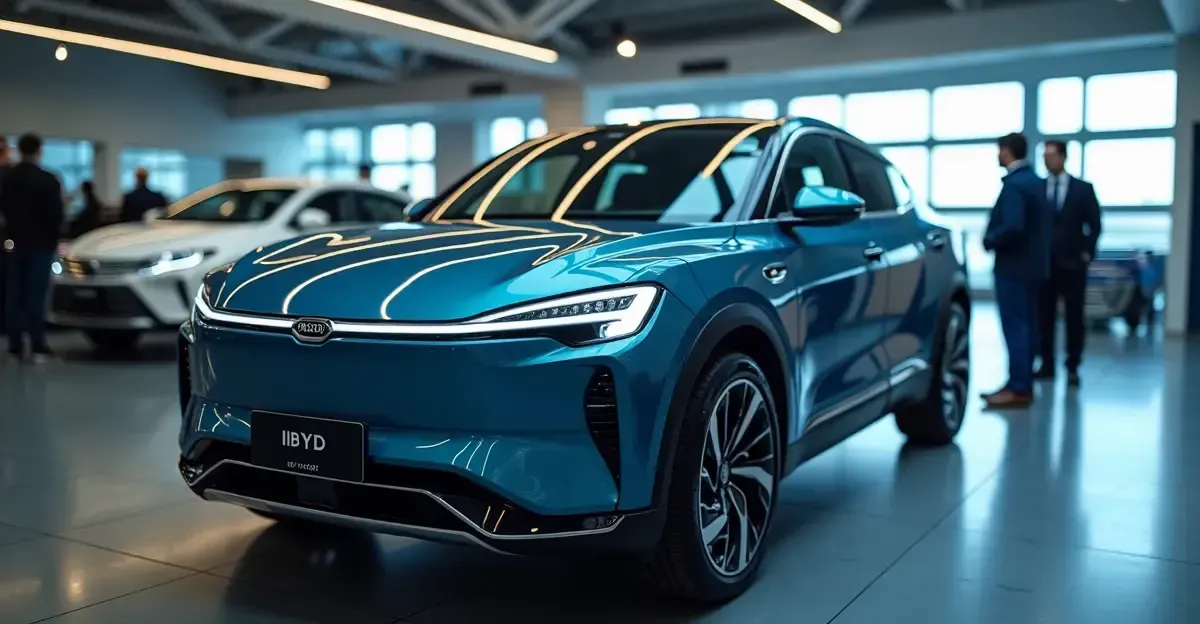
The European automotive sector, once the undisputed global leader, now finds itself at a critical crossroads as Chinese electric vehicle manufacturers rapidly gain market share across the continent. What began as a trickle of affordable EVs has turned into a flood, with Chinese brands like BYD, Geely, and SAIC capturing significant portions of the European market despite existing trade barriers.
The Tariff Tango: Minimum Prices Instead of Duties
In a significant policy shift, the European Commission has moved from imposing punitive tariffs to establishing minimum price undertakings for Chinese EVs. The EU had previously imposed tariffs of up to 35.3% on Chinese electric vehicles following an anti-subsidy investigation that concluded Chinese manufacturers benefited from unfair state support. 'The published document was intended to provide guidance to Chinese exporters who may be considering submitting price undertaking offers,' said Commission spokesman Olof Gill.
Under the new guidelines published last week, Chinese manufacturers can avoid these tariffs by committing to minimum prices for their vehicles sold in Europe. The Commission has already received one such offer, though details remain confidential. This approach represents a delicate balancing act between protecting European industry and avoiding a full-blown trade war with China.
German Auto Angst: From Powerhouse to Peril
Germany, Europe's automotive heartland, faces particularly acute challenges. While EV sales in Germany rebounded strongly in 2025 with a 43.2% increase to 545,142 vehicles, Chinese manufacturers made dramatic inroads from a low base. BYD saw its German sales skyrocket over 700% to more than 23,000 cars, giving it 0.8% of the overall market.
'International vehicle manufacturers with affordable battery electric vehicles and plug-in hybrids have contributed disproportionately to growth in these segments,' noted Imelda Labbé, head of the VDIK foreign carmakers' lobby in Germany.
Meanwhile, German manufacturers are losing ground in China itself. Volkswagen reported an 8% sales decline in 2025, Mercedes-Benz saw a 19% drop, and BMW sold 12.5% fewer cars in the crucial Chinese market. With German carmakers selling about 30% of their vehicles in China, this represents a double squeeze.
Job Losses Mount Across the Continent
The human cost of this transition is becoming increasingly apparent. According to the EU research agency Eurofound, the automotive industry directly employs around 6 million workers in the EU, with another 6 million in related sectors. Since 2019, job losses have accelerated dramatically, with around 100,000 layoffs announced by European companies in 2024 and early 2025 alone.
Leading German automotive expert Ferdinand Dudenhöffer, head of the Center Automotive Research (CAR), remains skeptical about the effectiveness of minimum prices. 'Given the current price level in Europe, there should still be significant scope for Chinese manufacturers to reduce prices,' he warned.
Green Policy Retreat: The 2035 Combustion Engine Rollback
Adding to the industry's uncertainty, the EU has significantly revised its ambitious climate targets for the automotive sector. The previously announced 2035 ban on new internal combustion engine vehicles has been scaled back to a 90% emissions reduction target, with the remaining 10% gap allowed to be offset through various means.
This policy reversal has drawn criticism from both environmentalists and industry groups. 'In times of increasing international competition, in times when European economic power is crucial, this overall package from Brussels is disastrous,' said Hildegard Müller, president of the German Association of the Automotive Industry (VDA).
The Supply Chain Ripple Effect
The impact extends beyond major manufacturers to the entire automotive ecosystem. Countries like Bulgaria, which have become important suppliers of automotive components to European manufacturers, face indirect exposure to the EU-China trade dispute. The sector generates close to €11 billion in annual turnover for Bulgaria, making it one of the country's strongest industrial branches.
Dudenhöffer's outlook remains grim: 'Growth is taking place in Asia, and Asian car manufacturers (Japan, Korea, China) are increasingly dominating the car business.' He expects the European automotive sector to shrink in coming years as production shifts to the US and Asia.
The European automotive industry stands at a pivotal moment, caught between aggressive Chinese competition, shifting environmental policies, and the urgent need to transform its business model. How European carmakers navigate these challenges will determine not just their own future, but that of millions of workers across the continent.
Follow Discussion