


 Deutsch
 English
 Español
 Français
 Nederlands
 Português


 Share
Share




The HBM Gap: How High-Bandwidth Memory Became the Critical Chokepoint in US-China AI Competition
In December 2024, the US government escalated its technology competition with China by imposing new export controls specifically targeting high-bandwidth memory (HBM) chips, marking a strategic shift that recognizes HBM as the critical bottleneck for advanced artificial intelligence systems. This analytical examination reveals why HBM represents a more significant vulnerability than AI processors themselves, with the global market dominated by just three companies—SK Hynix, Samsung, and Micron—controlling 97% of production. As China's ChangXin Memory Technologies (CXMT) races to develop domestic HBM capabilities, this specific technology gap illustrates broader strategic vulnerabilities in export control regimes and the race for next-generation computing architectures.
What is High-Bandwidth Memory (HBM)?
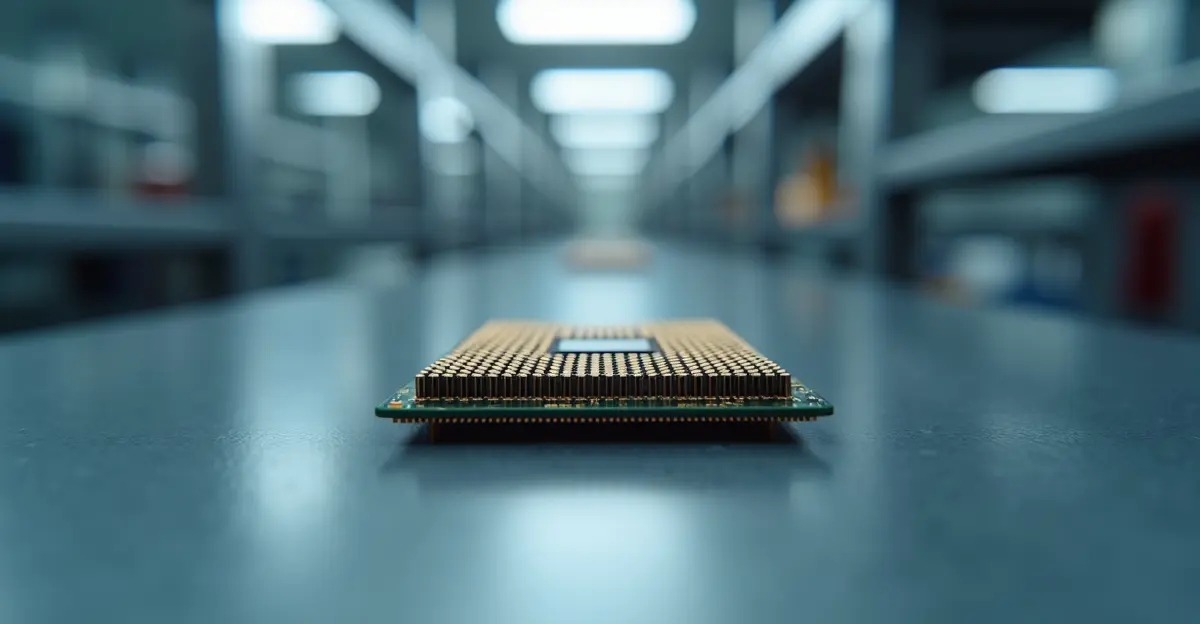
High-bandwidth memory is a specialized 3D-stacked synchronous dynamic random-access memory interface that dramatically improves AI chip performance by enabling higher data throughput at lower power consumption. Developed through innovations by AMD and SK Hynix, HBM achieves higher bandwidth than conventional DDR4 or GDDR5 memory while using substantially less power and occupying a smaller form factor. The technology stacks up to eight DRAM dies vertically interconnected by through-silicon vias (TSVs), creating memory buses up to 1024 bits wide compared to the 32-bit width of GDDR memories. According to US Department of Commerce documentation, HBM accounts for approximately half the production cost of advanced AI chips, making it both economically and strategically critical.
The Global HBM Market Structure
The high-bandwidth memory industry represents one of the most concentrated technology markets globally, with South Korea's SK Hynix commanding 62% market share in Q2 2025, followed by Micron at 21% and Samsung at 17%. This triopoly creates a natural chokepoint that the US has strategically targeted. "HBM has become the critical bottleneck because AI requires both powerful processors and high-speed memory working in tandem," explains semiconductor analyst Dr. Elena Rodriguez. "While China can potentially develop alternative processor architectures, replicating the advanced packaging and manufacturing expertise for HBM represents a much higher barrier." The current shortage is so severe that memory prices are expected to rise 50-55% in early 2026, with SK Hynix having already secured demand for its entire 2026 production capacity.
Why HBM Matters More Than AI Processors
Unlike general-purpose processors, HBM requires specialized manufacturing capabilities that combine advanced DRAM production with sophisticated 3D packaging technologies. Each HBM stack involves precise thermal management, hybrid bonding techniques, and through-silicon via integration that represent years of accumulated manufacturing expertise. The semiconductor packaging technology gap between leading manufacturers and emerging competitors spans 3-4 years, creating a significant time advantage for established players. Furthermore, HBM production consumes manufacturing capacity at a 3:1 ratio compared to conventional memory, meaning every bit of HBM production reduces three bits of consumer memory capacity—creating cascading effects throughout the electronics supply chain.
China's Domestic HBM Development Efforts
China's leading memory chipmakers, ChangXin Memory Technologies (CXMT) and Yangtze Memory Technologies Corp. (YMTC), have formed a strategic partnership to accelerate domestic HBM production. CXMT has reportedly produced HBM2 samples and is targeting HBM3 production between 2026-2027, putting it roughly 3-4 years behind Korean industry leaders. YMTC brings valuable hybrid bonding expertise through its 'Xtacking' architecture, which could help address HBM's increasing stack heights and heat management challenges. According to industry analysis, CXMT's DRAM production capacity surged 70% year-over-year to 720,000 wafers in Q3 2025, with market share projected to reach 12% by year-end. However, the partnership faces significant obstacles from US export controls that explicitly target HBM technology and chip-making tools, potentially limiting early Chinese HBM products to domestic customers.
The Export Control Loophole Challenge
Despite the December 2024 export restrictions, significant loopholes remain that allow Chinese companies to continue acquiring HBM directly and purchasing manufacturing tooling. The US semiconductor export controls framework has been updated four times since October 2022, but enforcement gaps persist. "Chinese firms are exploiting regulatory gaps including chip smuggling, inadequate oversight of manufacturers like TSMC, and slow regulatory updates that allowed stockpiling," notes a RAND Corporation analysis. Without closing these export control gaps, China could significantly ramp up domestic HBM production, potentially manufacturing enough for approximately 600,000 AI chips comparable to Nvidia's H100 accelerator in 2026.
Strategic Implications for AI Advancement
The HBM gap represents a fundamental constraint on China's AI ambitions, as advanced generative AI models require both massive compute power and high-bandwidth memory working in concert. While Chinese AI company DeepSeek has demonstrated impressive efficiency gains, training a GPT-4-level model for just $5.6 million, the company's founder acknowledges that chip embargoes remain their primary constraint. The next-generation HBM4 technology, with 40% better power efficiency and 10-11 Gbps data rates, will further widen the performance gap between those with access to cutting-edge memory and those relying on domestic alternatives. The AI compute advantage maintained through HBM restrictions gives US companies a significant edge in developing more powerful and efficient AI systems.
Long-Term Supply Chain Security Concerns
The concentration of HBM production in just three companies creates systemic vulnerabilities for the global technology ecosystem. As noted in CNBC reporting, the current shortage has led to consumer electronics companies like Apple and Dell facing pressure to raise prices or cut margins, with memory now accounting for about 20% of laptop hardware costs. This memory wall crisis illustrates how strategic competition in advanced technologies creates ripple effects throughout consumer markets. The situation is exacerbated by the fact that all three major HBM suppliers are transitioning from HBM3E to next-generation HBM4 technology simultaneously, creating potential bottlenecks in the qualification and production ramp-up phases.
Expert Perspectives on the HBM Competition
Industry analysts emphasize that the HBM competition extends beyond simple market share to encompass production scale, packaging technology, and customer trust in the AI-era supply chain. "The battle has shifted from who can develop the technology first to who can manufacture it at scale with consistent quality," says semiconductor consultant Michael Chen. "SK Hynix's established relationship with Nvidia gives them a significant advantage, but Samsung's aggressive HBM4 production timeline and Micron's technological innovations mean the competitive landscape remains fluid." The semiconductor manufacturing equipment required for HBM production, particularly from companies like ASML and Applied Materials, represents another critical chokepoint that export controls must address comprehensively.
FAQ: High-Bandwidth Memory and US-China Competition
What makes HBM different from regular computer memory?
HBM uses 3D stacking technology to create much wider memory buses (up to 1024 bits vs. 32 bits for GDDR) and operates at lower power while delivering significantly higher bandwidth, making it essential for AI workloads that require massive parallel data access.
Why did the US specifically target HBM with export controls?
HBM represents a more concentrated and technically challenging market than AI processors, with only three companies controlling 97% of global production. Targeting HBM creates a higher barrier for China's AI advancement than restricting processors alone.
How far behind is China in HBM development?
China's CXMT is currently manufacturing second-generation HBM chips and targeting HBM3 production in 2026-2027, putting it approximately 3-4 years behind industry leaders SK Hynix, Samsung, and Micron.
Can China overcome the HBM gap through domestic development?
While China is making rapid progress, replicating the advanced packaging and manufacturing expertise for cutting-edge HBM represents a significant challenge that requires years of accumulated knowledge and access to specialized equipment currently restricted by export controls.
What are the broader implications of the HBM competition?
The HBM gap illustrates how strategic technology competition creates vulnerabilities in global supply chains, affects consumer electronics pricing, and determines which nations can lead in developing next-generation AI systems.
Conclusion: The Memory Frontier
The high-bandwidth memory gap represents a critical front in the US-China technology competition, with implications extending far beyond semiconductor manufacturing to encompass AI advancement, supply chain security, and global economic competitiveness. As the industry transitions to HBM4 technology in 2026, the strategic importance of memory will only increase, making effective export controls and domestic innovation equally crucial for maintaining technological leadership. The coming years will determine whether current restrictions create a lasting advantage or merely delay China's inevitable catch-up in this critical technology domain.
Sources
US Department of Commerce Bureau of Industry and Security, AI Frontiers Media analysis, CNN Technology reporting, UPI World News, CNBC market analysis, Astute Group industry research, Tom's Hardware, Notebookcheck, Policy Economy analysis, CSIS report, Anthropic policy submission, RAND Corporation commentary, Wikipedia HBM technology overview.





Follow Discussion