


 Deutsch
 English
 Español
 Français
 Nederlands
 Português


 Share
Share




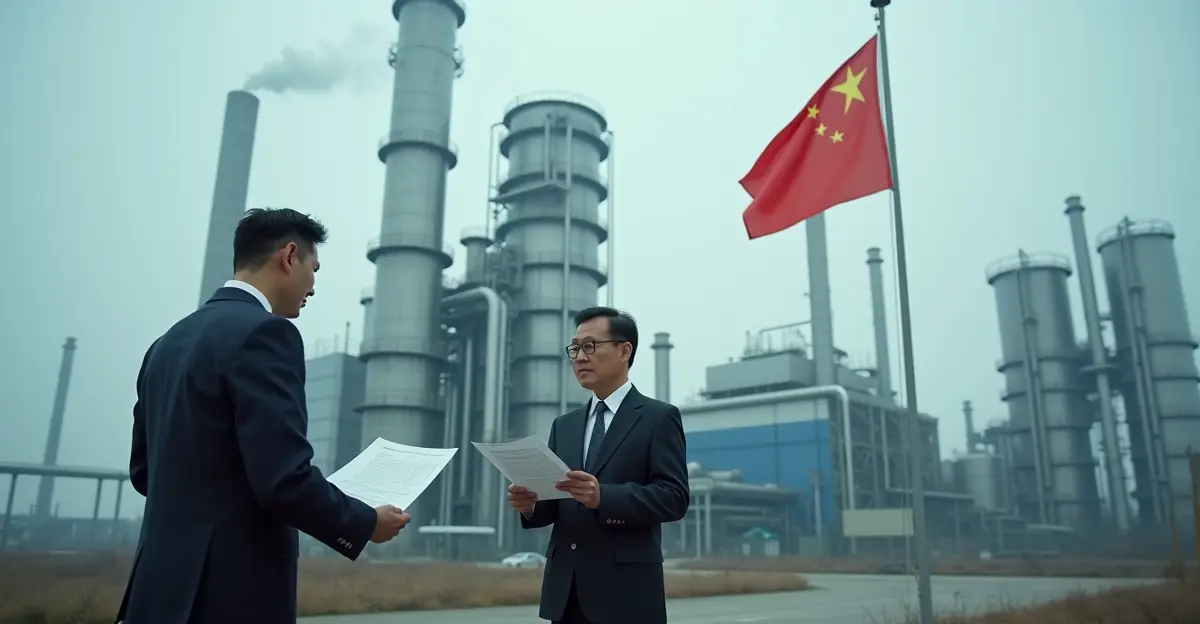
In 2025, China imposed two waves of rare earth export controls that have sent shockwaves through global defense, electric vehicle (EV), and renewable energy supply chains. With the second wave suspended only until November 2026, Western nations face a narrowing window to build independent processing capacity. China controls approximately 90% of global rare earth refining and has reduced licensing approval rates for European firms below 25%, creating what analysts call a geopolitical sword of Damocles over critical mineral supplies.
Background: China's Rare Earth Dominance
Rare earth elements (REEs) comprise 17 metals essential for permanent magnets in EV motors, wind turbine generators, and defense systems such as missile guidance and night vision. Despite the name, rare earths are relatively abundant in the Earth's crust, but China's decades-long investment in processing infrastructure has given it a near-monopoly on refining. As of 2025, China accounts for over 60% of global mining and roughly 90% of processing capacity, including a near-total monopoly on heavy rare earth elements (HREEs) like dysprosium and terbium, which are critical for high-performance magnets.
The EU Critical Raw Materials Act identifies rare earths as among the most strategically vulnerable inputs for Europe's green and digital transitions. The World Economic Forum noted in October 2025 that China supplies 95% of global rare-earth oxides and 98% of Europe's rare-earth magnets. When China tightened export licenses in 2025, several European carmakers were forced to halt production.
The Two Waves of Export Controls
First Wave: April 2025
In response to US tariffs, China's Ministry of Commerce (MOFCOM) introduced the first wave of export controls in April 2025, citing national security interests. These measures imposed licensing requirements on rare earth elements, their production equipment, and related technologies. The controls immediately disrupted supply chains, with European prices for neodymium-praseodymium (NdPr) oxide jumping 37% by April 2026 and dysprosium prices surging over 100% internationally compared to Chinese domestic prices.
Second Wave: October 2025, Suspended Until November 2026
The second wave, announced in October 2025, expanded controls to include medium and heavy rare earths (holmium, erbium, thulium, europium, ytterbium), lithium battery materials, artificial graphite anodes, and superhard materials. However, on November 7, 2025, MOFCOM issued Announcement No. 70, suspending the second-wave controls until November 10, 2026. The suspension was welcomed by European industries but created a precarious window: the April 2025 rules remain fully in force, and the suspension could be lifted at any time, leaving procurement teams with a six-month clock to secure supplies.
As one European Parliament briefing noted, 'The partial suspension was welcomed, but the EU's strategic dependency on China for these essential materials remains a major vulnerability that is difficult to mitigate.'
Strategic Calculus: Why Beijing Is Weaponizing Rare Earths
China's approach is not about scarcity but about control. By imposing temporary, reversible restrictions, Beijing maintains pricing power and extracts geopolitical concessions while discouraging large-scale Western alternative investment. The rare earth processing monopoly gives China leverage over the entire downstream supply chain, from magnets to EVs to defense systems.
A multi-institutional analysis published in early 2026 found that export controls triggered sixfold price spikes outside China for some rare earths, while domestic Chinese prices remained artificially low. This dual-market structure creates a powerful incentive for Western manufacturers to relocate production to China, further entrenching dependency. The report concluded that rebuilding independent alternatives would take 20 to 30 years — far exceeding the current geopolitical window.
The Western Response: Critical Minerals Alliance and Domestic Investments
The 54-Nation Critical Minerals Alliance
On February 4, 2026, the US Department of State hosted the 2026 Critical Minerals Ministerial, bringing together representatives from 54 countries and the European Commission. The event launched FORGE (Forum on Resource Geostrategic Engagement) as successor to the Minerals Security Partnership, signed 11 new bilateral critical minerals frameworks, and mobilized over $30 billion in US government financing for strategic minerals projects. Notably, the US Export-Import Bank approved Project Vault — a $10 billion domestic strategic reserve for critical minerals.
EU Sovereign Purchasing and the Critical Raw Materials Act
The European Union has responded through the Critical Raw Materials Act, which aims to secure EU sovereignty over critical raw materials and boost domestic supply. The European Parliament debated the EU's heavy dependence on rare earth imports from China in November 2025, with MEPs discussing trade and industrial policy tools to address China's export restrictions. The EU is exploring sovereign purchasing mechanisms and joint stockpiling to buffer against supply disruptions.
Domestic Refining Investments
From January 2025 to January 2026, Western governments invested over $3 billion in rare earth supply chain projects. The US led with $1.4 billion through Department of Defense and Department of Energy programs spanning mining to magnet production. MP Materials restarted Mountain Pass operations and produced its first commercial NdFeB magnets in March 2026. USA Rare Earth commissioned the Stillwater Phase 1a processing facility, and Round Top mine in Texas achieved first commercial-grade dysprosium oxide (99.1% purity) in 2025.
Canada committed approximately $51.6 million via its sovereign fund, Australia allocated roughly $260 million primarily for Arafura's Nolans project, Japan invested $380–400 million including a joint heavy REE plant in France, and Europe disbursed approximately €150–200 million under the Critical Raw Materials Act. Despite this unprecedented funding, experts estimate the West needs $10–20 billion and systemic reform to build a resilient supply chain within five years.
The Western rare earth supply chain gap remains stark: China still controls 85–91% of global refining capacity and 94% of permanent magnet manufacturing. The US still relies on approximately 80% imports for critical minerals.
Impact on Defense and Green Energy
The defense sector faces the highest risk from heavy rare earth dependency. Permanent magnets are essential for missile guidance systems, precision munitions, radar, and electronic warfare. The EV sector is equally vulnerable: neodymium magnets are the standard for traction motors in most electric vehicles. Wind turbine generators, particularly direct-drive turbines, require large quantities of rare earth magnets. Clean energy technologies could increase mineral demand four- to six-fold by 2040, according to the World Economic Forum.
The price divergence between Chinese and international markets has created a competitive disadvantage for Western manufacturers. By February 2026, dysprosium reached $931/kg internationally (+105% year-to-date) while trading at roughly $200/kg domestically in China. Terbium hit $4,029/kg internationally (+103% YTD). This gap incentivizes production migration to China and undermines the business case for Western processing investments.
Can the 12-to-18-Month Window Close the Gap?
Analysts identify three strategic paths for Western nations: managed dependence (accepting Chinese dominance while building limited alternatives), costly independence (massive investment to replicate the full supply chain), or a hybrid model balancing resilience and realism. The hybrid approach — combining strategic stockpiles, diversified sourcing from allied nations, recycling, and targeted domestic processing — appears most feasible within the 12-to-18-month window before the November 2026 deadline.
However, significant obstacles remain. Permitting reform, demand signaling, and workforce development lag behind financial commitments. Heavy rare earth processing, in particular, remains the biggest supply gap, with no Western facility currently capable of separating HREEs at commercial scale. Lynas Rare Earths leads non-Chinese production with its Mt Weld mine and Malaysian separation facility, but its output of 5,000–6,000 tonnes per year of NdPr oxide covers only a fraction of global demand.
As one industry expert noted, 'The suspension window expires November 10, 2026. That is a six-month clock for procurement teams. If Western projects do not show tangible progress by then, the strategic vulnerability will become a crisis.'
FAQ
What are rare earth elements and why are they important?
Rare earth elements are 17 metals essential for permanent magnets used in EV motors, wind turbines, defense systems, and electronics. Despite the name, they are relatively abundant but difficult to refine, giving China a strategic advantage due to its decades-long investment in processing infrastructure.
What did China's 2025 rare earth export controls involve?
China introduced two waves of export controls in April and October 2025, citing national security. The first wave imposed licensing on rare earths and production equipment. The second wave expanded to heavy rare earths and other materials but was suspended in November 2025 until November 10, 2026.
How are Western nations responding to China's rare earth dominance?
The US launched the 54-nation Critical Minerals Ministerial in February 2026, mobilizing over $30 billion in financing. The EU passed the Critical Raw Materials Act and is exploring sovereign purchasing. Western governments invested over $3 billion in domestic refining projects from January 2025 to January 2026.
Can the West build independent rare earth supply chains by 2026?
Experts say the West needs $10–20 billion and systemic reform to build a resilient supply chain within five years. Heavy rare earth processing remains the biggest gap, with no Western facility operating at commercial scale. The 12-to-18-month window before the November 2026 deadline is likely insufficient for full independence, making a hybrid approach of stockpiles, diversification, and recycling the most realistic path.
What happens if China reimposes export controls in November 2026?
If the suspension is not extended, the second-wave controls would take full effect, potentially cutting off Western access to heavy rare earths and other critical materials. This could disrupt EV production, wind turbine manufacturing, and defense supply chains, forcing rapid price increases and production halts. The geopolitical implications of rare earths would escalate significantly.
Conclusion: A Race Against Time
China's rare earth export controls represent one of the most strategically urgent geopolitical issues of the decade. The November 2026 deadline creates a clear timeline for Western action, but the gap between ambition and capability remains wide. While the 54-nation Critical Minerals Alliance and domestic investments signal serious intent, the structural advantages China has built over decades cannot be replicated in months. The next 12 to 18 months will determine whether the West can achieve meaningful supply chain resilience or must accept prolonged strategic vulnerability.
Sources
- European Parliamentary Research Service, 'China's rare-earth export restrictions,' November 2025
- US Department of State, '2026 Critical Minerals Ministerial,' February 2026
- Rare Earth Exchanges, 'China's 2026 Export Controls Redraw the Global Supply Chain Map,' 2026
- World Economic Forum, 'From chips to turbines: Europe depends on critical raw materials,' October 2025
- Discovery Alert, 'Critical Minerals Energy Transition 2026 Geopolitical Influence,' February 2026
- Mainrich International, 'Rare Earth Market Update May 2026'
- CSET Georgetown, 'China's Ministry of Commerce Notice 2025 No. 61'


Follow Discussion