


 Deutsch
 English
 Español
 Français
 Nederlands
 Português


 Share
Share




What is Quantum Technology's Strategic Shift?
January 2026 marked a watershed moment in quantum technology's evolution, signaling a decisive strategic pivot from academic research to coordinated national strategies and industrial-scale manufacturing. Governments worldwide advanced formal roadmaps linking quantum development to defense, cybersecurity, and economic competitiveness, while industry prioritized fabrication, supply chains, and integration. This convergence of public policy and private investment represents quantum technology's entry into a more pragmatic phase focused on building, governing, and scaling within existing political and industrial constraints. The shift reflects growing recognition that quantum capabilities have matured beyond laboratory experiments to become strategic infrastructure requiring systematic development and deployment.
Global Quantum Roadmaps: Defense and Economic Priorities
Nations across Asia and the G7 have unveiled comprehensive quantum strategies with specific timelines and industrial targets. India's Department of Science and Technology released a military-focused quantum framework requiring Critical Information Infrastructure (defense, power, telecom) to complete quantum-safe implementation by 2029, with other sectors following by 2033. The roadmap establishes quantum risk governance by 2027-2028 and mandates cryptographic bill of materials from vendors, addressing both confidentiality and integrity threats through domestic testing labs and sector-specific guidance.
South Korea's Quantum Chip Manufacturing Ambition
South Korea announced an ambitious national strategy to become the global leader in quantum chip manufacturing by 2035 through the establishment of five quantum clusters nationwide. The Ministry of Science and ICT's "First Master Plan for Quantum Clusters" (2026-2030) creates region-specific clusters focused on quantum computing, communications, sensing, materials/components, and algorithms. These clusters will integrate regional core industries with quantum technology to build a full-cycle industrial ecosystem spanning research, demonstration, commercialization, and investment. The government plans to construct a "Quantum Highway" connecting quantum infrastructure nationwide and create hybrid infrastructure linking quantum computing with high-performance computing.
Taiwan's Industrial Quantum Computing Goal
Taiwan has set a five-year target for achieving industrial-grade quantum computing capabilities, positioning itself as a critical node in the global quantum supply chain. This initiative builds on the island's existing semiconductor manufacturing expertise, creating synergies between traditional chip fabrication and emerging quantum technologies. The semiconductor industry's evolution provides valuable lessons for quantum manufacturing scale-up, particularly in areas of precision engineering, materials science, and supply chain management.
Industry Response: Manufacturing and Supply Chain Investments
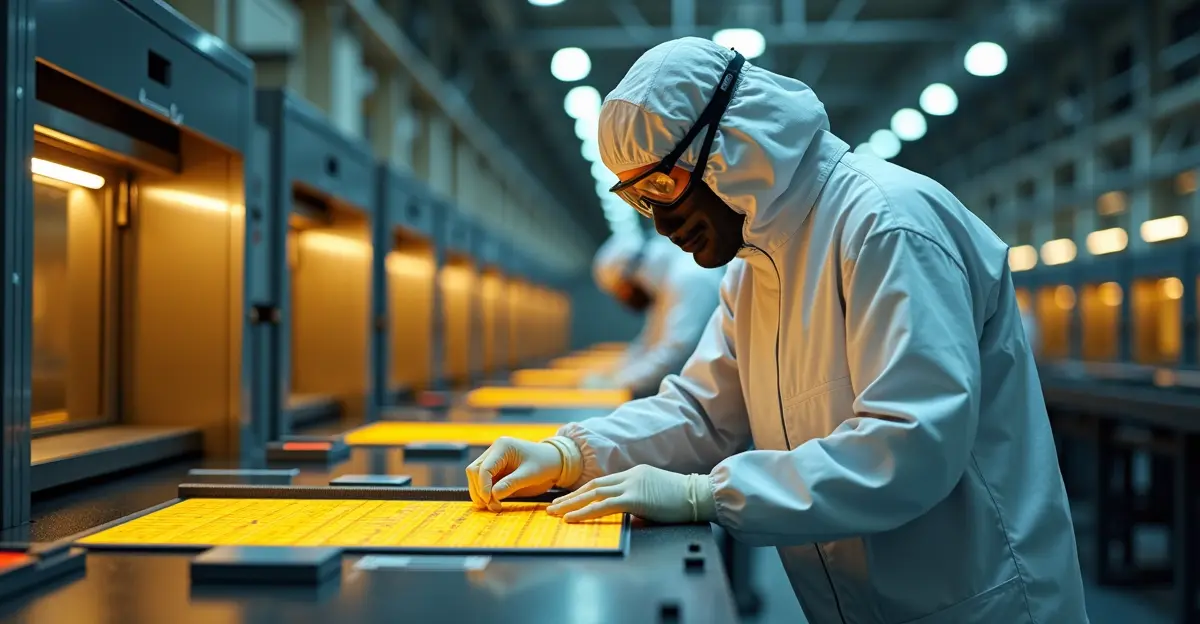
Companies are responding to government initiatives by prioritizing fabrication, supply chains, and integration, with significant investments in foundries, photonics, and vertical manufacturing. Quantum Computing Inc.'s $110 million acquisition of Luminar Semiconductor exemplifies this trend, combining thin-film lithium niobate integrated photonics expertise with laser, detector, and advanced packaging capabilities. This vertical integration enables development of chip-scale quantum hardware operating at room temperature, moving from technology innovation to scalable manufacturing.
Foundry Investments and Photonics Integration
The quantum industry is witnessing increased investment in specialized foundries capable of producing quantum chips and components at scale. Photonics integration has emerged as a critical area, with companies developing technologies that combine quantum processors with optical communication systems. These investments reflect a broader shift toward treating quantum systems as manufacturable products rather than experimental prototypes, with companies establishing domestic manufacturing capabilities to serve government, defense, aerospace, and national security markets.
G7 Guidance on Post-Quantum Cryptography
The G7 Cyber Expert Group released a coordinated roadmap for transitioning the financial sector to post-quantum cryptography, treating quantum threats to current encryption as systemic concerns. The January 2026 statement outlines a flexible, risk-based approach for financial institutions to migrate to quantum-resistant cryptographic algorithms before quantum computers can break current encryption. The roadmap targets 2035 as the completion date for migration across the financial system, with critical systems prioritized for earlier transition by 2030-2032.
Financial Sector Implications
The G7 guidance emphasizes collaboration across jurisdictions, standards-based implementation, and phased transition activities including awareness, discovery, inventory, risk assessment, and planning. It addresses the 'harvest now, decrypt later' threat model where attackers collect encrypted data today for future quantum decryption, making immediate action essential for protecting long-lived financial data. The cybersecurity landscape evolution now includes quantum threats as a fundamental consideration for financial stability and data protection.
Strategic Implications and Future Outlook
The convergence of national quantum strategies with industrial manufacturing priorities signals quantum technology's maturation into a strategic sector with geopolitical implications. Countries are positioning themselves not just as quantum technology users but as manufacturers and exporters of quantum systems and components. This shift has significant implications for global technology leadership, with nations investing in domestic capabilities to reduce dependence on foreign quantum technologies.
Workforce and Infrastructure Development
Beyond manufacturing, governments are expanding funding for shared infrastructure and workforce programs to support quantum technology deployment. Educational initiatives are emerging to develop the specialized skills needed for quantum engineering, manufacturing, and maintenance. The STEM education transformation now includes quantum literacy as a core component, with universities establishing dedicated quantum engineering programs and industry partnerships.
Expert Perspectives on the Quantum Transition
Industry analysts note that quantum technology is experiencing a 'magic moment' as it transitions from research to deployment, with global investment growing 50% year-over-year to reach $2 billion in 2024. The market is expected to reach up to $97 billion by 2035, with quantum computing alone potentially hitting $72 billion. "We're seeing quantum move from the laboratory to the factory floor," observes a senior technology analyst. "Governments and companies are treating it as strategic infrastructure rather than speculative science, focusing on practical challenges of building and delivering quantum systems."
FAQ: Quantum Technology's Strategic Shift
What is quantum technology's strategic pivot in 2026?
Quantum technology is shifting from academic research to coordinated national strategies and industrial-scale manufacturing, with governments linking quantum development to defense, cybersecurity, and economic competitiveness while industry prioritizes fabrication and supply chain investments.
Which countries have announced quantum manufacturing roadmaps?
South Korea aims to become the global leader in quantum chip manufacturing by 2035 through five quantum clusters, Taiwan targets industrial-grade quantum computing within five years, and India has established quantum-safe implementation timelines for critical infrastructure by 2029.
What is the G7's guidance on post-quantum cryptography?
The G7 Cyber Expert Group released a coordinated roadmap for financial institutions to transition to quantum-resistant cryptographic algorithms by 2035, with critical systems prioritized for earlier migration by 2030-2032, addressing 'harvest now, decrypt later' threats.
How is industry responding to quantum manufacturing demands?
Companies are investing in foundries, photonics, and vertical manufacturing, with acquisitions like Quantum Computing Inc.'s $110 million purchase of Luminar Semiconductor enabling chip-scale quantum hardware development and scalable manufacturing capabilities.
What are the economic implications of quantum manufacturing?
The quantum technology market is expected to reach up to $97 billion by 2035, with countries positioning themselves as manufacturers and exporters of quantum systems, creating new industrial sectors and reducing dependence on foreign quantum technologies.
Conclusion: Quantum's Pragmatic Phase
The strategic pivot of quantum technology in 2026 represents a fundamental shift in how nations and companies approach this transformative technology. By focusing on manufacturing, supply chains, and practical deployment within existing industrial and political constraints, stakeholders are moving quantum from speculative science to strategic infrastructure. This pragmatic phase marks quantum technology's transition from theoretical potential to tangible capability, with implications for national security, economic competitiveness, and technological sovereignty that will shape global dynamics for decades to come.


Follow Discussion