


 Deutsch
 English
 Español
 Français
 Nederlands
 Português


 Share
Share




The Quantum Arms Race: How Post-Quantum Cryptography is Redefining Global Security Architecture
As nations worldwide confront the impending 'Q-Day' – the moment when quantum computers could break current encryption – a strategic competition is reshaping global security architecture. With NIST finalizing post-quantum cryptography standards in 2024 and the European Union setting a 2026 deadline for migration, governments are racing to overhaul their security infrastructure against what experts call the 'harvest now, decrypt later' threat, where adversaries are already stockpiling encrypted data for future quantum decryption. This technological shift extends far beyond encryption, encompassing quantum sensing for submarine detection, GPS-independent navigation, and secure quantum communications that are creating new geopolitical fault lines between the US, China, and EU.
What is Post-Quantum Cryptography?
Post-quantum cryptography (PQC) refers to cryptographic algorithms designed to be secure against attacks by quantum computers. Current widely-used encryption methods like RSA and elliptic curve cryptography rely on mathematical problems that quantum computers could solve using Shor's algorithm. According to Wikipedia, 'Most widely used public-key algorithms rely on the difficulty of one of three mathematical problems: the integer factorization problem, the discrete logarithm problem, or the elliptic-curve discrete logarithm problem. All of these problems could be easily solved on a sufficiently powerful quantum computer running Shor's algorithm.' The NIST PQC standards finalized in 2024 include ML-KEM (FIPS 203) for key encapsulation, ML-DSA (FIPS 204) for digital signatures, and SLH-DSA (FIPS 205) for hash-based signatures, providing mathematically secure alternatives based on lattice problems and hash functions resistant to both classical and quantum attacks.
The Global Timeline: From NIST Standards to EU Mandates
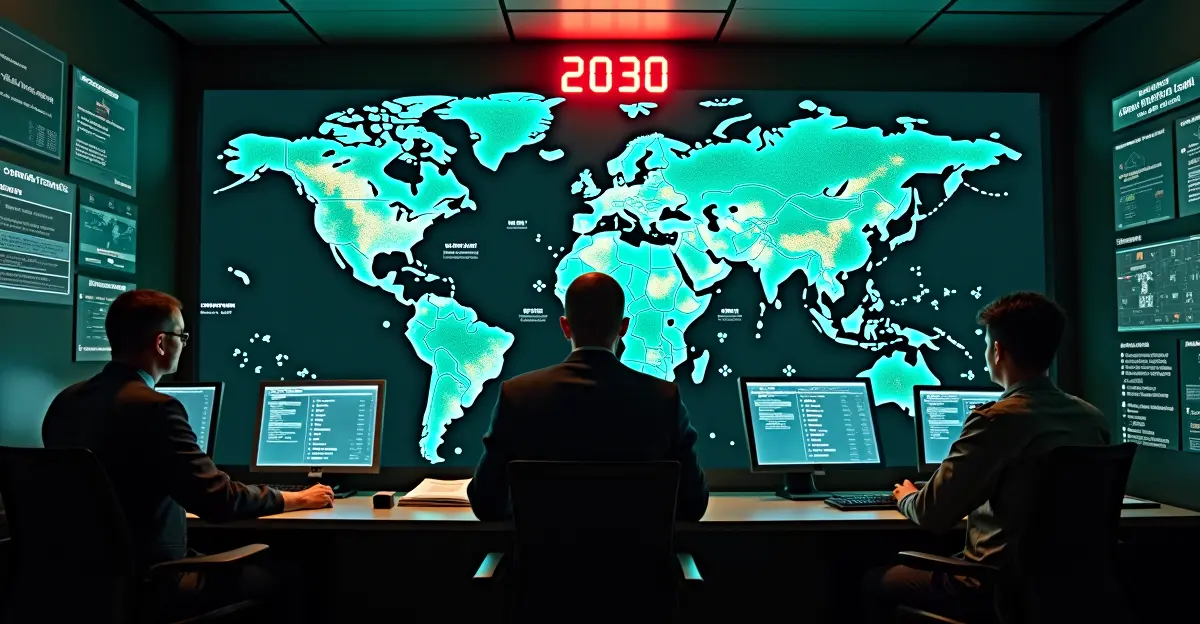
The urgency of quantum migration is underscored by concrete deadlines from major powers. The United States established its framework through three key laws: the Quantum Computing Cybersecurity Preparedness Act (2022), National Quantum Initiative Act (2018), and CHIPS and Science Act (2022). National Security Memorandum 10 (NSM-10) from 2022 sets a 2035 target for quantum risk mitigation, with a TLS 1.3 deadline of January 2, 2030. Meanwhile, the European Union has mandated that critical infrastructure must migrate to post-quantum cryptography by 2030, with initial transition steps required by the end of 2026. This coordinated roadmap involves two phases: by 2026, organizations must complete a full cryptographic asset inventory and pilot hybrid PQC use cases; by 2030, all high-risk critical infrastructure must run quantum-resistant algorithms natively.
The 'Harvest Now, Decrypt Later' Threat
Perhaps the most immediate concern driving quantum migration is the 'harvest now, decrypt later' threat model. As explained in a Federal Reserve paper examining post-quantum cryptography and financial stability, adversaries are already collecting encrypted data with the intention of decrypting it once large-scale quantum computers become available. This means sensitive government communications, financial transactions, and military intelligence intercepted today could be decrypted within years when quantum computers reach sufficient power. The risk analysis framework known as Mosca's theorem helps organizations identify migration urgency by comparing three time horizons: the time required to transition systems (X), the time during which data must remain secure (Y), and the estimated arrival of cryptographically relevant quantum computers (Z). If X + Y > Z, migration is considered urgent.
Strategic Competition: US, China, and EU Quantum Initiatives
The quantum arms race has become a central arena for great power competition. China has positioned itself as a global leader through massive state-led investment of approximately USD 15 billion, now publishing more quantum-related research papers annually than any other nation, including the United States. China leads in quantum communications with the world's largest quantum communication network spanning 12,000 kilometers, including two quantum satellites. Meanwhile, the United States maintains technological leadership through DARPA-funded research and private sector innovation, while European countries excel in quantum research but struggle to translate findings into practical applications. This competition extends to export controls, with US restrictions on quantum technology exports to China highlighting the strategic military importance of quantum technology in cryptology, communication, and information processing.
Beyond Encryption: Quantum Sensing and Navigation
The quantum revolution extends far beyond cryptography to fundamentally reshape defense capabilities. Quantum sensing technologies are poised to revolutionize modern warfare by potentially nullifying the stealth advantages of submarines and advanced aircraft. These technologies detect atomic-scale interactions in gravity, magnetism, and light, enabling tracking of previously invisible military assets. Quantum navigation technology is emerging as a solution to military GPS jamming problems, with researchers developing quantum sensors that enable vehicles to navigate independently without satellite dependence. Key approaches include quantum inertial navigation using atom interferometry (like Infleqtion's sensors that split and recombine rubidium atoms to measure acceleration and direction), quantum magnetometers using nitrogen-vacancy diamonds to measure Earth's magnetic fields, and ultra-precise atomic clocks. The GPS-independent navigation systems represent a transformative approach to military operations in contested electromagnetic environments.
Defense Implications and Geopolitical Fault Lines
The quantum technological shift is creating new geopolitical fault lines and redefining deterrence strategies. The first country to operationalize quantum technologies for defense will gain a decisive advantage in reshaping nuclear deterrence and conventional warfare. Quantum sensing applications include submarine detection through magnetic field mapping, underground tunnel identification via density anomalies, and GPS-free navigation using cold-atom inertial sensors. However, current prototypes face significant challenges including fragility, susceptibility to environmental interference, and difficulty transitioning from laboratory to battlefield conditions. The strategic implications extend to secure communications, where quantum key distribution (QKD) enables theoretically unbreakable encryption through quantum mechanical principles, though implementation challenges remain. The global security architecture is being fundamentally rewritten as nations recognize that quantum superiority could determine future military and economic dominance.
Expert Perspectives on the Quantum Transition
Industry experts emphasize that successful quantum transition requires more than just timelines. According to European analysis, 'a timeline alone is insufficient - successful transition requires technical implementation guidance, adequate funding, European technology development, clear standards, and crypto-agility.' Organizations are urged to begin cryptographic discovery and risk analysis immediately rather than waiting, as the transition requires complex hardware/software updates and migration of legacy systems. The transition requires deep discovery of cryptographic dependencies, hybrid deployments, rigorous testing, and compliance with regulations like NIS2 and DORA. Companies are developing solutions including automated key discovery, modular algorithm plug-ins, zero-knowledge proof compliance verification, and fully homomorphic encryption to facilitate this critical migration.
FAQ: Post-Quantum Cryptography and Global Security
What is Q-Day and when is it expected?
Q-Day refers to the day when quantum computers become powerful enough to break current encryption standards. While estimates vary, experts suggest a 19-34% probability of quantum computers breaking today's encryption within 10 years, making migration urgent despite uncertainty about exact timing.
What are the NIST post-quantum cryptography standards?
NIST finalized three PQC standards in 2024: ML-KEM (FIPS 203) for key encapsulation, ML-DSA (FIPS 204) for digital signatures, and SLH-DSA (FIPS 205) for hash-based signatures. These replace vulnerable classical systems like RSA and elliptic curve cryptography.
What is the 'harvest now, decrypt later' threat?
This refers to adversaries collecting encrypted data today with the intention of decrypting it later when quantum computers become powerful enough. Sensitive data intercepted now could remain vulnerable for years, making immediate migration critical.
How does quantum sensing change military capabilities?
Quantum sensing enables detection of submarines and stealth aircraft through magnetic field mapping, provides GPS-independent navigation using atom interferometry, and allows underground tunnel identification via density anomaly detection.
What are the key deadlines for quantum migration?
The EU mandates initial transition steps by 2026 and full critical infrastructure migration by 2030. The US has a TLS 1.3 deadline of January 2, 2030, with a broader 2035 target for quantum risk mitigation under NSM-10.
Conclusion: The Future of Quantum Security
The quantum arms race represents one of the most significant technological shifts in global security since the advent of nuclear weapons. As nations race to implement post-quantum cryptography standards and develop quantum sensing capabilities, the balance of power is being recalibrated around quantum technological superiority. The strategic competition in quantum technologies between the US, China, and EU will likely define the next decade of geopolitical competition, with implications for everything from financial stability to military deterrence. Organizations that begin their quantum migration now will not only protect against future threats but position themselves advantageously in the emerging quantum economy, while those that delay risk catastrophic exposure in what is rapidly becoming the defining security challenge of our time.




Follow Discussion