


 Deutsch
 English
 Español
 Français
 Nederlands
 Português


 Share
Share




Commercial Launch Fleet Expansion Accelerates in 2025-2026
The commercial space industry is experiencing unprecedented growth as private companies dramatically increase their launch cadence while navigating evolving regulatory landscapes. According to recent market analysis, the global space launch market is projected to grow from USD 17.74 billion in 2026 to USD 42.81 billion by 2035, representing a compound annual growth rate (CAGR) of 10.6%. This explosive growth is driven by companies like SpaceX, Blue Origin, Rocket Lab, and United Launch Alliance, which are transforming space access through innovative technologies and business models.
Record-Breaking Launch Schedules
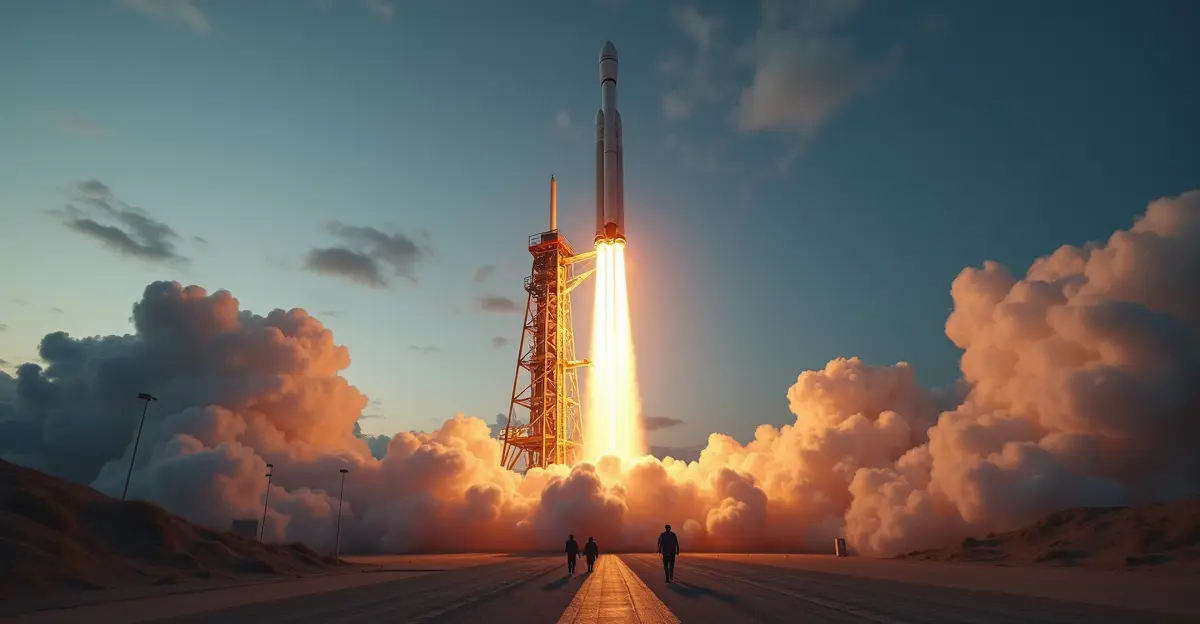
SpaceX leads the charge with plans for 106 Falcon 9 missions in 2025 alone, including a record-setting week in December with seven launches. The company's Falcon 9 launch schedule shows 104 planned missions, with the next launch scheduled for February 7th at 5:21pm UTC from Vandenberg SFB carrying Starlink Group 17-33 satellites. 'We're seeing launch rates that were unimaginable just five years ago,' says industry analyst Mark Johnson. 'The combination of reusable rockets and standardized payloads has created a manufacturing-like approach to space access.'
Other key players are also ramping up operations. Rocket Lab continues its Electron launches from New Zealand, while Blue Origin prepares for its NS-37 crewed suborbital flight. United Launch Alliance's Vulcan rocket is entering regular service, and Blue Origin's New Glenn heavy-lift vehicle is preparing for its debut. The 2026 rocket launch schedule includes multiple SpaceX Falcon 9 Starlink missions from both Cape Canaveral and Vandenberg, various Chinese Long March launches, and international missions from India and New Zealand.
Regulatory Landscape Evolution
The regulatory environment is struggling to keep pace with this rapid expansion. The Office of Commercial Space Transportation (FAA/AST), the branch of the United States Federal Aviation Administration that approves commercial rocket launch operations, faces increasing pressure to streamline processes while maintaining safety standards. Recent regulatory changes include an August 2025 Executive Order streamlining environmental reviews and launch licenses.
'The regulatory framework was designed for a handful of government launches per year, not hundreds of commercial missions,' explains regulatory expert Sarah Chen. 'We need smarter regulations that enable innovation while protecting public safety and the environment.' The FAA's Aerospace Forecast for Fiscal Years 2025-2045 provides comprehensive projections for the commercial space industry, analyzing growth trends, launch projections, and regulatory frameworks over a 20-year period.
Market Demand and Infrastructure Challenges
Market demand is driving much of this growth, with diverse payloads including Starlink satellites, Earth observation missions, communications satellites, and national security payloads. The U.S. Space Force recently awarded $13.7 billion in contracts under the NSSL Phase 3 program, with SpaceX receiving 60% of missions. This military demand complements commercial needs for satellite-based services including broadband connectivity, Earth observation, and navigation.
However, infrastructure at major spaceports is operating near capacity. 'We're hitting physical limits at traditional launch sites,' notes spaceport director Maria Rodriguez. 'We need new facilities and better airspace management to support this growth trajectory.' Environmental concerns also remain significant, with communities near launch sites expressing concerns about noise, pollution, and ecosystem impacts.
Technological Innovations Driving Growth
The market transformation has been powered by private aerospace companies introducing cost-effective solutions including reusable rockets and miniaturized satellites. SpaceX's Starship program represents the next frontier, with Flight 4 demonstrating significant advancements in reusability and landing capabilities. Reusable rocket technology has significantly reduced space access costs, enabling more frequent launches and new business models.
Other technological trends include electric propulsion systems, AI-powered automation for launch operations, and standardized satellite buses that reduce manufacturing costs. These innovations are creating a virtuous cycle where lower costs enable more missions, which in turn drive further innovation and cost reductions.
Future Outlook and Challenges
Looking ahead to 2026 and beyond, the industry faces both opportunities and challenges. The scheduled launches for 2026 include Crew-12 on February 11th (NASA's twelfth crewed operational flight to ISS), multiple Starlink missions throughout February, and several Space Development Agency Tranche 1 Transport Layer missions for military communications starting in February 2026.
Key challenges include regulatory adaptation, infrastructure development, environmental sustainability, and international competition. China's expanding launch capabilities and Europe's Ariane 6 program represent significant competitive pressures. However, industry leaders remain optimistic about continued growth. 'We're just at the beginning of the commercial space revolution,' says SpaceX executive Tom Mueller. 'As costs continue to fall and capabilities increase, we'll see entirely new markets emerge in orbit and beyond.'
The commercial launch fleet growth represents a fundamental shift in how humanity accesses space, moving from government-dominated programs to a vibrant commercial ecosystem. As regulatory frameworks evolve and infrastructure expands, the coming years will determine whether this growth can be sustained while addressing environmental and safety concerns.
Follow Discussion