


 Deutsch
 English
 Español
 Français
 Nederlands
 Português


 Share
Share




China's Ministry of Commerce has placed seven European defense companies on its export control blacklist, imposing immediate restrictions on the supply of Chinese dual-use goods and technology. The move, announced on April 24, 2026, marks the first time Beijing has directly sanctioned European entities over arms sales to Taiwan, escalating tensions between the EU and China over the One-China policy.
Background: China's Export Control Action
The Chinese Ministry of Commerce announced the sanctions on Friday, accusing the targeted firms of involvement in weapons sales to Taiwan or colluding with the island's authorities. Dual-use items — goods, software, and technology designed for civilian use that can also be repurposed for military applications — are now banned for export to these entities. The blacklist includes companies from Belgium, Germany, and the Czech Republic, according to Bloomberg and Reuters reports.
A spokesperson for the Chinese ministry stated that the action is a targeted measure against specific companies with military backgrounds and emphasized that it should not affect broader China-Europe trade. However, the move signals Beijing's growing willingness to use trade leverage to enforce its territorial claims over Taiwan, which it considers a renegade province. This is part of a pattern where China's sanctions on foreign firms have expanded beyond U.S. and Japanese companies to include European entities.
Companies Targeted by China's Blacklist
Belgian Firms: FN Herstal and FN Browning
Two Belgian companies, FN Herstal and FN Browning Group, both specialized in firearms and ammunition manufacturing, were placed on the blacklist. FN Herstal is one of the world's oldest and largest manufacturers of small arms, supplying military and law enforcement agencies globally. The company's inclusion signals Beijing's intent to target any entity in the European defense supply chain linked to Taiwan's military capabilities.
German Defense Electronics Giant Hensoldt
Germany's Hensoldt AG, a major supplier of radar and sensor technology for military platforms, including the Eurofighter Typhoon and German frigates, was also sanctioned. Following the announcement, Hensoldt's stock dropped over 5% to around €74, down 35% from its 52-week high. The company is currently pivoting toward services, including a drone pilot training project and an innovation hub in Ukraine. Analysts have mixed views, with price targets ranging from €85 (J.P. Morgan) to €101 (Deutsche Bank). The blacklist adds to the challenges faced by European defense companies under China sanctions.
Czech Defense Firms: Omnipol, Excalibur Army, and Others
Four Czech companies were blacklisted, including Omnipol, Excalibur Army (part of the Czechoslovak Group), SpaceKnow, and the Czech Aeronautical Research and Testing Institute. These firms are involved in defense manufacturing and research. Czech MEP Tomáš Zdechovský noted that Czech companies are prominently affected due to their active support for Ukraine, but said the EU defense sector has already been reducing dependency on Chinese components. However, smaller specialized firms may face delays, higher costs, or need to re-certify alternative suppliers.
Impact on EU-China Trade Relations
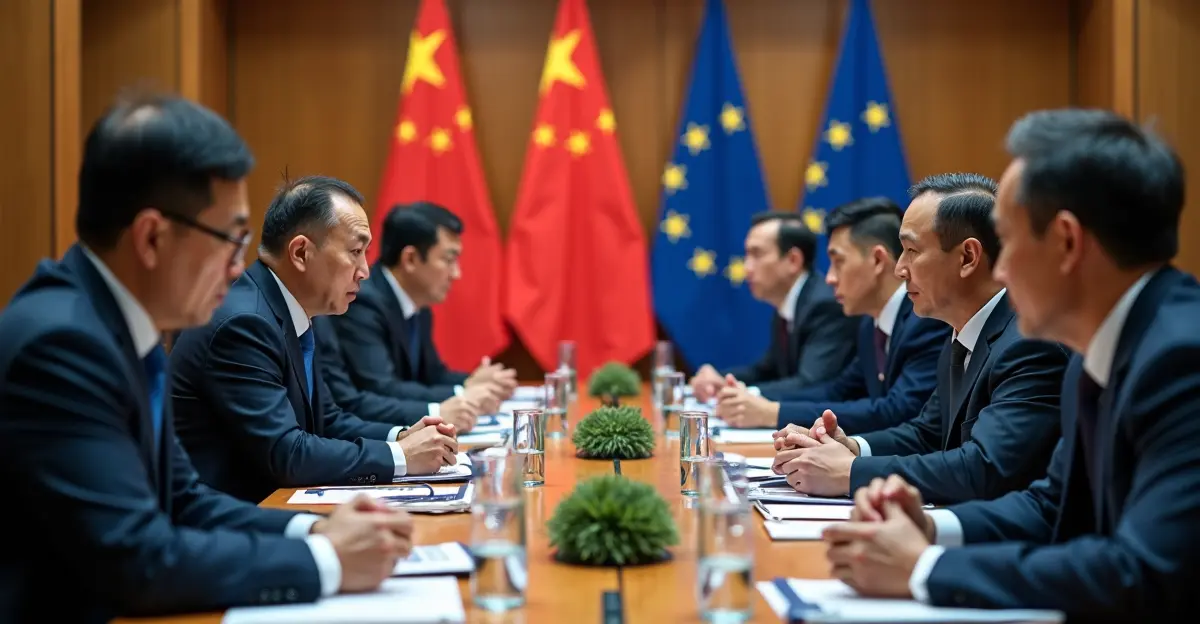
China's export restrictions on European firms come amid growing geopolitical friction between Brussels and Beijing. The EU recently announced its 20th sanctions package against Russia, which included restrictions on 27 Chinese companies accused of aiding Russia's war efforts. China's move is seen by some analysts as a retaliatory measure, though Beijing officially cites the Taiwan arms sales as the reason.
China has previously sanctioned over 20 U.S. defense companies and 10 executives in December 2025 over a $10 billion U.S. arms sale to Taiwan, as well as more than 20 Japanese firms earlier in 2025. The expansion to European companies marks a significant escalation. The targeted firms will now face a ban on importing Chinese dual-use items, including advanced materials, electronics, sensors, and aerospace components that are critical for defense manufacturing.
According to the Chinese Ministry of Commerce, foreign organizations are prohibited from transferring Chinese dual-use items to these blacklisted entities, though exceptions may be granted on a case-by-case basis. The ministry informed the EU before the announcement and reiterated that normal China-Europe trade should not be affected. However, the move is likely to further strain EU-China trade tensions 2026.
Taiwan's Growing Isolation and Beijing's Strategy
China views Taiwan as a breakaway province and has intensified efforts to isolate the island diplomatically and economically. The One-China principle is a core interest for Beijing, and any foreign arms sales to Taiwan are seen as a direct challenge to its sovereignty. The sanctions against European firms are part of a broader strategy to discourage international defense cooperation with Taiwan by imposing economic costs on foreign entities.
Taiwan has been strengthening its defense capabilities amid rising Chinese military activity near the island. The U.S. and several European nations have increased arms sales to Taiwan, prompting Beijing's retaliatory measures. The blacklisting of European companies signals that no region is exempt from China's sanctions regime when it comes to Taiwan-related defense trade.
FAQ
What are dual-use items under China's export controls?
Dual-use items are goods, software, and technologies that have both civilian and military applications. China's 2026 Dual-Use Export Control Catalogue lists 846 items requiring export licensing, including advanced materials, electronics, sensors, aerospace components, and precursor chemicals.
Which European companies were blacklisted by China?
The seven entities are: FN Herstal (Belgium), FN Browning Group (Belgium), Hensoldt AG (Germany), Omnipol (Czech Republic), Excalibur Army (Czech Republic), SpaceKnow (Czech Republic), and the Czech Aeronautical Research and Testing Institute.
Why did China impose these sanctions?
China accuses these companies of involvement in arms sales to Taiwan or colluding with Taiwanese authorities, which violates Beijing's One-China principle. Taiwan is considered a renegade province by China, and foreign arms sales are viewed as a challenge to its sovereignty.
Will these sanctions affect broader EU-China trade?
China's Ministry of Commerce stated that the measures are targeted and should not affect normal China-Europe trade. However, the move adds to existing tensions, particularly after the EU's 20th sanctions package against Russia that targeted Chinese firms.
What is the impact on the sanctioned companies?
The companies face a ban on importing Chinese dual-use goods, which may disrupt supply chains for defense manufacturing. Hensoldt's stock dropped over 5% following the announcement. Smaller Czech firms may face delays and higher costs as they seek alternative suppliers.

Follow Discussion