Nederlands
 English
 Deutsch
 Français
 Español
 Português
The Biden-Harris Administration announces a national Plastic Pact rollout with ambitious 2025 targets, extended producer responsibility framework, and environmental justice provisions that will transform plastic markets and benefit communities.
National Plastic Pact Rollout Announced: A Watershed Moment for Circular Economy
The Biden-Harris Administration has announced a comprehensive national rollout of the Plastic Pact initiative, marking a significant policy shift that will reshape markets and impact communities across the United States. This ambitious program represents the most coordinated effort to date to tackle plastic pollution through a circular economy framework.
What the National Plastic Pact Entails
The newly announced national rollout builds on the existing U.S. Plastics Pact Roadmap to 2025, which outlines four key targets: eliminating problematic or unnecessary plastic packaging by 2025, making 100% of plastic packaging reusable, recyclable, or compostable, effectively recycling or composting 50% of plastic packaging, and achieving 30% recycled or responsibly sourced bio-based content. The national expansion means these targets will now be supported by federal policy mechanisms and funding.
Environmental Protection Agency Administrator Michael Regan stated, 'This national strategy represents our commitment to protecting communities from plastic pollution while creating economic opportunities in the circular economy. We're bringing together industry, government, and communities to fundamentally rethink how we produce, use, and dispose of plastics.'
Policy Implications and Market Transformation
The policy implications are far-reaching. The national rollout includes the creation of a national extended producer responsibility (EPR) framework, which will make manufacturers financially responsible for the entire lifecycle of their plastic products. This represents a fundamental shift from the current system where municipalities and taxpayers bear the burden of waste management.
Industry analysts predict this will trigger significant market transformation. 'We're looking at a complete restructuring of the plastics value chain,' says Dr. Sarah Chen, a circular economy expert at the University of California. 'Companies that innovate in sustainable packaging, recycling technologies, and reuse systems will see tremendous growth opportunities, while those clinging to traditional linear models will face increasing regulatory and market pressures.'
The strategy aligns with the EPA's National Strategy to Prevent Plastic Pollution, which aims to reduce cancer-causing pollution from plastic manufacturing and prevent waste from entering the environment. The plan leverages infrastructure funding from the Bipartisan Infrastructure Law to build recycling and composting facilities nationwide.
Community Impact and Environmental Justice
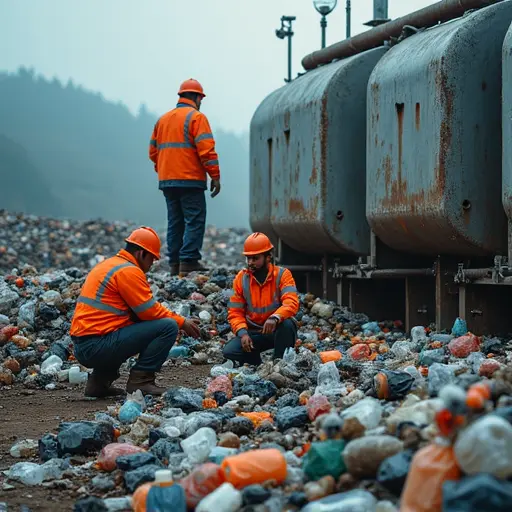
Perhaps most significantly, the national rollout includes specific provisions for environmental justice communities that have historically borne the brunt of plastic pollution. The strategy prioritizes reducing pollution in overburdened communities located near plastic manufacturing facilities and waste processing sites.
Maria Gonzalez, community organizer with the Environmental Justice Coalition, welcomed the announcement: 'For too long, low-income communities and communities of color have been treated as sacrifice zones for plastic production and disposal. This national approach finally acknowledges that environmental justice must be at the heart of our plastic policy.'
The plan includes funding for community-led recycling programs, education initiatives, and job training in circular economy sectors. This could create thousands of new jobs in recycling, materials recovery, and sustainable packaging design.
Global Context and International Alignment
The U.S. national rollout comes at a critical time in global plastic policy. The initiative supports the country's commitment to international efforts to negotiate a global plastic pollution agreement and aligns with the goal to eliminate plastic waste release by 2040.
The Plastics Pact Network now spans 19 countries across every continent, engaging over 900 organizations. According to WRAP, the network has already eliminated over 360,000 tonnes of problematic plastics and prevented billions of items from entering landfills or the environment.
Challenges and Implementation Timeline
Despite the ambitious goals, significant challenges remain. Current data from the U.S. Plastics Pact shows that only 50% of plastic packaging is currently reusable, recyclable, or compostable, up from 47.7% previously. Average post-consumer recycled or bio-based content stands at just 11%, far from the 30% target.
Jonathan Quinn, CEO of the U.S. Plastics Pact, acknowledged the scale of the challenge: 'We're asking industry to make generational shifts in just a few years. It will require difficult decisions, substantial investment, and compromise, but the environmental, social, and economic benefits will be transformative.'
The national rollout will be implemented in phases, with initial regulations focusing on single-use plastics and packaging design standards. The full extended producer responsibility framework is expected to be operational by 2026, with the 2025 targets serving as interim milestones.
Looking Ahead: A Circular Future
The announcement represents more than just another environmental policy—it signals a fundamental rethinking of our relationship with materials. By embracing circular economy principles that keep products and materials in use for as long as possible, the national Plastic Pact rollout could reduce global emissions by targeting one of the most problematic material streams.
As the implementation begins, all eyes will be on how industry adapts, how communities benefit, and whether this ambitious national approach can deliver on its promise of creating a truly circular economy for plastics in America.