
 Deutsch
 English
 Español
 Français
 Nederlands
 Português

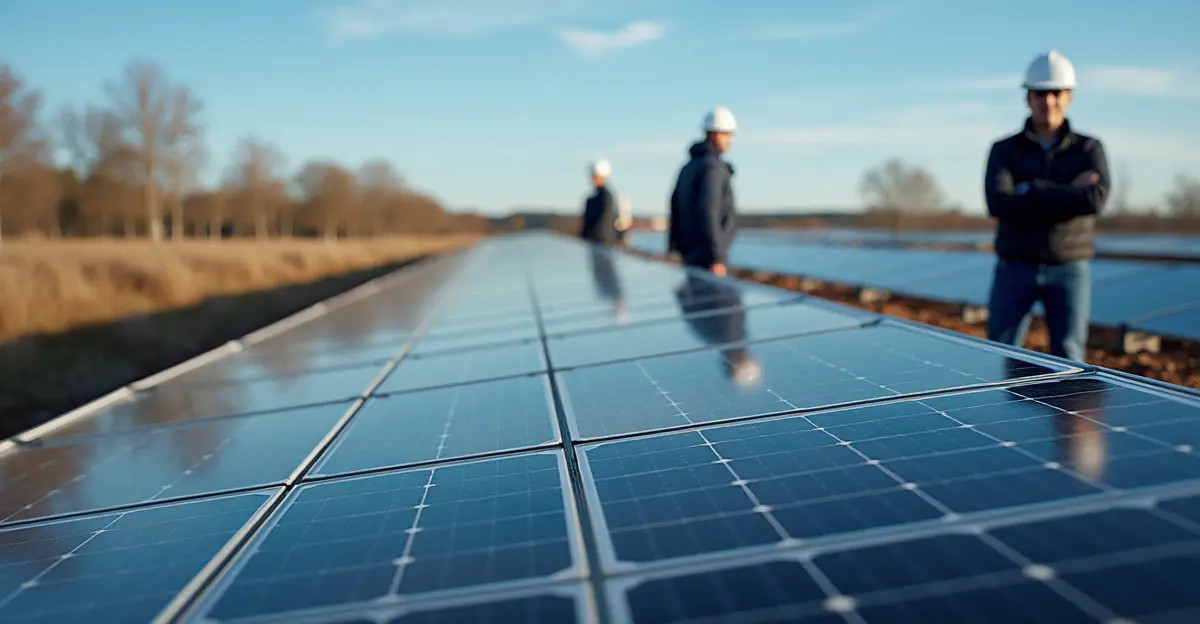





Historic Commissioning of Baltic's First Perovskite Solar Plant
In a landmark development for renewable energy in Northern Europe, the Baltic region has witnessed the commissioning of its first commercial-scale perovskite solar power plant. The facility, located in Lithuania, represents a significant technological leap forward for a region that has been rapidly expanding its solar capacity in recent years. The plant utilizes cutting-edge perovskite-silicon tandem solar cells, which have achieved record-breaking efficiencies of over 34% in laboratory settings.
'This commissioning marks a turning point for solar technology adoption in the Baltics,' said Dr. Ava Bakker, the project's lead analyst. 'We're moving beyond traditional silicon photovoltaics into next-generation materials that offer higher efficiency at potentially lower costs.'
Technological Breakthrough Meets Regional Ambition
Perovskite solar cells have been the fastest-advancing solar technology since 2016, with laboratory efficiencies skyrocketing from 3.8% in 2009 to 27% in 2025 for single-junction architectures. The Baltic plant employs perovskite-silicon tandem cells that have recently achieved 34.85% efficiency in certified tests, surpassing traditional silicon solar cells. According to industry reports, commercial modules are now achieving 24-26% efficiency, significantly higher than the 20-23.5% range of conventional TOPCon and PERC technologies.
The plant's commissioning comes at a critical time for the Baltic States, which achieved full synchronization with the Continental European Network in 2025 and have set ambitious targets for renewable energy adoption. Lithuania, where the plant is located, aims for one-third of households to generate their own electricity by 2030, while Latvia targets 57% renewable energy by the same year.
Policy Implications and Market Transformation
The perovskite plant's commissioning has significant implications for energy policy across the Baltic region. 'This technology changes the economic calculus for solar deployment,' noted energy policy expert Markus Kõiv from Tallinn University. 'With projected manufacturing costs of $0.29-0.42 per watt for modules achieving 25-30% efficiency, perovskite solar could accelerate our transition away from fossil fuels.'
According to a 2025 study analyzing rooftop photovoltaic systems in the Baltic States, the region's rooftop solar potential is estimated at 40 GW, potentially attracting over 150 billion euros in investments by 2050. The study found that rooftop PV systems are economically viable with median Levelized Cost of Electricity (LCOE) values of 0.08 EUR/kWh for Latvia and Lithuania.
The Baltic States have been simplifying regulations to encourage solar development. Lithuania has removed requirements for environmental impact assessments for certain solar projects and now allows solar plants on agricultural land without changing land usage type. These policy changes, combined with advancing technology, create a favorable environment for perovskite solar adoption.
Community Impact and Energy Security
For local communities, the perovskite plant represents both economic opportunity and enhanced energy security. The facility is expected to create approximately 50 permanent jobs in operations and maintenance, along with hundreds of temporary construction positions. More importantly, it contributes to the region's energy independence at a time when energy security has become a paramount concern.
'What's exciting about perovskite technology is its potential for distributed energy generation,' explained community energy coordinator Laura Jansone from Riga. 'These cells can be manufactured using low-cost printing techniques and deployed in lightweight, flexible formats that work well in urban environments and on buildings with structural limitations.'
The timing aligns with major regional energy developments, including the Baltic Storage Platform which is developing Europe's most powerful battery park complex in Estonia. The Kiisa battery park was energized in October 2025, with commissioning scheduled for end-2025, while the Aruküla battery park is expected to be operational by Q3 2026. These storage solutions are crucial for integrating intermittent renewable sources like solar into the grid.
Challenges and Future Outlook
Despite the promising commissioning, perovskite solar technology faces significant challenges that must be addressed for widespread adoption. Stability remains a primary concern, with projected degradation rates of 0.5-0.8% per year and shorter 10-20 year warranties compared to 25+ years for traditional silicon panels. Additionally, lead toxicity in some perovskite formulations presents environmental and health concerns that require careful management.
A 2025 review article highlighted that commercialization faces significant stability challenges from phase instability, ion migration, moisture, heat, and light exposure. Researchers are developing mitigation strategies including additive engineering, optimized charge transport layers, and advanced encapsulation techniques.
The industry is progressing toward full bankability for utility projects, with expectations that perovskite solar will achieve this milestone by 2027-2029. In the meantime, the technology makes economic sense for space-constrained applications and early adopters. The Baltic plant serves as an important test case for colder climate performance, with researchers closely monitoring how the cells withstand the region's harsh winters and variable sunlight conditions.
As the Solarplaza Summit Baltics approaches in March 2026, industry leaders will gather in Vilnius to discuss the future of solar and energy storage in the region. The perovskite plant commissioning provides concrete evidence of technological innovation meeting regional energy ambitions, setting the stage for accelerated renewable adoption across Estonia, Latvia, and Lithuania.


Follow Discussion