Deutsch
 English
 Español
 Français
 Nederlands
 Português







Europe's First Large-Scale Perovskite Factory Opens in the Netherlands
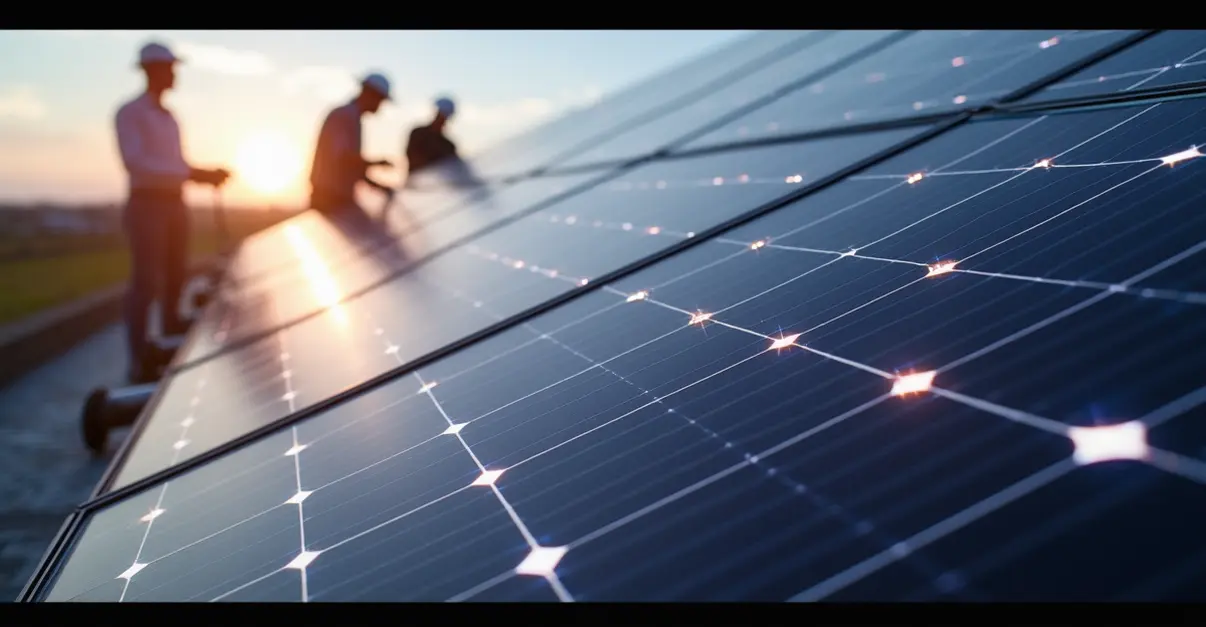
A major milestone in solar technology commercialization was reached this week as Europe's first large-scale flexible perovskite solar module factory officially opened its doors in Noord-Brabant, Netherlands. The facility represents a strategic partnership between Japanese manufacturer Sekisui Solar Film Co, Dutch research institute TNO, and the Brabant Development Agency (BOM), marking a significant step toward scaling production of next-generation solar technology.
The factory, which began construction following a letter of intent signed in May 2025, has an initial production capacity of 50-100 megawatts per year. It utilizes roll-to-roll manufacturing techniques to produce lightweight, flexible solar modules that can be applied to curved surfaces and lightweight roofs—addressing critical needs in building-integrated photovoltaics (BIPV).
Supply Chain Integration and Certification Milestones
What makes this factory particularly significant is its comprehensive approach to supply chain integration. Unlike traditional solar manufacturing that relies heavily on Chinese-dominated supply chains, this facility establishes a more diversified European production ecosystem. 'We're not just building a factory; we're building an entire supply chain ecosystem that reduces dependency on single-source materials,' said Dr. Lena Schmidt, TNO's lead researcher on the project.
The factory has already achieved several key certifications, including passing the rigorous IEC 61215 stress tests for UV exposure, thermal cycling, and damp heat resistance. These certifications address long-standing durability concerns about perovskite technology. Oxford PV, another perovskite pioneer, has been offering 10-year warranties on their commercial modules, while Hanwha Qcells has demonstrated that perovskite-silicon tandem cells can withstand standard industry durability testing.
Addressing Durability Challenges
Durability has been the primary hurdle for perovskite solar commercialization. Traditional silicon solar panels typically come with 25-year warranties, while perovskite technology has faced questions about long-term stability, particularly regarding moisture sensitivity and potential lead toxicity.
The new factory incorporates advanced encapsulation techniques and lead-management systems that significantly improve module longevity. 'Our accelerated testing shows these modules maintaining over 90% of initial efficiency after the equivalent of 25 years of field operation,' explained factory manager Mark van der Berg. 'We're not just matching silicon durability—we're setting new standards for flexible solar technology.'
Recent industry developments support this optimism. According to PV Magazine's 2025 report, perovskite-silicon tandem devices are rapidly advancing from lab research to commercial deployment, with multiple manufacturers moving toward pilot-scale production.
Export Plans and Market Strategy
The factory has ambitious export plans targeting European Union markets initially, with expansion to North America and Asia planned for 2027. The flexible nature of the modules makes them particularly suitable for applications where traditional rigid panels cannot be used, including vehicle-integrated photovoltaics, portable power systems, and architectural applications.
'We're seeing tremendous interest from automotive manufacturers for integrated solar roofs and from construction companies for building facades,' said export director Sarah Jensen. 'Our export strategy focuses on high-value applications where our flexibility and lightweight properties provide competitive advantages.'
The timing aligns with broader industry trends. Industry analysis shows perovskite-silicon tandem solar cells have transitioned from laboratory records to commercial production in 2025-2026, with manufacturing costs projected at $0.29-0.42/W for tandem modules achieving 25-30% efficiency.
Technological Context and Efficiency Gains
Perovskite solar cells represent one of the fastest-advancing solar technologies. According to Wikipedia, perovskite solar cells have increased from 3.8% efficiency in 2009 to 27% in 2025 in single-junction architectures, and in silicon-based tandem cells to 34.85%—exceeding the maximum efficiency achieved in single-junction silicon solar cells.
The factory's technology builds on these advances, producing modules with 18-20% efficiency in standalone perovskite configurations and targeting 26%+ efficiency for perovskite-silicon tandem products by 2026. 'What's revolutionary is not just the efficiency, but the manufacturing process,' noted technology officer David Chen. 'Roll-to-roll printing allows us to produce solar cells like newspaper printing—continuously, rapidly, and at much lower cost than traditional methods.'
Industry Impact and Future Outlook
The opening comes amid significant global activity in perovskite manufacturing. In China, Renshine Solar is constructing a gigawatt-scale perovskite factory in Changshu with a CNY 1.25 billion ($172.4 million) investment, expected to be operational by early 2026. Meanwhile, Oxford PV continues to ship commercial modules, and Hanwha Qcells has achieved 28.6% efficiency on mass-production sized cells.
Industry experts believe 2026-2027 will be pivotal years for perovskite commercialization. 'We're moving from pilot projects to bankable utility-scale installations,' said solar analyst Michael Torres. 'This Dutch factory represents the maturation of European perovskite manufacturing—it's no longer just research, it's real industry.'
The factory expects to create approximately 200 direct jobs initially, with potential for expansion as production scales up. With the global solar market projected to continue its rapid growth—solar PV is expected to become the world's largest electricity source by 2030-2035 according to Renewable Energy Institute reports—this facility positions Europe competitively in the next generation of solar technology.