


 Deutsch
 English
 Español
 Français
 Nederlands
 Português


 Share
Share




In a series of unprecedented moves during early 2026, America's closest allies are quietly but decisively reducing their reliance on the U.S. dollar. France repatriated all 129 tons of its gold from the Federal Reserve Bank of New York between July 2025 and January 2026, booking a $15 billion gain. Canada announced a $25 billion sovereign wealth fund to reduce financial dependence on the United States. And the dollar's share of global foreign exchange reserves has fallen from 71% in 1999 to 57% today. This article analyzes how U.S. sanctions policy—particularly the freezing of Russian assets and the Iran conflict—is paradoxically driving even traditional allies to diversify away from the dollar, marking the most significant shift in the global monetary order in 80 years.
The Sanctions Paradox: Weaponizing the Dollar
The U.S. dollar has served as the world's primary reserve currency since the 1944 Bretton Woods Agreement, which pegged major currencies to the dollar and the dollar to gold at $35 per ounce. That system collapsed in 1971 under President Nixon, but the dollar's dominance persisted—bolstered by the 1974 petrodollar deal with Saudi Arabia, which ensured oil was priced exclusively in dollars. For decades, this arrangement gave Washington extraordinary geopolitical leverage: the ability to freeze assets, cut off adversaries from the financial system, and impose extraterritorial sanctions.
However, the weaponization of the dollar has accelerated dramatically since 2022, when the U.S. and its allies froze approximately $300 billion in Russian central bank reserves following the invasion of Ukraine. That move, unprecedented in scale, sent shockwaves through the global financial system. "The freezing of Russian reserves was a watershed moment," says Sana Ur Rehman, market analyst at EBC Financial Group. "It demonstrated that no country's dollar-denominated assets are truly safe if they fall out of geopolitical favor."
France's Gold Repatriation: A $15 Billion Signal
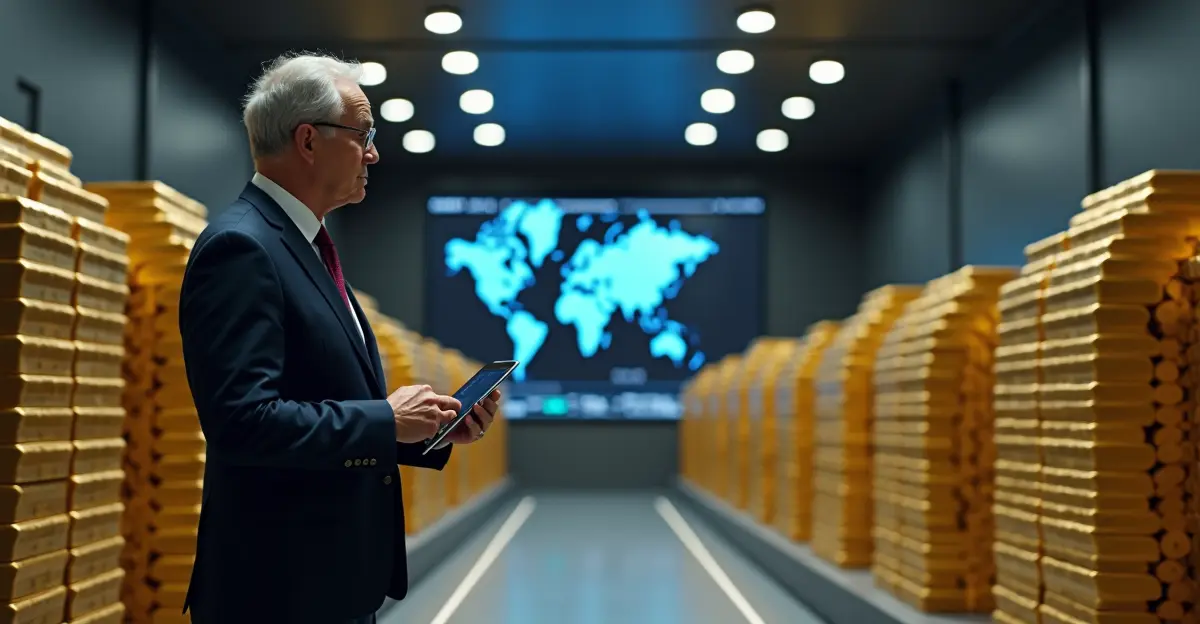
The Banque de France completed the full withdrawal of its gold reserves from the Federal Reserve Bank of New York in January 2026, after executing 26 staggered transactions over six months. The central bank sold older non-standard bars and purchased London Good Delivery standard bars, realizing a capital gain of approximately €12.8 billion ($13.8 billion) amid gold prices surging above $4,700 per ounce. France now holds all its approximately 2,437 tonnes of gold in its secure Paris vaults, La Souterraine, making it the world's fourth-largest official gold holder.
This move is part of a broader European trend. The Netherlands repatriated its gold earlier, and Germany's gold repatriation debate is approaching a critical juncture with the May 2026 budget vote. Germany holds the world's second-largest gold reserves, with approximately €164 billion worth (1,236 tonnes) stored in New York's Federal Reserve vaults. German economists and lawmakers have renewed calls for repatriation, arguing the gold is "no longer safe" in U.S. vaults under the current administration. Ifo president Clemens Fuest warned such a move could escalate transatlantic tensions, but the pressure is mounting.
Canada's Sovereign Wealth Fund: Independence Through Investment
On April 27, 2026, the Canadian federal government announced the creation of the Canada Strong Fund, the country's first national sovereign wealth fund. The fund will receive an initial $25 billion over three years and operate as a commercial investment vehicle targeting competitive returns while investing alongside private capital in infrastructure, advanced manufacturing, clean energy, critical minerals, and agriculture. Notably, the fund includes a retail investment product accessible to individual Canadians with capital protection.
Finance Minister François-Philippe Champagne emphasized the government's commitment to fiscal discipline and strategic investments for long-term prosperity. While Ottawa framed the fund as a nation-building initiative, analysts note its timing is no coincidence. "Canada is explicitly reducing its financial dependence on the United States," says Rehman. "This is a hedge against the risk that Washington's financial leverage could one day be turned on allies."
The Petroyuan Rises: Oil Trade Shifts East
Perhaps the most consequential shift is occurring in energy markets. The petrodollar system—established by a secret 1974 deal between Henry Kissinger and Saudi Arabia—has been weakening for years. Saudi Arabia quietly did not renew its commitment to dollar-only oil pricing in 2024, and in 2023 signed a $7 billion currency swap with China. The U.S. war on Iran is now accelerating the transition. Iran has been selling much of its oil in yuan to avoid sanctions, with China buying 90% of Iran's exported oil. China's Shanghai International Energy Exchange offers a yuan-based alternative, positioning the 'petroyuan' as a potential successor to the petrodollar.
China's Cross-Border Interbank Payment System (CIPS) shattered records in March 2026, processing 1.22 trillion yuan ($178.5 billion) in a single day across nearly 42,000 transactions—a nearly 50% rise from February. While CIPS still relies on SWIFT for over 80% of its messaging, the BRICS de-dollarization infrastructure is expanding rapidly. Indian refiners have settled Iranian oil in yuan under sanctions, and African banks are building direct yuan channels. Each crisis pushes marginal oil flows into yuan settlement, leaving behind expanded infrastructure and growing comfort with the currency.
The Numbers: Dollar Dominance in Decline
The data tells a clear story. According to the IMF's COFER database, the dollar's share of global foreign exchange reserves fell to 56.32% in Q2 2025—its lowest since 1995, down from a peak of 72% in 2001. While 92% of the 2025 decline was driven by exchange rate movements rather than active central bank selling, the trend is unmistakable. Central banks have been diversifying into gold (over 1,000 tonnes purchased annually for three straight years) and smaller currencies like the Australian and Canadian dollars.
Yet the dollar still settles 88% of global FX transactions, and no credible alternative reserve currency exists at scale. The euro holds roughly 20% of reserves, while the Chinese renminbi sits at just 2.1%. As one analyst put it, the dollar is losing its monopoly, not its reserve status. But the direction of travel is clear—and accelerating.
Implications for Global Financial Stability
The erosion of dollar dominance carries profound implications. A multipolar reserve currency system could reduce the U.S.'s ability to impose sanctions, increase borrowing costs for the U.S. government (which benefits from the dollar's "exorbitant privilege"), and introduce new sources of financial instability as countries adjust portfolios. However, the transition is likely to be gradual. "The dollar doesn't need to be replaced overnight for this to matter," Rehman explains. "Even marginal shifts in reserve composition and trade settlement compound over time, reducing U.S. geopolitical leverage and increasing the resilience of alternative systems."
The future of the global monetary order is being written now. With Germany's gold repatriation debate approaching a vote, more allies watching closely, and energy trade patterns shifting, 2026 may be remembered as the year the great unwinding truly began.
Frequently Asked Questions
What is de-dollarization?
De-dollarization refers to efforts by governments, firms, and market participants to reduce the use of the U.S. dollar in reserves, trade invoicing and settlement, cross-border finance, and domestic transactions. Motivations include gaining greater economic independence, reducing exposure to U.S. sanctions policy, and lowering currency mismatch risks.
Why are U.S. allies abandoning the dollar now?
The freezing of Russian central bank reserves in 2022 demonstrated that dollar-denominated assets can be weaponized. The Iran conflict and escalating U.S. sanctions have accelerated concerns among allies that their own holdings could be at risk if geopolitical alignments shift. France's gold repatriation and Canada's sovereign wealth fund are direct responses to this perceived risk.
Can the yuan replace the dollar as the global reserve currency?
Not in the near term. The yuan accounts for only 2.1% of global reserves, compared to the dollar's 57%. China maintains capital controls, and its financial markets are less deep and transparent than U.S. markets. However, the yuan is gaining ground in energy trade settlement, particularly through the petroyuan mechanism, and CIPS is expanding rapidly.
What is the petroyuan?
The petroyuan refers to oil trades settled in Chinese yuan rather than U.S. dollars. China's Shanghai International Energy Exchange offers yuan-denominated oil futures, and countries like Iran, Russia, and increasingly Saudi Arabia are conducting oil trades in yuan. This directly challenges the petrodollar system established in 1974.
How much gold did France repatriate from the U.S.?
France repatriated all 129 tonnes of its gold held at the Federal Reserve Bank of New York between July 2025 and January 2026, booking a capital gain of approximately $15 billion as gold prices surged above $4,700 per ounce. France now holds all its 2,437 tonnes of gold in Paris.
Conclusion: A New Monetary Order Takes Shape
The great unwinding of the dollar-centric global financial system is no longer a theoretical possibility—it is happening, and it is being driven by America's closest allies. France, Canada, Germany, and others are taking concrete steps to reduce their exposure to the dollar, motivated by a growing recognition that the currency Washington uses to punish its adversaries could one day be turned on them. The transition will be slow, uneven, and contested, but the direction is unmistakable. The world is moving toward a more multipolar monetary order, and 2026 may be the year that shift became irreversible.




Follow Discussion